Thirsty for a Fresh Take on All Things True Blood?

WELCOME! Thirsty for a fresh take on all things True Blood? Pull up a virtual barstool at the Pierced Pomegranate Tavern where sisters Rachel and Rebecca are serving up juicy feminist analysis with a twist and opening a vein of thoughtful sociocultural dialogue on HBO's hit series.

Like the epic literary salons of eras past - theaters for conversation and debate which were, incidentally, started and run by women; where the spirited debate about the issues of the day ran as copiously as the actual spirits did - but updated for the digital age, the Pierced Pomegranate Tavern is a fun forum for exploring questions ripe for discourse about the human condition & today's most crucial social issues through the medium of True Blood.

Your salonnières are not peddling liquor per se, but they are offering up new and alternative ideas informed by such diverse influences as pop culture, art, music, cultural history, Goddess studies, transformative theory, literature and poetry, and archaeomythology, filtered through the sieve of their own lived experiences as feminist women of a particular age, background, and culture.

This is a space where you - patrons and passersby alike - can view and engage with these perspectives through the lens of True Blood and contribute your own thoughts. So, no matter if you're a Truebie or a more casual viewer of True Blood, or your drink of choice is a pomegranate martini - one of Rachel's favorite cocktails to drink and Rebecca's to mix - an herbal tea, a frothy double mocha latte, or a can of Fresca (wink, wink) you're invited to join the conversation on the show's complexities in a way that can spark transformation.

Hopefully you'll find something to sink your teeth...err...straw, into! PLEASE ENJOY RESPONSIBLY ;-)

YOU'VE BEEN SERVED (A WARNING)...

The Pierced Pomegranate Tavern is dedicated to exploring social issues and more through the lens of True Blood. As such, you may encounter:

*SPOILERS
*TRIGGERS
related to the often provocative and adult themes presented by the show

If you choose to enter and participate in this virtual salon, please be prepared to do so in a thoughtful, respectful, and mature fashion with the above in mind. Click here to check out our comment policy. Thanks!

Disclaimer

No copyright infringement is intended, all rights to True Blood belong to HBO, credit is ascribed to sites where images appearing here were originally found.

Showing posts with label Sookie. Show all posts

Thursday, September 15, 2011

Women Setting Boundaries in True Blood S4 Finale

WOW. I mean, really, WOW. There's so much that can be said about the unreal True Blood S4 finale that aired this past Sunday, "And When I Die".

Multiple viewings of it may in fact be truly hazardous to your health!

Case in point: I crashed at Rebecca's house on Tuesday night, and we decided to re-watch the episode together. Just as the opening credits began, our brother pulled into the driveway and we shot each other looks acknowledging the fact that as soon as he came in the door and realized we were watching it AGAIN, he might just kill us!

You see, Johnny's a fan of the show too, but for him watching each episode once is enough. And when he comes in from work, he likes to relax in front of the tube and decompress. So as the key turned in the door we braced ourselves and when we heard him in the hallway, we both grimaced and Rebecca almost timidly called out, "hey man" to test his mood. 

Luckily for us, his shift had been good and he was feeling benevolent. Striding up the stairs, he caught the strains of Bad Things rising and joked, "third time's the charm, huh?" before briefly taking inventory of the fridge and descending back down the stairs to his room.

Whew, close call. We were now free to watch "And When I Die" yet again, and although each of us had already seen it at least once (we viewed the finale together late Sunday night and Rebecca had re-watched the next day and taken notes), we were both still feeling the effects of the fangover and attempting the process the show's dizzying chain of events. 

As I mentioned at the beginning of this post, so much happened during the finale that we could discuss here at the PPT. But since the Web has been abuzz for several days with recaps, reflections, and questions concerning the central action, I'd like to address a subtly nuanced theme of female empowerment nestled within the episode's dizzing action.  

Easy to overlook in light of the general craziness of the S4 finale, this theme is made evident in the pattern of several female characters drawing boundaries for themselves in their relationships that emerged during the course of the show, particularly in relation to Sookie, Jessica, Luna & Holly.

Rebecca and I started to flesh out our ideas on this topic on Tuesday night.

When the episode ended, we joked a little about how I had, in a moment of denial that the season had actually come to its conclusion on Sunday night, told her "no, we've got to see the coming attractions" when she lifted the remote to switch the station. Rebecca had astutely pointed out on Sunday that there would be no trailers for next week and that I'd have to face the fact that a sobering nine months of True Blood withdrawal stretched out like a barren wasteland before us.

Maybe a little over-dramatic, but true nonetheless.

So we laughed a little about that again, and Rebecca quickly turned our attention to an article she had read online that pointed out how, in her two-way break up with Eric and Bill, Sookie has actually chosen herself.


Although leaving without either of them in her life caused she and both her lovers great heartache, Sookie realized - perhaps due in part to the poignant words of her dearly departed Gran's spirit - that being alone is nothing to be afraid of.

And that maybe the best thing for her to do instead of trying to choose between Bill and Eric was to take some time to discover and get to know herself, outside of a relationship. Although shocked and deeply hurt, both vampires respected Sookie's wishes enough (at least for now) to let her go.


Similarly, during her sexy Halloween night tryst with Jason, Jessica verbalized her own sense that she is just barely getting to know herself.

Jessica is Rebecca's favorite female character for the reason that she feels the baby vamp displays the most real, believable [human] emotion. Sorry Sookie - Rebecca's words, not mine ;-) but I don't disagree.


Despite their strong mutual attraction and genuine caring towards one another, Jessica was brave and authentic enough to draw a mid-coitus line in the sand, telling Jason that she did not want to be his girlfriend. It's not that she doesn't want him; she's simply not ready to commit to him yet because she recognizes her inexperience in relationships and she doesn't want to hurt Jason the way Hoyt ended up hurt when they broke up.

In this scene, Jessica asserted herself as a sexual woman and vampire who is beginning to know what she wants and needs and isn't afraid to articulate that to the man in her life. And for his part, Jason was understanding and accepting of Jessica's reticence to jump into a committed relationship with him or to be intimate enough with him to drink his blood; as Jessica said, at least not yet.

Luna, too, put the breaks on a close encounter that could have heated up into quite the romantic night for she and Sam.
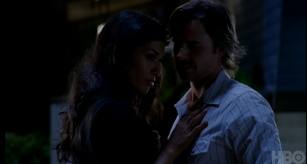

Not because she's not ready to stay the night with Sam or for them to be an official item (although that may well the be the case), but because she felt her baby girl Emma may not be. Luna and Sam both displayed the emotional maturity required to take their budding relationship slow; let's hope the snarling wolf that confronted Sam just as the van carrying Luna and Emma home drove up the Merlotte's driveway towards the parish road and out of view doesn't put the permanent brakes on this promising couple!

Last but not least, we've got fairy-costumed Holly, who, despite (or maybe because of) her mental and physical exhaustion brought on by the drama of the night had the gumption to tell it like it is to a persistent, Halloween bouquet-toting Andy Bellefleur.

Here's the dialogue courtesy of Television Without Pity

Andy: "Sorry about the last time, when I took your flowers."
Holly: "That's okay, you were nervous."
Andy: "No, I was a drug addict. V. thought I needed it to do the job, and to talk pretty ladies like you... So I didn't feel like a loser all the time. It worked for a while, then it didn't."
Holly, wearily: "Okay look, honey. You're really sweet and everything, but this is all just too much for me right now."
Andy: "It's no problem. Lot of baggage, I get it. I just wanted to say that I'm sober and I'm lonely. And I can be good to someone if they let me. 'Night."


After taking in and weighing what he had to say, Holly asked Sheriff Andy for a much-needed hug, which I think may have been balm for both their souls. I look forward to seeing what will come next for these two, and if the kind of "rigorous honesty" the tragically doomed Debbie Pelt had talked about having with Alcide might prevail for both of them; given their respective pasts (Holly as a survivor of sexual assault and Andy as a recovering addict) should they become involved.

Now, the above is not to suggest that self-actualization and being in relationship are mutually exclusive. In fact, as the introduction to the section on self-in-relation in the book Weaving the Visions: New Patterns in Feminist Spirituality asserts, the idea of self as relational is prominent in feminist thinking.

The concept of the relational self has not caught on in the traditions of dominant Euro-Western philosophy and theology in which Descartes's' vision of the self as essentially rational, disembodied, and solitary holds sway. From this perspective, it is easy to see how relationships could be seen as detrimental to the growth and development of the self - especially for women - whose stereotyped roles as nurturers and caregivers of others threaten to swallow us alive.

Another vision of the self suggests that we are by nature embodied, passionaterelational, and communal. Many feminist adhering to this viewpoint stress that identity is found in community. Black womanist theologian Delores S. Williams coined the term "relational interdependence" to name Black women's struggles for freedom from racist and sexist stereotypes within the context of relationships, family, and community. In this view, women's independence is relational.

There is no you without me; no me without you. The self is forged in relationship.

Even so, drawing healthy boundaries for the relationships that structure our lives and bind us to others is necessary, and it's refreshing to see the women of True Blood taking these steps - and their men responding in kind!

Yours in TB withdrawal...

~ Rachel

Sunday, September 4, 2011

Some more thoughts on Pam & the (postmodern) veil

So as far as we know of, Pam is still cursed, right?

In her desperation to prevent a world without Bill in it, Sookie's amped-up fairie power knocked the spell right out of the attacking amnesia Eric, restoring him to his former Viking god state with his memories of his entire life - both human and vampire - up until the present intact.

Rebecca thinks this is a nod to the exceeding complexity of a woman's psyche; with a snap of Sookie's microwave fingers Eric has recovered his "true" self , but for Pam, a solution is not so simple.

Because although Pam has looked none the worse for wear since undergoing Dr. Ludwig's unconventional full body spa treatment and a painful series of daily injections administered by the dizzy-but-stalwart Ginger, she continues to rot from the inside-out.


When she's been on the receiving end of the lady vamp's rage, Tara's made it all too clear that Pam's putrefying innards continue to emit a horrific smell despite her back-to-glamour-puss appearance.


And (high maintenance) glamour-puss Pam is! In my last post on this topic, Pam's Taken the Veil, I referenced The Vault interview "Kristin Bauer talks about her 'face-off' in which the actress remarks that Pam's predicament is an intolerable affront to her vanity: "Having her skin peel off in ribbons of goo is a massive blow for Pam".

She's a woman whose priorities include Eric and her appearance, not always in that order. Putting her face on is a deeply embedded part of who she is.


Remember when Bill tried to suggest that perhaps there was a cosmetic solution to her plight; that maybe a little more lipstick might help?


Now, although for the most part I try my best to remain non-partisan here at the PPT, I admit that I love Bill with the best of the Team Bill girls. But come on, Bill, seriously? How clueless can you be? A little extra make-up is not going to solve a problem that runs far more than skin deep, and to suggest that it might smacks a smidgen too much of the dismissive recommendations male medical practitioners and others have made for ages when it comes to "female ailments".

For example, there's Sigmund Freud's notoriously biased and inadequate understanding of women whose perspectives formed the once-common diagnosis of female hysteria in which a woman's unmanageable emotional excesses (or maybe her wandering uterus, since according to Plato and others down the line, female psychology and biology are ruled by the reproductive system) was to blame for her ills. Feeling weepy and irritating the men in your life? You must be PMSing, or maybe you're on the rag - pop a pill and get over it. Crass, I know, but I'm fairly certain that most women have been blown off with such patronizing comments when they're facing legitimate life challenges that extend beyond that time of the month.

I found an interesting take on the idea of Pam taking the veil that actually relates to her penchant for make-up, and Bill's tragically (but typical guy?) misinformed impression that a little extra lipstick might help her situation.

An article on veiling entitled Some thoughts on the Veil appears on Max Dashu's Suppressed Histories Archives. It's in her confronting oppression section on taming the female body and it addresses some fascinating topics like the gender and class implications of veiling from a historical perspective far older than Islam - which is, aside from the communion and bridal veils common in Western culture, what most people think of when it comes to the practice. 

It also raises some interesting points about make-up as a post-modern veil, citing its near-compulsory use in certain contexts (like shielding Pam's disfigured face from the innocent gaze of hapless onlookers who should not have to be exposed to such female monstrosity?).

Here's an excerpt from the article, which picks up after the mention of the compulsory use of make-up:
It remains so in the workplace, at the employer's whim, according to a ruling by the California Supreme Court in 2000. The judges upheld the firing of Darlene Jesperson, a longtime bartender at Harrah's Casino in Reno, for refusing new requirements that women wear lipstick, face powder and mascara on the job. This court decision also allows employers to dictate dress, hair length, and other grooming decisions for their employees. These strictures have special ramifications for African-American women; employers often bar them from wearing their hair in natural and cultural styles (or simply refuse to hire them).
Here the rationale of enforcement is economic; in the Iranian context, it is religious. There, both the state and the family act as enforcers. Posters in Tehran explain that "Bad hijab [incomplete covering of hair] is equal to prostitution. Lack of hijab means lack of man's manhood." With these kinds of controls in place, lipstick looks like freedom to many Iranian women...
...which the article goes on to state has been scraped off the faces of Muslim women with a razor blade.

Damned if we do and damned it we don't, huh? What do you think of this catch-22? I wear make-up, and I won't stop wearing it because of the perspective offered in this article (which I do encourage you to read) but the idea of make-up as a post-modern veil has certainly occurred to me before.

This taps into related debates about cosmetic surgery, advertising culture, the cult of beauty, whose beauty is beautiful, etc. You can never be too young, too rich, and too thin, right?

Please share your thoughts on this!

Oh, and keep your fingers crossed that Pam's curse is lifted before the Season 4 finale...is it 9 yet!?!

~ Rachel            

Thursday, June 30, 2011

Boy, I wa-wa-want whatchu wa-wa-want...

...give it to me baby like boom, boom, boom...
what I wa-wa-want is what you wa-wa-want na nah...
                                                      ~ Rude Boy by Rihanna
After such a long wait the new season of True Blood is finally under way! But before we launch into our review of its premiere episode, "She's Not There", I'd like to first take a look at a particular piece of Season 4 promo material.


In this poster we see Sookie seated in the center of the frame surrounded by three suitors, each with a hand on her, staking a claim, wanting a piece. Which one will she choose? Which supernatural contender for Sookie's affections will prevail, who will win? Because it's a competition after all, and she's the prize - the object of strong male sexual desire being fought over. She's the spoils, the booty - her booty going to whichever alpha male can assert himself over the others.


That's one way of looking at it.


But this image isn't really about Team Bill, Team Eric, or Team Alcide, is it? It's about Team Sookie.


For me, it's no accident that she's the central figure in this poster. Look at her posture; her body, and indeed, her countenance as she gazes directly into the camera exudes relaxed confidence. An at-easiness with herself and who she has become.


Gone is the virginal innocent we met in Season 1. Swathed in deep red, this Sookie - like our tavern's heraldic pomegranate with its abundant scarlet seeds so evocative of the redness of the fertile womb - is the picture of blooming female sexuality.


Her hair is loose, unconstrained - quite unlike the tight ponytail stretching her facial features that she wore in "Strange Love", when she was so utterly thrown for a loop by the sexual banter of her co-workers at Merlotte's.


In the Show Your True Colors poster above Sookie is shown as being possessed of a healthy, active female-centered sexuality. Kind of like in Rihanna's Rude Boy - is it so shocking to think that women could want what men want...a gratifying sex life...and that our sex drive can be just as strong, just as audacious, and just as pleasure-for-pleasure's-sake seeking as theirs? And that it's normal, natural, and healthy - and doesn't make us deviants, whores, or hypersexualized vixens performing for men's benefit alone?


In the video above, a self-assured Rihanna sits astride a lion. Could it be that women aren't (or aren't justonly, or always) lithe prey animals made for men's hunting pleasure; or as 1970's pioneer of erotica and Imaginative Sex author John Gorman writes, "the smaller, more sleek female who is natural quarry and game" (p. 33)?


Writing as Pat Califia in 1997, the transgender activist now known as Patrick Califia-Rice described Gorman's work as "unrelievedly heterosexual" and as positing "a world in which biology is supposedly allowed to dictate the social and sexual roles which men and women will play - dominant and warlike, submissive and servile, respectively" (p.vi)..."the hero or the dazzling object of his desire" (p. xiii). But even Gorman (whose writing, Califia wholeheartedly admits, is focused on the arousal, excitement, and gratification of the female "slave" much more so than that of her male "Master") allows that women are not passive, that "She, too, has needs. She often provokes the male to her hunt" (p. 33).


OK, maybe sometimes we want to feel that we are being chased, caught, and "ravished in a thoroughly satisfying manner" (Califia, 1997, p. xii) by a determined, energetic, and worthy partner - on our terms. As agents of our own fate, not commodities for male consumption. And for mutual pleasure, not just his. But maybe, just maybe, sometimes we'd like to be the hunter.


Califia writes, "The process of creating a sex life or love life for oneself is at least as much about learning and teaching as it is about discovering one's secret, innate self" (p. xi, italics are mine). What if, as Sookie's secret, innate self - the seat of her sexual self - is bubbling up to the surface, she'd like to be something other than "game, sleek, beautiful and desirable, frightened of him, who could be caught and owned, and tamed, and who, in his snare, would writhe and cry out" (Gorman, 1974, p. 21)?


Hypothetically, why does she even have to choose between Bill, Eric, and Alcide?


Of course, that's a somewhat rhetorical question since we know that in this culture, the industrial family ethic - which was preceded by the colonial family ethic, insists that the proper place for a woman is in a monogamous relationship with one man. I'm not saying that coupling up is wrong, or that women (or men) of any sexual orientation who want to do so are somehow less liberated.


What I am saying is that it's limiting and outright damaging - especially to women - to insist that this is the morally ordained, right, and only way to live.


As Mimi Abramovitz writes in the feminist classic, Regulating the Lives of Women: Social Policy from Colonial Times to the Present (1996) our contemporary social structures are still based upon the patriarchal family ethic that emerged during the early 19th century primarily as a means of controlling and regulating women’s productive and reproductive labor, placing them in their husband’s home and subordinate to him as the male head-of-household.


Seems like the basis for the Defense of Marriage Act - under which marriage = 1 man + 1 woman only - the fangs-out fight over which happily ended in marriage equality in my home state of New York just this past weekend.


In Bram Stoker's 1897 novel Dracula we meet a female character reflective of a new social order - Lucy Westenra.

Sadie Frost as Lucy Westenra in the 1992 film Bram Stoker's Dracula

Like Sookie, she too had three suitors - and collected marriage proposals from all of them on the same day. As Susan Parlour (2009) writes in her essay, "Vixens and Virgins in the 19th Century Anglo-Irish Novel: Representations of the Feminine in Bram Stoker's Dracula", even though she failed to postulate a new image of feminine roles in the the workplace - as her best friend Mina, who might on the surface appear more of an expression of the New Woman in that regard, did - Lucy nonetheless shook up the strictures of the Victorian patriarchal machine.


According to Parlour, Lucy demonstrated her voracious sexual appetite. She admitted to being a "horrid flirt". These behaviors certainly transgressed the accepted Victorian etiquette demanded of young ladies. But Lucy took it a dangerous step further in her desire to marry Arthur Holmwood, Quincy Morris, AND Dr. John Seward. "Why can't they let a girl marry three men, or as many as want her, and save all the trouble?" (Stoker, 1986, pp. 73, 78) Lucy wistfully wondered, and in doing so, embraced some of the more radical ideals of the New Woman's challenge to prevailing sexual values. In the minds of the Victorian patriarchs, could a destabilized society and accelerated moral decay be far behind?


Would Sookie ever suggest a similar solution to the Team Bill, Team Eric, or Team Alcide quandary? What if she did?


Do you know what became of that little minx Lucy? She fell prey to Count Dracula, was turned vampire, and as such became a "phallic woman", having fangs with the power to penetrate and draw blood; a sexually empowered aggressor. This, of course, could not stand. Lucy was subjected to a particularly brutal "second death" at the hands of four men - including her three suitors and the famed Dr. Van Helsing - during which she was staked in a manner reminiscent of gang-rape.

Vampire Lucy is destroyed in Bram Stoker's Dracula
The violation of her vampiric body yields the restoration of her benign femininity; her threat to the symbolic or social order extinguished (Parlour, 2009).


Is this the fate of the overtly sexually desirous woman? I'd like to think not, but one need only reflect back on René Lenier's Season 1 rampage to be reminded of how our society often treats its fangbangers, sluts, and bad girls (i.e. women whose sexual behavior transgresses the clearly demarcated gender roles mapped out for them).


This is a topic that is deserving of a lot more fleshing out and continued discussion. For now, suffice it to say that although I'm not holding out hope for Sookie to choose not to have to choose between Bill, Eric, Alcide, and whoever else may come her way (I'm not even saying that's the best option for her, anyway) I AM glad to have an image that we can claim as one representative of Team Sookie - where her needs, wants, and desires can be seen as central.

~ Rachel    

References

Abramovitz, M. (1996). Regulating the Lives of Women: Social Welfare Policy from Colonial Times to the Present. Boston, MA: South End Press.

Califia, P. (1997). "No Fantasy, Please, We're Americans: A Foreward by a Feminist". In Gorman, J. Imaginitive Sex. (pp. v-xiv). New York, NY: Masquerade Books.

Gorman, J. (1997).  Imaginitive Sex. New York, NY: Masquerade Books.

Parlour, S. (2009). "Vixens and Virgins in the 19th Century Anglo-Irish Novel: Representations of the Feminine in Bram Stoker's Dracula". Journal of Dracula Studies, Number II.

Stoker, B. (1986). Dracula. Penguin edition.  
     

Saturday, June 25, 2011

Tru Blood Tru World: In the Face of a Harsh Economic Landscape for African-American & Latino Men, Lafayette Adapts

It's not often that I send off a quick missive, but here's one.

Listening to NPR as I was driving home from work yesterday (I know, something else out of character for me, right?) I was struck by some disturbing labor and economics statistics. Unemployment amongst African-American men is currently hovering at around 15% and the figures are similar for Latino men. Here's the kicker: most economists agree that these numbers will likely not budge for the next decade!!!

I immediately thought of Lafayette. Yes, I know. He's a fictional character. The U.S. Department of Labor Statistics is probably not keeping data on him or his cohorts, the town of Bon Temps where he works as a short order cook at Merlotte's (also fictional), or on Reynard parish and its environs where he plies his various other trades, since these locales, too, are fictional.

Even so, is it really so odd that Lafayette would cross my mind in the context of a news report pointing out that unemployment figures for African-American and Latino men are nearly double those for white men?

We know that popular culture not only shapes, but is shaped by society. Therefore, could the desertified Bon Temps economic landscape and its dried-up job market - one's options for (low wage) work include Merlotte's (apparently the town's chief employer, aside from the sheriff's office), big box stores like the one Tara quit in "Strange Love" (perhaps a stand in for Walmart which just got an enormous class action gender discrimination suit tossed), or the Grab-It-Quik - be an allusion to the U.S. Main Street vs. Wall Street divide?

Is it that hard to see how, in the face of limited opportunities in the mainstream economy, Lafayette or someone like him may resort to carving out a niche for himself in the informal (i.e. underground or shadow) economy?

LaLa the short order cook

LaLa the drug dealer


LaLa the prostitute

LaLa the road crew worker

LaLa the webcam operator


Lafayette is a hustler; a survivor. He's got jobs in both the legit and the informal economies.

He's got to work - hard - to stay above ground because unlike the Stackhouse kids, he hasn't benefited from intergenerational wealth transfer. Sookie and Jason work hard too, but they each inherited the homes they live in from deceased family members. This affords them a certain level of comfort and financial stability that fewer working and middle-class people of color will have access to in the future, given that the sub-prime mortgage and foreclosure crisis has disproportionately impacted their communities. It should go without saying that without homes to either be sold or passed down as an inheritance, families with fewer means have less options available to them as they plan for their heirs' futures.

As a social worker for a non-profit that - amongst other things - provides community development services I've seen the Great Recession's negative impact on first-time homebuyers and homeowners who are upside-down on their mortgages as well on low-income households who are striving for financial self-sufficiency. Disparities across race, class, and gender lines, unsustainable and often predatory lending targeting elders and people of color, and a lack of living-wage jobs are driving the gap between those with a foothold on the economic ladder to the middle class and those without - to say nothing of those who are tumbling from the middle-income rungs every day.

Will the informal economy expand in response to the constriction of the mainstream one? What are the implications if it does, and what kinds of outcomes can we anticipate in key sectors of our society?

It looks like - for the next decade, at least - LaLa's gonna have to keep on hustlin'.

~ Rachel   

Thursday, June 23, 2011

The Great Revelation:True Blood Season 4 Premiere Party Menu Unveiled!!

Upon a mushroomes head
Our table-cloth we spread;
A grain of rye or wheat;
Is manchet which we eat;
Pearly drops of dew we drink
In acorn cups fill'd to the brink.
                              ~ Old Poem
      My friends, we have created a feast fit for a fairy! Inspired by this magical change of season, we partnered elements of  the summer solstice with important elements that will be highlighted in this season of True Blood. Think Afro-Caribbean, meets ancient pagan, meets Fairy!

     Our menu pays homage to our Celtic roots while celebrating the season of Litha (better known as Mid-Summer). The very same roots that are the cornerstones for modern day Wicca; a religious practice heavily represented in the new season of True Blood. As we rejoice in the return of the light, we remember that from here on our nights will begin to grow longer, as the Earth continues her revolution around the Sun. By gathering recipes from online sources and cookbooks, such as "The Healthy Hedonist: Holidays" by Myra Kornfeld, and  "Witch in the Kitchen: Magical Cooking for All Seasons" by Cait Johnson, we put together a meal that any Witch/Wiccan, Brujo, Fairy, Shifter, Were and yes, even Vampire (Tru Bloods will be served!) could enjoy.
    

       The Menu-


     "Titania's Cherry Soup" (shooters)- "This 'Mid-Summer Nights' dream of a first course would be right at home in a fairy court."  Dark sweet cherries blended with honey and lemon juice.

    
     "Strawberry Guacamole"- a gift to appease even the most mischievous of fairies, this surprising combination is  a treat for the eyes as well as the taste buds. Ripe avocados, lime juice, cilantro, and sliced scallions combined with fresh, sweet strawberries add depth to this already delicious dip.


     "Bite and Kiss" - This spicy Jamaican starter could not be more appropriately named! Fiery Jamaican Jerk seasoned shrimp (we have substituted chicken for the non-fish eaters and vegan chicken for the non-meat eaters) paired with vibrant mango salsa and sour cream dip to cool things off a bit!


     "Flowering Salad"This delightfully delicate salad is more art than appetizer. Lush green lettuce, crisp, crunchy cucumber, highlighted by a sprinkle of edible flower blossoms (eg. nasturtium, borage and calendula) all tossed with a light summer dressing.


     "Banana Corn Fritters"-  "An exotic appetizer that's savory, smoky and slightly sweet" Banana and cornmeal held together by a mixture of eggs, milk, cinnamon and a dash of heat, fried to a golden perfection.


     "Dirty Rice" - This Louisiana staple evokes  images of the bayou. Hot and sticky, this side dish will have you thinking that you're in Bon Temps!


     Dessert-


     "Enchanted Berries"- "This dish is sheer elfin enchantment....the mysterious violet-blue flames remind us of magical winged creatures glimmering in the shadows just beyond our reach." Berries, berries and more berries, add a little sugar and a little more brandy, strike a match and admire.


     Beverages-


     Mead- possibly one of the oldest alcoholic drinks in the world (and one Shreveport's resident Viking vampire would recall imbibing as a human), this honey based libation has been served at feasts and festivals for centuries.  For more on this keep an eye out for our upcoming post on our trip to the "Long Island Meadery".


     Berry Mojito- being the bartender that I am, I found great joy in coming up with a drink to fit this already great menu. A "quite delicious" mix dark red berries (a nod to the fruit that goes in to creating the "blood" used on the set of True Blood) light rum, mint and simple syrup. This cocktail is sure to please.


     Tru Blood- Sheer marketing genius, no True Blood premiere party should go without a bottle of this blood orange flavored soda!


    Assorted Teas- the perfect end to this Fairy Feast!


IF DURING THE COURSE OF YOUR TRUE BLOOD SEASON 4 PREMIERE PARTY REVELRY YOU FIND YOURSELF TRANSPORTED TO FAIRYLAND TAKE HEED!!!

Thanks to the Victorian folklorists who traveled about the Irish, Scottish, and English countryside recording the old stories and ways, we know of many taboos to remember when visiting Fairyland (Skye, 2007). Sookie, unfortunately, has broken all of them. Don't make the same mistakes she did!

During your premiere party, follow these three simple rules to ensure that you and your guests return from the Otherworld unscathed:

1. DO NOT EAT OR DRINK ANYTHING!

As Michelle Skye writes in Goddess Alive! Inviting Celtic and Norse Goddesses into Your Life, the food and drink in Fairyland is imbued with the essence of the Otherworld and will leave you craving more to the extent that earthly fare will no longer satisfy you. Beware of food and drink offered to you in fairyland, and do not  take any until you know and trust the the beings giving it to you.

2. DO NOT DANCE WITH THE FAIRIES!

Fairies love to dance and make merry. Some mortals, stumbling upon the party, join in with the fair folk as they whirl in a spiral dance. If you see such a dance, stand on the sidelines and clap your hands. Do not dance with the fey as your human body will undoubtedly tire (as Sookie's part fairy body did), being unable to keep up with the otherworldly beings. We simply cannot keep up with the stamina of the fey when in their environment.

3. DO NOT STAY TOO LONG IN FAIRYLAND!

Given that allegedly a year has elapsed since we saw Sookie join hands with Claudine and dissolve in a flash of light and the S4 premiere, we can only assume that she has overstayed her welcome with the fair folk. Time in Fairyland shifts and twists; it's not linear and can be deceiving. Upon her return to the mortal world, Sookie - and you, if you're not careful - may find that things have changed dramatically!    


That said...eat and drink responsibly and enjoy the Season 4  Premiere!

We look forward to your next visit to the Pierced Pomegranate Tavern - now open for Season 4 business!!!

~ Rebecca & Rachel

Saturday, May 28, 2011

Sexual Consciousness - The Forbidden Fruit - Sookie's Orgasmic Awakening

(the following is excerpted from the presentation embedded in the post below)

“The power of the erotic is acknowledged in many cultures” (p. 110); Shakti is the Sanskrit term for the erotic as female life force (Austen, 1991). Audre Lorde (1989) poetically describes the erotic as a kernel within herself that, when released from its intense and constrained pellet, flows through and colors her life with a kind of energy that heightens and sensitizes and strengthens all her experience.

Regrettably, in our culture the erotic has been misnamed, made into the confused, the trivial, the psychotic, the plasticized sensation (Lorde, 1989); perverted by ideas associated with pornography (Martin, 1995). In euro-Western culture, the erotic has been denigrated and relegated to so few areas of life that its remaining expressions are overloaded and distorted (Austen, 1991).

We are taught to separate the erotic from most vital areas of our lives other than sex - and to take the true erotic out of our sex; "to fear the yes within ourselves, our deepest cravings" (Lorde, 1989, p. 211).

Women empowered with the erotic are seen as dangerous (Lorde, 1989); the Hebrew Lilith's exile for her sexual independence is emblematic of the Judeo-Christian suppression of women (Austen, 1991). 

How would our society differ for women and men if the erotic's true psychic and emotional components were fully integrated into our lives?

Let's look back to mythology for such a model...

Persephone's pre-Olympian initiation would have been fertile in that it was a complex, transformative experience of the erotic.

Death, life, male, female and, above all, the irrepressible power of reproduction—all are found in the image of the pomegranate seed. It is this seed that Persephone takes within her body—literally incorporating it into her own being. With this seed, she becomes a new person: whole, mature, fertile, and infinitely more complex than before. Having tasted it, she has crossed a barrier from which there can be no turning back. (Gadon, 1989, p. 159).
Sookie’s emergent erotic life has been cited as a central theme of True Blood. Vampire fiction often reflects the fear that such strong, independent, sexual  women will disrupt the fabric of society (Parlour, 2009). For McCabe, Dracula’s worst sin may have been not only rendering women capable of enjoying sex, but transforming them into sexual aggressors.
The legends of the Sumerian Innana contain some of the most erotic, female, and eros-positive literature known (Austen, 1990); she takes an aggressive role in the sacred marriage. Like Innana—and certainly no Virgin Mary, Sookie initiated with Bill, encouraged him along when he faltered, offering her neck, asked him to bite her, signals Bill with her eyes when she was ready to be penetrated – on HER terms. As Brace & Arp (2010) write, when Bill and Sookie consummate their relationship, he penetrates her simultaneously with both penis and fangs, heightening the pleasure for both of them.
HERE YOU'LL SEE THE BRIEF YET POTENT VIDEO - BEST EXPERIENCED WITH SPEAKERS ON - THAT SHOULD APPEAR ON SLIDE 125 OF THE PRESENTATION BELOW (it was part of the original conference presentation but didn't translate in the conversion from PowerPoint to Blogger): 
The ancient initiates to Persephone’s mysteries experienced a special seeing, an “opening of the eyes” (Gadon, 1989); might Sookie’s eyes snapping open in her moment of orgasmic awakening depict “the disturbingly powerful potential of women” (Amador, 2003, p. 1, ¶5) in touch with Eros, sexually sovereign?

(citations correspond to reference list posted here)

~ Rachel

Monday, February 28, 2011

It's Still the Month of Love...For All!

All over town today I saw St. Patrick's Day flags flying; it's an encouraging sign of spring but it's too soon...don't get me wrong, I want to see the patches of snow here and there along with their larger, more imposing dirty pile counterparts dotting the neighborhood melt away as much as the next girl, but...it's still the month of love!

I can't bring myself to put out the greens until the first day of March, and while that's right around the corner, let's stay in the present -  like it or not, February is for Valentines.


I know that V-day (pun intended!!!) has both supporters and detractors, but it can't be denied that the month of cupid, chocolate and flowers kicks our culture into overdrive for the ideal of romantic love; an ideal that is usually represented in a manner consistent with heteronormativity.

That's where GLAAD comes in...
You may know that True Blood has been nominated for a GLAAD Media Award in the category of Outstanding Drama Series. YAY TB!

Put on by the Gay & Lesbian Alliance Against Defamation (GLAAD) (a non-profit organization whose mission is to promote understanding, increase acceptance and advance equality by amplifying the voice of the LGBT community, empowering real people to share their stories, holding the media accountable for the words and images they present, and helping grassroots organizations communicate effectively) the GLAAD Media Awards are  - according to the organization - the largest, most visible LGBT gala in the nation. And this year, GLAAD is celebrating it's 25th Anniversary with awards shows held in New York, Los Angeles and San Francisco bringing 5,000 attendees, corporate partners and celebrities together to recognize outstanding representations of the LGBT community in the media and GLAAD's vital work to achieve full equality.

While I was checking out GLAAD's website for information on the New York awards show (who knows, the PPT may have to make an appearance on the scene ;-) I discovered a timely piece on Valentine's Day; it's a resource kit for crafting V-Day coverage that integrates LGBT couples' romantic celebrations. While aimed at the media, I think it's such a great resource for everyone - a real awareness and sensitivity raiser - that I've pasted some of it below; click here for the whole thing, plus links to local and national organizations and resources for marriage, marriage equality, civil unions, and commitment ceremonies:

Valentine's Day Media Resource Kit
BACKGROUND

Valentine's Day receives a great deal of media attention. Print and electronic press outlets nationwide share stories of couples proclaiming their love and commitment for one another. However, lesbian, gay, bisexual and transgender (LGBT) couples are often excluded from Valentine's Day media coverage—and LGBT couples of color receive even less attention in both mainstream and people of color media. GLAAD hopes that the following resources will help you produce Valentine's Day stories that reflect the true diversity of our society by including LGBT couples in the coverage of this romantic holiday.

LANGUAGE

LGBT people and relationships are often excluded by the kinds of language media professionals choose to use. Consider the language used to describe couples in general: Does it assume that all couples are heterosexual? Does it allow for non-traditional families? Does it subtly endorse opposite-sex relationships while marginalizing same-sex commitments? GLAAD encourages media to use words and descriptions that can be universally applied to all couples – gay and straight – and that respect the significance of their commitments.

LGBT people use a variety of terms to describe their relationships and significant others, including: partner, spouse, girlfriend/boyfriend, lover, husband/wife, companion, same gender loving couples (for couples from communities of African descent), marriage, partnership and family, among others. We encourage you to ask people which term they would like you to use. Also, please do not put quotation marks around the description, as this implies the described relationship is somehow illegitimate.

GLAAD'S Media Reference Guide contains a comprehensive glossary of LGBT-related terminology.

NEWSPAPERS ACROSS THE COUNTRY RECOGNIZE SAME-SEX UNIONS

A growing number of newspapers are committed to reporting on weddings, civil unions and commitment ceremonies for gay and lesbian couples. In 2008, six years after persuading The New York Times to open its Weddings/Celebrations pages to same-sex couples and launching its Announcing Equality campaign, GLAAD now reports that 1,049 newspapers – nearly 72 percent of all daily newspapers in the United States – now accept wedding and/or commitment ceremony announcements for gay and lesbian couples. In late 2002, only 70 newspapers said they would print such announcements.

DIVERSITY

In reporting on LGBT couples, please also remember that they are as diverse as the rest of society, crossing lines of gender, race, age, income, class, family structure, religion, geography and political affiliation. We encourage you to reflect this diversity in your coverage.

STORY POSSIBILITIES

Please consider integrating LGBT couples into your Valentine's Day feature story. You might cover topics such as:

- Couples looking back at how they met

- Valentine's Day weddings and anniversaries

- Dating trends (meeting online, dating services, blind dates, etc.)

- Anniversaries of marriage equality legislation: Massachusetts (2004), Connecticut (2008), Iowa (2009), Vermont (2009), Washington, D.C. (2009) and New Hampshire (2009)

- Valentine's Day events for singles

- Long-distance relationships

- Surprise marriage proposals on Valentine's Day

- Retired couples re-igniting romance

- Planning a Valentine's Day getaway

- Couples' favorite poems, songs, vacation spots, etc.

- Choosing the perfect Valentine's Day gift

- High school sweethearts

- Celebrity couples and break-ups

- Wedding-day successes and disasters

- Balancing romance and family obligations

- Workplace romances

- Bi-national couples’ stories

- Making Valentine’s Day dinner reservations – especially at the last minute

-Finding a babysitter on Valentine’s Day

Also:

- Include romantic lesbian/gay-owned restaurants in your area in your list of Valentines Day dating recommendations.

- Include lesbian/gay-themed comedies or dramas in your list of all-time most romantic movies.

- List relationship development books for same-sex couples in features about keeping romance alive.

- Talk to local jewelry stores, wedding planners, bakeries, florists and other companies that offer services and products for same-sex couples' commitment ceremonies.

- Talk to pastors who conduct same-sex ceremonies at inclusive churches, particularly in communities of color.

So I'm thinkin', in our current media and cultural climate, how might True Blood couples like...


Lafayette and Jesus

Russell and Talbot


Sophie-Ann and Hadley
...negotiate the joys and pitfalls of Valentine's Day? Would there be venues for their tales of couplehood to be heard, validated, celebrated?

I make no judgement on these relationship in the sense that I'm neither lifting them up as model unions nor denouncing them for their flaws; these are not perfect relationships (if there were such a thing) but I have singled these couples out for a reason.

Sure, hooking up is fun and who am I to say that recreational sex is bad (I wouldn't say that, but that's neither here nor there) whether you're gay, straight, bisexual, transgender, queer, or...Pamsexual (OK, OK, a silly play on words - I mean pansexual which is the way Kristin Bauer van Straten describes her character Pam). But for the purposes of this post, hook-ups aren't what I'm talking about... 


Pam and Yvetta
Nor am I referring to vampire blood-induced homoerotic dream sequences played out for comic impact:


Bill and Sam...saved by the cell!
 The reason I chose to highlight Russell & Talbot, Sophie-Ann & Hadley and Lafayette & Jesus is that despite the problems of representation that we see in some homosexual couples and couplings (i.e. the camera cuts away from love scenes with Lafayette & Jesus just before, as Nelsan likes to say, they "do the do" yet the camera stays fixed as Eric, posing as a gay man, graphically "seduces" and stakes Talbot, etc.), in each of these couples, Alan Ball and the writers have allowed us to see moments of true caring and connection and moments of tenderness - physical and otherwise. Evil as he is, Russell's pain and grief at Talbot's death is palpable. As it turns out, Hadley really is the closest person to Sophie-Ann, human, vampire, or otherwise. Lafayette may just be willing to get out of the player game for Jesus.

We don't often see complex and nuanced homosexual relationships on TV, but that's changing. Back in October fellow TB blogger sunnynala posted on True Blood Underground, True Blood found to be the most inclusive television program of LGBT characters. That piece also draws from GLAAD - as mine does - and gives good stats on LGBT characters on broadcast and cable TV plus a good discussion in the comments section  on the topic.  

Even Sookie and Bill - who at the end of S2, were it not for the no-good-rapscallion-V-head weres kidnapping the groom-to-be would have been celebrating a very special engagement, since human-vampire marriage does not yet enjoy universal marriage equality in the world of True Blood - bring issues of injustice that are relevant to the LGBT community to the fore...


.reinforcing for me that, as Alan Ball says, while the vampires are not stand-ins for the LGBT community per se; the show is conveying a broader message more like that of Martin Luther King, Jr., "Injustice anywhere (and to anyone) is a threat to justice everywhere (and to everyone)". [parenthetical phrases are mine, but I think are in MLK's spirit].

On that note, nighty-night all!

~ Rachel

Wednesday, January 5, 2011

Another Quickie!

Just enough time for another quickie...wink wink ;-)

The Pierced Pomegranate Tavern will be opening up shop for a limited time (kinda sorta) in San Antonio, Texas from April 20-23rd, 2011.

I'll be presenting an academic paper exploring issues of sexuality and representation through the lens of True Blood at the PCA/ACA & Southwest/Texas Popular Culture and American Culture Associations joint conference, in the Science Fiction and Fantasy Area: Special Area: True Blood track.

The paper's entitled, True Blood Reenacts the Goddess Persephone's Ordeal of Abduction and Rape...or Self-Directed Sexual Initiation? Opening a Vein on Woman-Centered Sexuality

Here's a summary:

HBO’s hit series True Blood is not only wildly entertaining; it is also a potent medium through which to explore the human condition and to critically engage the cultural currents and provocative sociopolitical issues of today. With the surging movement of contemporary women’s studies as its guiding framework, this visual talk revolves around two True Blood sexual story arcs—one centered on Tara Thornton; the other on Sookie Stackhouse—both of which culminate in scenes featuring a white nightgown reminiscent of a wedding dress. Although similarities exist between these narratives of carnal encounter, they differ markedly; each can be seen as paralleling one of two versions of the Demeter-Persephone myth—the first being the well-known version of Persephone’s abduction and rape and the second being the feminist imagining of the original pre-Olympian sacred story in which the Goddess enjoyed a free and joyous sexuality. Cycling between True Blood and the mythology it recapitulates, we will explore the charged concepts and themes of sex and sexuality they illuminate: virginity, sex-roles and stereotypes, pleasure, initiation, the erotic, violence, dominance and rape, attitudes toward sexually autonomous women, the sacred sexual, etc. Persephone’s mysteries confront us with the divide between Goddess and patriarchal consciousness. Drawing upon 30,000 years of art, myth, histories and poetry, we will contextualize modern notions about sex and gender revealed in True Blood within the shift from egalitarian to dominator societal structure, explore woman and sex-positive cultures, and identify new models for sexual and body sacrality – both female and male.

My main challenge will be fitting all my content into the 15 minutes presenters are allotted! Think I can do it? I'm not convinced!!!

Feel like joining us deep in the heart of Texas this spring? Here's a link to the conference website for more info: http://www.swtxpca.org/

Back later...

~ Rachel

Friday, December 24, 2010

Contemplating a Different Kind of Jingle Ball...Celebrating Secession?!?

I listen to NPR; it's a great way to keep up with current events. While driving around the other day, I heard something on one of the afternoon shows that puzzled, and frankly, upset me: South Carolina, in the first of a four-year series of events planned to celebrate the state's decision 150 years ago to secede from the United States of America, held a "Secession Ball"  this past Monday.

Have you heard about this? It doesn't seem to have garnered widespread media attention - but I was able to find a piece in the Huffington Post covering the gala, "NAACP Protests 'Secession Ball' In South Carolina".
The article's title certainly hints at the controversial nature of the Charleston ball; protesters held up placards emblazoned with phrases like, "SC Suffers from the 'Confederacy of the Mind'", while supporters and attendees spoke to the desire to honor heritage, not hate.

What is your reaction to this? Clearly, the fallout from the Civil War and Reconstruction continues to reverberate; North and South alike must face and process this painful period and come to grips with how the issues that were germane to it are still a part of our lives today.

I, for one, would love to hear some diverse takes on this, from readers in different parts of the nation, and perhaps outside the U.S. Please weigh in on this one!

Remember a while back when I posted an image from the wall of Fangtasia - George W. Bush as a vampire taking a bite out of Lady Liberty? One of the points I was trying to make in that post is that True Blood is such a dense, multilayered show; like an onion, you can just keep peeling away layer after layer of skin and find something new underneath.

This issue of the "Secession Ball" reminded me of a powerful - though fleeting - image from Season One, Episode Five (I think), Sparks Fly Out. Do you remember the scene when, right before the Descendants of the Glorious Dead meeting got underway, two men came out with the Confederate Flag and placed it in a pedestal at the front of the church? The camera panned to Tara - the only African-American present as far as I could see (and certainly the only African-American woman in the all-white audience), and she was clearly impacted by the introduction and prominent display of this loaded symbol.


Here's that part of the scene transcribed, courtesy: http://www.losttv-forum.com/forum/showthread.php?t=56195

In the church, two older men place a Confederate flag onto a pedestal base, as Tara (perhaps the only African-American in attendance) watches wide-eyed, saying nothing. There is an empty seat to her right, and more on her left. Sam and Sookie make their way down the row of chairs.)

Sookie (to Tara): Hey, girl. Can we join you?

(Sam and Sookie approach Tara.)

Sam: Hi, Tara.

Tara (laughing nervously): Sure, come on in.

(Sam sits at Tara's left, and Sookie sits at Sam's left.)


look closely and you'll see the tension in this picture- recall that Sam recently
slept with Tara but still pines for Sookie; and Tara knows it 
Tara (to herself): Could always use more white people.

(Tara elbows Sam and he jumps)

I've got to go and make merry with my family (Rebecca will be there!) for the holiday, but when I come back, I'm going to be putting up some images from this scene, some quotes from the book "Regulating the Lives of Women" that I think are relevant to it, and posing some questions to ponder as visions of sugarplums dance through your heads on this Christmas Eve!

HAPPY HOLIDAYS FROM THE PIERCED POMEGRANATE TAVERN!

OK, I'm back after a snowed-in Christmas weekend. Hope your holiday was happy! As I was saying...

TARA AND THE CONFEDERATE FLAG
What might this potent imagery and quietly- but powerfully - written and played scene say about the legacy of Confederate culture and slavery in the South, and how Tara confronts it?

Does Tara's relationship to symbols of the Confederacy like the flag differ than those of anyone else gathered for the DGD meeting? What are her experiences with the Confederate flag, and with her predominantly white friends and associates (and as of Season One when this scene took place, lover) as an African-American woman? What happens for Tara at the intersection of race, class, and gender in Bon Temps?

We can't answer all these questions in this post, but we can take on a few.

I wonder if Tara's relationship to Sam, and to Sookie, in the quasi-love triangle they found themselves in over the course of Season One, might have been at least in part informed or impacted by how "white colonial society simply denied the 'rights of womanhood' to black slaves" (Abramovitz, 1996) - particularly in the South.

In her book "Regulating the Lives of Women: Social Welfare Policy from Colonial Times to the Present", Mimi Abramovitz deftly uses first-person narrative material to paint a devastating picture of what life was like for black women under slavery. They never had the right to legal marriage, family integrity, or protection from physical, sexual, or economic abuse. The brutality we associate with slavery - the beatings, lynchings, mistreatment, and more - was in many ways exacerbated for female slaves; they were vulnerable in ways male slaves weren't.

According to Abramovitz, the reproductive labor done by female slaves for their masters was indistinguishable from other kinds of labor. Especially after the slave trade was outlawed in 1808, plantation owners became increasingly interested in the inhumane "breeding" of slaves. The threat of sexual assault from white masters and overseers was constant. Virtually all of the slave narratives contain accounts of the sexual victimization of slave women. Although our modern sensibilities may be shocked or offended by the use of language in this slave's report, I think it's valuable for us to read her first-person account of the rampant abuse which originally appeared in "We are Your Sisters: Black Women in the Nineteenth Century" by Dorothy Sterling:
Ma mama said that a nigger 'oman couldn't help herself, fo' she had to do what de marster say. Ef he come to de field whar de women workin' an' tel gal to come on, she had to go, He would take one down in de woods an use her all de time he wanted to, den send her on back to work. Times nigger 'omen had chillun for de marster an his sons and some times it was fo' de ovah seer. (Abramovitz, 1996, p. 64)
Rape was institutionalized as part and parcel of slavery; black women's sexual integrity was crushed, their rights of motherhood denied, their choice all but removed when it came to sexual contact with white men. The child of a slave recounted what happened when his mother tried to choose:
I don't like to talk 'bout dem times 'cause my mother did suffer misery. You know dar was an overseer who use to tie mother up in the barn wid a rope aroun' her arms up over her head, while she stood on a block. Soon as dey got her tied, di block was moved an' her feet dangled, you know, couldn't tech de flo'. Dis ole man, now would start beaten' her nekked 'til the blood run down her back to her heels. I asked mother 'what she done fer 'em to beat and do her so? She said, 'Nothin 'other dan 'fuse to be wife to dis man'.
Under slavery black women often found them doubly victimized when white women took their wrath out on female slaves while their husbands, sons, and brothers continued to rape and abuse with impunity.

Now, we know that for a time slavery also existed in the North and racism continued here far after its abolition. We also know that despite the regulation of slavery, black family ties persisted, black slaves- both men and women - resisted their subordination' they escaped slaveholders, carried out uprisings, deliberately withheld their labor, and taught themselves to read in clandestine "midnight schools" often run by women. I am not for a moment suggesting that black slaves, or African-Americans living in the South or other part of the U.S. today should be seen only - or mainly - as victims. What I AM suggesting is that we face the painful history of slavery and we must consider how its legacy still impacts and influences life in our nation.

We see some of this in Tara's character development and story arc; she is depicted as a strong women who is self-educated, she has directly challenged men - Bill over the issue of slavery in his family, Sam over what she perceives as his racism in their sexual relationship (which he may well be blind to), and Andy and Bud over what she views as illegitimate police power.

Is it unreasonable to think that her sexual relationship with Sam might be problematized due in part to the history of female slave's sexual exploitation by white men?

SOCIAL CONTROL OR CHANGE?
Maxine Fortenberry admonishes that Adele Stackhouse hadn't really thought through the idea of booking the church for this particular DGD meeting, since the guest of honor was a vampire who might just sizzle up like a slab of fat-back bacon when he caught sight of the big cross at the front of the room. But maybe, just maybe, the church as venue was more thought out and purposefully planned (not by Gran, but by the writers, of course) to send a message of social control.

Could it be that the church as institution- and all the symbols of religious tradition housed within which condition us and to a certain extent mold our ideas and behavior (even if we are not personally religious, since we live in a society deeply rooted and soaked in Judeo-Christian tradition)...


...like the altar bearing the words from scripture which recall Jesus' sacrifice and the sacrament of communion commemorating it, juxtaposed with the DGD sign featuring the Confederate flag as a reminder of yet another sacrificial body - the rebel soldiers killed in battle - and the cross, here draped by yet another powerful symbol of patriotism, the American Flag...


...be set up here as legitimizing devices for the maintenance of the status quo - the version of the social order that the DGD so fondly recalls?

Adele told Mayor Norris she didn't know why Bud Dearborne felt compelled to wear his Sheriff's uniform to the DGD meeting. Could it be that True Blood's writers wanted the friendly lawman to bring a tacit expression of state power to the DGD by having him wear his uniform, which is emblematic of law and order?


We may be onto something with the theme of seemingly benign reassertion of social order and control. Let's take a look at surface-level appearances. Certainly Adele Stackhouse, the organizer of this event, is a beloved figure for many reasons and a model of welcoming and tolerance in Bon Temp; the grandfatherly Mayor Norris - although slightly wary of Bill's vampiric presence - does not seem to be a bigot...


...and looking out over the (overwhelmingly white) faces of the DGD attendees one may be inclined view this as a celebration of family and community history as opposed to the uplifting of racism.


And yet, the Confederacy it celebrates had in its very constitution a clause outlawing the banning of slavery; it was an inherently stratified (and often brutal) society built upon the backs of people who were owned as chattel. 

Here we see the people of Bon Temps casting a nostalgic eye towards this past, perhaps earnestly wishing to find themselves in the recollections of the gallantry and heroic deeds of their forebearers who bravely fought in what Adele called the "war for Southern independence". We've got to take pause to really think about the complexities of the impulse behind the DGD.

I think this scene beautifully illustrates the push-and-pull of old and new ideas and social constructions; of changes happening within the community and within the larger society even as some try desperately to hold onto the past.

Remember when Royce and company made their entrance to the DGD meeting, commenting that everyone assembled looked so old; to paraphrase, they thought they were there for vampires, not the descendants of the walking dead? In this seemingly throwaway turn of phrase, the DGD and its aging membership is cast as a dinosaur, a quaint if irrelevant relic from another time. Could this be a comment on the place of the most damaging of the ideas that formed the backbone of the Confederacy in the New South - a fading remnant?

Could it be that having Bill Compton, both "Other" (vampire) and "one of us" (founding citizen of Bon Temps) at the front of the congregation, speaking from the pulpit, was True Blood's way of suggesting that perhaps Southern society is wrestling with its history and identity - it can be at once old and new, rooted in legacy and facing the future, and that things, people, and whole cultures can, and do, in fact, change?

LOCATION, LOCATION, LOCATION (AND IDENTITY, AND BACKGROUND, ETC...)
These are the musings of a white woman from the North of a certain age and background. We need diverse voices to round out this conversation. Please lend us yours!


~ Rachel

References

Abramovitz, M (1996). Regulating the lives of women: Social welfare policy from colonial times to the present. Boston: South End Press.