Thirsty for a Fresh Take on All Things True Blood?

WELCOME! Thirsty for a fresh take on all things True Blood? Pull up a virtual barstool at the Pierced Pomegranate Tavern where sisters Rachel and Rebecca are serving up juicy feminist analysis with a twist and opening a vein of thoughtful sociocultural dialogue on HBO's hit series.

Like the epic literary salons of eras past - theaters for conversation and debate which were, incidentally, started and run by women; where the spirited debate about the issues of the day ran as copiously as the actual spirits did - but updated for the digital age, the Pierced Pomegranate Tavern is a fun forum for exploring questions ripe for discourse about the human condition & today's most crucial social issues through the medium of True Blood.

Your salonnières are not peddling liquor per se, but they are offering up new and alternative ideas informed by such diverse influences as pop culture, art, music, cultural history, Goddess studies, transformative theory, literature and poetry, and archaeomythology, filtered through the sieve of their own lived experiences as feminist women of a particular age, background, and culture.

This is a space where you - patrons and passersby alike - can view and engage with these perspectives through the lens of True Blood and contribute your own thoughts. So, no matter if you're a Truebie or a more casual viewer of True Blood, or your drink of choice is a pomegranate martini - one of Rachel's favorite cocktails to drink and Rebecca's to mix - an herbal tea, a frothy double mocha latte, or a can of Fresca (wink, wink) you're invited to join the conversation on the show's complexities in a way that can spark transformation.

Hopefully you'll find something to sink your teeth...err...straw, into! PLEASE ENJOY RESPONSIBLY ;-)

YOU'VE BEEN SERVED (A WARNING)...

The Pierced Pomegranate Tavern is dedicated to exploring social issues and more through the lens of True Blood. As such, you may encounter:

*SPOILERS
*TRIGGERS
related to the often provocative and adult themes presented by the show

If you choose to enter and participate in this virtual salon, please be prepared to do so in a thoughtful, respectful, and mature fashion with the above in mind. Click here to check out our comment policy. Thanks!

Disclaimer

No copyright infringement is intended, all rights to True Blood belong to HBO, credit is ascribed to sites where images appearing here were originally found.

Showing posts with label Bill. Show all posts

Thursday, September 15, 2011

Women Setting Boundaries in True Blood S4 Finale

WOW. I mean, really, WOW. There's so much that can be said about the unreal True Blood S4 finale that aired this past Sunday, "And When I Die".

Multiple viewings of it may in fact be truly hazardous to your health!

Case in point: I crashed at Rebecca's house on Tuesday night, and we decided to re-watch the episode together. Just as the opening credits began, our brother pulled into the driveway and we shot each other looks acknowledging the fact that as soon as he came in the door and realized we were watching it AGAIN, he might just kill us!

You see, Johnny's a fan of the show too, but for him watching each episode once is enough. And when he comes in from work, he likes to relax in front of the tube and decompress. So as the key turned in the door we braced ourselves and when we heard him in the hallway, we both grimaced and Rebecca almost timidly called out, "hey man" to test his mood. 

Luckily for us, his shift had been good and he was feeling benevolent. Striding up the stairs, he caught the strains of Bad Things rising and joked, "third time's the charm, huh?" before briefly taking inventory of the fridge and descending back down the stairs to his room.

Whew, close call. We were now free to watch "And When I Die" yet again, and although each of us had already seen it at least once (we viewed the finale together late Sunday night and Rebecca had re-watched the next day and taken notes), we were both still feeling the effects of the fangover and attempting the process the show's dizzying chain of events. 

As I mentioned at the beginning of this post, so much happened during the finale that we could discuss here at the PPT. But since the Web has been abuzz for several days with recaps, reflections, and questions concerning the central action, I'd like to address a subtly nuanced theme of female empowerment nestled within the episode's dizzing action.  

Easy to overlook in light of the general craziness of the S4 finale, this theme is made evident in the pattern of several female characters drawing boundaries for themselves in their relationships that emerged during the course of the show, particularly in relation to Sookie, Jessica, Luna & Holly.

Rebecca and I started to flesh out our ideas on this topic on Tuesday night.

When the episode ended, we joked a little about how I had, in a moment of denial that the season had actually come to its conclusion on Sunday night, told her "no, we've got to see the coming attractions" when she lifted the remote to switch the station. Rebecca had astutely pointed out on Sunday that there would be no trailers for next week and that I'd have to face the fact that a sobering nine months of True Blood withdrawal stretched out like a barren wasteland before us.

Maybe a little over-dramatic, but true nonetheless.

So we laughed a little about that again, and Rebecca quickly turned our attention to an article she had read online that pointed out how, in her two-way break up with Eric and Bill, Sookie has actually chosen herself.


Although leaving without either of them in her life caused she and both her lovers great heartache, Sookie realized - perhaps due in part to the poignant words of her dearly departed Gran's spirit - that being alone is nothing to be afraid of.

And that maybe the best thing for her to do instead of trying to choose between Bill and Eric was to take some time to discover and get to know herself, outside of a relationship. Although shocked and deeply hurt, both vampires respected Sookie's wishes enough (at least for now) to let her go.


Similarly, during her sexy Halloween night tryst with Jason, Jessica verbalized her own sense that she is just barely getting to know herself.

Jessica is Rebecca's favorite female character for the reason that she feels the baby vamp displays the most real, believable [human] emotion. Sorry Sookie - Rebecca's words, not mine ;-) but I don't disagree.


Despite their strong mutual attraction and genuine caring towards one another, Jessica was brave and authentic enough to draw a mid-coitus line in the sand, telling Jason that she did not want to be his girlfriend. It's not that she doesn't want him; she's simply not ready to commit to him yet because she recognizes her inexperience in relationships and she doesn't want to hurt Jason the way Hoyt ended up hurt when they broke up.

In this scene, Jessica asserted herself as a sexual woman and vampire who is beginning to know what she wants and needs and isn't afraid to articulate that to the man in her life. And for his part, Jason was understanding and accepting of Jessica's reticence to jump into a committed relationship with him or to be intimate enough with him to drink his blood; as Jessica said, at least not yet.

Luna, too, put the breaks on a close encounter that could have heated up into quite the romantic night for she and Sam.
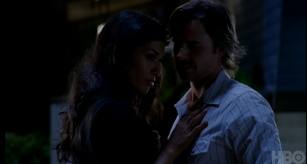

Not because she's not ready to stay the night with Sam or for them to be an official item (although that may well the be the case), but because she felt her baby girl Emma may not be. Luna and Sam both displayed the emotional maturity required to take their budding relationship slow; let's hope the snarling wolf that confronted Sam just as the van carrying Luna and Emma home drove up the Merlotte's driveway towards the parish road and out of view doesn't put the permanent brakes on this promising couple!

Last but not least, we've got fairy-costumed Holly, who, despite (or maybe because of) her mental and physical exhaustion brought on by the drama of the night had the gumption to tell it like it is to a persistent, Halloween bouquet-toting Andy Bellefleur.

Here's the dialogue courtesy of Television Without Pity

Andy: "Sorry about the last time, when I took your flowers."
Holly: "That's okay, you were nervous."
Andy: "No, I was a drug addict. V. thought I needed it to do the job, and to talk pretty ladies like you... So I didn't feel like a loser all the time. It worked for a while, then it didn't."
Holly, wearily: "Okay look, honey. You're really sweet and everything, but this is all just too much for me right now."
Andy: "It's no problem. Lot of baggage, I get it. I just wanted to say that I'm sober and I'm lonely. And I can be good to someone if they let me. 'Night."


After taking in and weighing what he had to say, Holly asked Sheriff Andy for a much-needed hug, which I think may have been balm for both their souls. I look forward to seeing what will come next for these two, and if the kind of "rigorous honesty" the tragically doomed Debbie Pelt had talked about having with Alcide might prevail for both of them; given their respective pasts (Holly as a survivor of sexual assault and Andy as a recovering addict) should they become involved.

Now, the above is not to suggest that self-actualization and being in relationship are mutually exclusive. In fact, as the introduction to the section on self-in-relation in the book Weaving the Visions: New Patterns in Feminist Spirituality asserts, the idea of self as relational is prominent in feminist thinking.

The concept of the relational self has not caught on in the traditions of dominant Euro-Western philosophy and theology in which Descartes's' vision of the self as essentially rational, disembodied, and solitary holds sway. From this perspective, it is easy to see how relationships could be seen as detrimental to the growth and development of the self - especially for women - whose stereotyped roles as nurturers and caregivers of others threaten to swallow us alive.

Another vision of the self suggests that we are by nature embodied, passionaterelational, and communal. Many feminist adhering to this viewpoint stress that identity is found in community. Black womanist theologian Delores S. Williams coined the term "relational interdependence" to name Black women's struggles for freedom from racist and sexist stereotypes within the context of relationships, family, and community. In this view, women's independence is relational.

There is no you without me; no me without you. The self is forged in relationship.

Even so, drawing healthy boundaries for the relationships that structure our lives and bind us to others is necessary, and it's refreshing to see the women of True Blood taking these steps - and their men responding in kind!

Yours in TB withdrawal...

~ Rachel

Sunday, September 4, 2011

Some more thoughts on Pam & the (postmodern) veil

So as far as we know of, Pam is still cursed, right?

In her desperation to prevent a world without Bill in it, Sookie's amped-up fairie power knocked the spell right out of the attacking amnesia Eric, restoring him to his former Viking god state with his memories of his entire life - both human and vampire - up until the present intact.

Rebecca thinks this is a nod to the exceeding complexity of a woman's psyche; with a snap of Sookie's microwave fingers Eric has recovered his "true" self , but for Pam, a solution is not so simple.

Because although Pam has looked none the worse for wear since undergoing Dr. Ludwig's unconventional full body spa treatment and a painful series of daily injections administered by the dizzy-but-stalwart Ginger, she continues to rot from the inside-out.


When she's been on the receiving end of the lady vamp's rage, Tara's made it all too clear that Pam's putrefying innards continue to emit a horrific smell despite her back-to-glamour-puss appearance.


And (high maintenance) glamour-puss Pam is! In my last post on this topic, Pam's Taken the Veil, I referenced The Vault interview "Kristin Bauer talks about her 'face-off' in which the actress remarks that Pam's predicament is an intolerable affront to her vanity: "Having her skin peel off in ribbons of goo is a massive blow for Pam".

She's a woman whose priorities include Eric and her appearance, not always in that order. Putting her face on is a deeply embedded part of who she is.


Remember when Bill tried to suggest that perhaps there was a cosmetic solution to her plight; that maybe a little more lipstick might help?


Now, although for the most part I try my best to remain non-partisan here at the PPT, I admit that I love Bill with the best of the Team Bill girls. But come on, Bill, seriously? How clueless can you be? A little extra make-up is not going to solve a problem that runs far more than skin deep, and to suggest that it might smacks a smidgen too much of the dismissive recommendations male medical practitioners and others have made for ages when it comes to "female ailments".

For example, there's Sigmund Freud's notoriously biased and inadequate understanding of women whose perspectives formed the once-common diagnosis of female hysteria in which a woman's unmanageable emotional excesses (or maybe her wandering uterus, since according to Plato and others down the line, female psychology and biology are ruled by the reproductive system) was to blame for her ills. Feeling weepy and irritating the men in your life? You must be PMSing, or maybe you're on the rag - pop a pill and get over it. Crass, I know, but I'm fairly certain that most women have been blown off with such patronizing comments when they're facing legitimate life challenges that extend beyond that time of the month.

I found an interesting take on the idea of Pam taking the veil that actually relates to her penchant for make-up, and Bill's tragically (but typical guy?) misinformed impression that a little extra lipstick might help her situation.

An article on veiling entitled Some thoughts on the Veil appears on Max Dashu's Suppressed Histories Archives. It's in her confronting oppression section on taming the female body and it addresses some fascinating topics like the gender and class implications of veiling from a historical perspective far older than Islam - which is, aside from the communion and bridal veils common in Western culture, what most people think of when it comes to the practice. 

It also raises some interesting points about make-up as a post-modern veil, citing its near-compulsory use in certain contexts (like shielding Pam's disfigured face from the innocent gaze of hapless onlookers who should not have to be exposed to such female monstrosity?).

Here's an excerpt from the article, which picks up after the mention of the compulsory use of make-up:
It remains so in the workplace, at the employer's whim, according to a ruling by the California Supreme Court in 2000. The judges upheld the firing of Darlene Jesperson, a longtime bartender at Harrah's Casino in Reno, for refusing new requirements that women wear lipstick, face powder and mascara on the job. This court decision also allows employers to dictate dress, hair length, and other grooming decisions for their employees. These strictures have special ramifications for African-American women; employers often bar them from wearing their hair in natural and cultural styles (or simply refuse to hire them).
Here the rationale of enforcement is economic; in the Iranian context, it is religious. There, both the state and the family act as enforcers. Posters in Tehran explain that "Bad hijab [incomplete covering of hair] is equal to prostitution. Lack of hijab means lack of man's manhood." With these kinds of controls in place, lipstick looks like freedom to many Iranian women...
...which the article goes on to state has been scraped off the faces of Muslim women with a razor blade.

Damned if we do and damned it we don't, huh? What do you think of this catch-22? I wear make-up, and I won't stop wearing it because of the perspective offered in this article (which I do encourage you to read) but the idea of make-up as a post-modern veil has certainly occurred to me before.

This taps into related debates about cosmetic surgery, advertising culture, the cult of beauty, whose beauty is beautiful, etc. You can never be too young, too rich, and too thin, right?

Please share your thoughts on this!

Oh, and keep your fingers crossed that Pam's curse is lifted before the Season 4 finale...is it 9 yet!?!

~ Rachel            

Tuesday, August 23, 2011

Gendered Judgmentalism

When Jason's Hot Shot rape arc first launched, our friend Amy (webmistress of the clever and hilarious She Liked Imaginary Men Best of All) was justifiably outraged.

She commented on Facebook that if a woman were strapped to a bed and used as a breeding mare, people would be going nuts. Rebecca responded that she felt people were supposed to be disgusted and outraged by this depiction of the repeated violation of a man by a string of (I would argue also exploited) women.

And during Sookie's (hot! hot! hot!) Bill/Eric dream this past Sunday, she admonished the two of them for buying into the double standard that she must be one of theirs, but she - as the proper lady she is -shoudn't even entertain the idea of having both of them be hers.


And forget the idea of a vampwich with Sookie in the middle; that's just too far outside the boundaries of society's standards for acceptable female sexuality (but as Sookie said, it's OK if the threesome consists of girl-boy-girl, even if the players barely know each other)!

It was her dream, so ultimately they both caved. I wonder if that had anything to do with the fact that she emphasized how her desire for both of them to love her was born out of her total, complete love for the two of them. Because women are hardwired to conflate love and sex, right...and to reserve intimate relations for partners with whom she is in love, rather than in lust, with?

Now, I'm not advocating for indiscriminate, lust-driven sex outside of a caring, mutually consenting, adult relationship. I'm just interested in seeing more expansive options for women to express ourselves and our sexuality outside the constricted bounds of our society's gender-based norms, is all.

This idea of double-standard and reversal got me to thinking...

...If a woman were carrying on a purely physical affair or two while still in love with, or hung up on an ex-lover (as Bill had been doing with Katerina and Portia) how would that be viewed?

How is it viewed when he's doing it?

Does it negate his continuing love for Sookie?


She sure let him have it for "sticking his fangs and God knows what else into every girl in Bon Temps". S4E6 I Wish I Was the Moon

Is it OK because he's a man, and as such, has needs for
companionship and sexual gratification that must be satisfied?

Granted, he has been upfront with these women and has not led them on.
He even told Portia outright (albeit rather coldly) that he could never love her, and although it was she who suggested that they casually add sex to the equation of their already successful and friendly professional relationship, I'm pretty sure I saw her flinch.


Yet she accepted Bill's terms for taking their relationship to the next level.

Does this diminish her femininity?

Reduce her to a cliché with all the fixins expected of the (in her words) "smartest and most powerful" professional woman in Bon Temps, i.e. ballbuster, bitch, etc.?

She goes after what she wants. She's willing to enter into a "friends with benefits" situation. She's a self-described "terrier", as a lawyer and a lover.

Does this make her emotionally bankrupt (an undesirable trait in a woman)?

Would these pitbull qualities make others see Portia as being too much like a man to be a real woman?

Now, since Bill found out that Portia is actually his great-great-great-great granddaughter, we're not likely to be seeing her again (at least not in his bed) any time soon. But honestly, don't you think his brush-off was a little silly and condescending?

Sure, Portia was very aggressive in her rationalization of incest. And yes, he's got an awful lot on his hands, what with his kingdom facing the witch crisis, and all. To top it off, Bill was not overly invested in their brief relationship; he had promised her nothing.

Even so, no matter how busy Bill was, however eager to short circuit their dance around his desk, with him in retreat as she gave chase he may have been, didn't such an intelligent, sophisticated woman deserve a letdown that didn't involve being glamoured to scream at this sight of him?

Please weigh in below!

~ Rachel

Monday, July 25, 2011

You aren't supposed to think, you're supposed to follow protocol!

So said King Compton to his [grudging] subject Pam in S4E4 I'm Alive and On Fire
This quote speaks well to a major theme I detected in that episode: hierarchical, authoritarian power & control

IN THE FAMILY

Joe Lee has a choke hold on Tommy and Melinda Mickens 
IN THE COMMUNITY

Crystal: "I'm big mama kitty now, finally. Everyone gonna do what I say"

AND IN THE NATION

the newly crowned vampire king of Louisiana


How is such autocratic rule achieved? How is it maintained? Is it legitimate? Effective? Do we have any alternatives? How can we throw it off?

If we are to organize ourselves and act to get out from under oppressive rule, we've got to be able to determine who's really in charge.

For example, Bill looks rather more presidential than kingly here, no?


In countries where there are both royalty and systems of representative government, the royals are generally seen more as figure heads than politicians; that label being reserved for those in elected office. Interestingly, Bill is being portrayed as the later. 

And he certainly seems to be more involved with matters of state than the two other vampire monarchs we have met thus far on True Blood,  Russell & Sophie-Ann, ever were. Yet, it seems someone else is really in charge.


Now, we all know that at least in this country, there is [supposed to be] balance of power. The executive branch of government is not omnipotent; the president must answer to the congress, etc.

On the surface, at least, this appears not be the case in the vampire nation.

So far this season, King Bill's power seems rather absolute and iron-fisted. Pam's telling him she wouldn't risk lying about Eric's whereabouts because word of Bill's ruthlessness as king has travelled far and wide is seemingly evidence of that. And then there's his condemning the vampire caught on YouTube feeding on a human to the true death without benefit of a trial (I want to take this case to the Authority!" Bill: "I am the Authority, you idiot !"). S4E3 If you Love Me, Why Am I Dyin'

But in this week's episode, we found out that things aren't so simple.

With Bill cast as somewhat of Nan's puppet - his distaste for power wielded unilaterally & unjustly made clear by his sarcasm when she inquird about the execution - could this be a critique of the U.S. system of government? Is True Blood suggesting that our elected officials from the school board to the Commander-In-Chief aren't really holding the reigns, the [fill in the blank - multinational corporations, shadowy interest groups, others in government, etc.] are?

Hhmmm...

Thoughts? Please share below.

~ Rachel

Saturday, July 23, 2011

"I'll trade you the red one for the blonde one"...Russell Edgington shows his true misogynist colors

In the mood for a little vintage True Blood? We're going deep, deep down into the wine cellar for this one, dear friends...all the way back to Season 3 ;-)


Remember the Episode 8 showdown between Russell and Bill in front of Sookie's house? Here's a quick recap.


Bill and Jessica had gone over to defend Sookie from Debbie and her werewolves. It was looking pretty good - vamps: 1, weres: 0 - when, before Bill could stop her, Jessica chased a fleeing wolf out the door and onto the front lawn where the King of Mississippi was waiting. Of course, he couldn't enter a human's residence; instead, he waited in stealth mode for an opportunity such as the one that had presented itself when Jessica ran straight into his evil clutches.


Bill - who was on the way up the stairs to give aid to Sookie - wavered for a moment before stepping out onto the porch in defense of his progeny. Challenging Russell, Bill asked the king if he was a coward or just plain lazy; hiding behind werewolves and the struggling baby vamp he was about to  sink his fangs into. "How about you and I settle this amongst men", Bill growled.


This next part is rich. Russell - in almost the same breath as he derided Bill for his sexism ("How very sexist of you, Bill. When it comes to killing, I've always been an equal opportunist.") - suggested, "I'll trade you the red one for the blond one". S3E8 Night On The Sun


Smacks of some of the essentialist concepts laid out in my post You Smell Like Dinner, i.e. women are not real subjects, complex and distinct but “infinitely substitutable beings”; objects branded with the “mark of the plural” (Rivera, 2003, p. 145 & 147), huh?


Me thinks King Russell hath shown his true [misogynist] colors!


And let's not forget some of his other most revealing gems, several of which were uttered in the Titanic-esque, patriarchal king-of-the-world plantation manor setting of 9 Crimes (S3E4) - complete with blood brandy and cigars...


...like the Rudyard Kipling quote he worked into his conversation with Bill; "A woman is only a woman, but a good cigar is a smoke." 

Or this lovely sentiment - apparently all his own in the sense that it wasn't lifted from a late 19th & early 20th century literary figure who celebrated British imperialism - although likely not foreign to the worldviews of many other men; "Tug on her purse strings, and you'll find a lady's heart".

It seems to me that these patronizing, dismissive attitudes would have been right at home in the dark wood paneled and opulently furnished retreats of Gilded Age wealthy men. Places where they could bathe in their power and the arrogance of their lording over their women, children, and servants shone through their masks of etiquette like the sun through clouds. Havens where their positions of authority both in the home and in the world of business were reinforced; their sexism [and other "isms"] likely met with a wink and a smile.
It is this type of Edwardian gentleman's parlour atmosphere that Russell seems to have tried to recreate, driven perhaps by his snobbish desperation to project an air of both affluent civility and unquestioned authoritarian power.             
Has the [white] male ruling class not changed that much since the time of first class crossings on the White Star Line? It seems such elitist fantasies have not gone down with the ship. 
Thoughts? We'd love to hear them.
~ Rachel
References
Rivera, R. Z. (2003). New York Ricans from the Hip Hop Zone. New York: Palgrave

Thursday, June 30, 2011

Boy, I wa-wa-want whatchu wa-wa-want...

...give it to me baby like boom, boom, boom...
what I wa-wa-want is what you wa-wa-want na nah...
                                                      ~ Rude Boy by Rihanna
After such a long wait the new season of True Blood is finally under way! But before we launch into our review of its premiere episode, "She's Not There", I'd like to first take a look at a particular piece of Season 4 promo material.


In this poster we see Sookie seated in the center of the frame surrounded by three suitors, each with a hand on her, staking a claim, wanting a piece. Which one will she choose? Which supernatural contender for Sookie's affections will prevail, who will win? Because it's a competition after all, and she's the prize - the object of strong male sexual desire being fought over. She's the spoils, the booty - her booty going to whichever alpha male can assert himself over the others.


That's one way of looking at it.


But this image isn't really about Team Bill, Team Eric, or Team Alcide, is it? It's about Team Sookie.


For me, it's no accident that she's the central figure in this poster. Look at her posture; her body, and indeed, her countenance as she gazes directly into the camera exudes relaxed confidence. An at-easiness with herself and who she has become.


Gone is the virginal innocent we met in Season 1. Swathed in deep red, this Sookie - like our tavern's heraldic pomegranate with its abundant scarlet seeds so evocative of the redness of the fertile womb - is the picture of blooming female sexuality.


Her hair is loose, unconstrained - quite unlike the tight ponytail stretching her facial features that she wore in "Strange Love", when she was so utterly thrown for a loop by the sexual banter of her co-workers at Merlotte's.


In the Show Your True Colors poster above Sookie is shown as being possessed of a healthy, active female-centered sexuality. Kind of like in Rihanna's Rude Boy - is it so shocking to think that women could want what men want...a gratifying sex life...and that our sex drive can be just as strong, just as audacious, and just as pleasure-for-pleasure's-sake seeking as theirs? And that it's normal, natural, and healthy - and doesn't make us deviants, whores, or hypersexualized vixens performing for men's benefit alone?


In the video above, a self-assured Rihanna sits astride a lion. Could it be that women aren't (or aren't justonly, or always) lithe prey animals made for men's hunting pleasure; or as 1970's pioneer of erotica and Imaginative Sex author John Gorman writes, "the smaller, more sleek female who is natural quarry and game" (p. 33)?


Writing as Pat Califia in 1997, the transgender activist now known as Patrick Califia-Rice described Gorman's work as "unrelievedly heterosexual" and as positing "a world in which biology is supposedly allowed to dictate the social and sexual roles which men and women will play - dominant and warlike, submissive and servile, respectively" (p.vi)..."the hero or the dazzling object of his desire" (p. xiii). But even Gorman (whose writing, Califia wholeheartedly admits, is focused on the arousal, excitement, and gratification of the female "slave" much more so than that of her male "Master") allows that women are not passive, that "She, too, has needs. She often provokes the male to her hunt" (p. 33).


OK, maybe sometimes we want to feel that we are being chased, caught, and "ravished in a thoroughly satisfying manner" (Califia, 1997, p. xii) by a determined, energetic, and worthy partner - on our terms. As agents of our own fate, not commodities for male consumption. And for mutual pleasure, not just his. But maybe, just maybe, sometimes we'd like to be the hunter.


Califia writes, "The process of creating a sex life or love life for oneself is at least as much about learning and teaching as it is about discovering one's secret, innate self" (p. xi, italics are mine). What if, as Sookie's secret, innate self - the seat of her sexual self - is bubbling up to the surface, she'd like to be something other than "game, sleek, beautiful and desirable, frightened of him, who could be caught and owned, and tamed, and who, in his snare, would writhe and cry out" (Gorman, 1974, p. 21)?


Hypothetically, why does she even have to choose between Bill, Eric, and Alcide?


Of course, that's a somewhat rhetorical question since we know that in this culture, the industrial family ethic - which was preceded by the colonial family ethic, insists that the proper place for a woman is in a monogamous relationship with one man. I'm not saying that coupling up is wrong, or that women (or men) of any sexual orientation who want to do so are somehow less liberated.


What I am saying is that it's limiting and outright damaging - especially to women - to insist that this is the morally ordained, right, and only way to live.


As Mimi Abramovitz writes in the feminist classic, Regulating the Lives of Women: Social Policy from Colonial Times to the Present (1996) our contemporary social structures are still based upon the patriarchal family ethic that emerged during the early 19th century primarily as a means of controlling and regulating women’s productive and reproductive labor, placing them in their husband’s home and subordinate to him as the male head-of-household.


Seems like the basis for the Defense of Marriage Act - under which marriage = 1 man + 1 woman only - the fangs-out fight over which happily ended in marriage equality in my home state of New York just this past weekend.


In Bram Stoker's 1897 novel Dracula we meet a female character reflective of a new social order - Lucy Westenra.

Sadie Frost as Lucy Westenra in the 1992 film Bram Stoker's Dracula

Like Sookie, she too had three suitors - and collected marriage proposals from all of them on the same day. As Susan Parlour (2009) writes in her essay, "Vixens and Virgins in the 19th Century Anglo-Irish Novel: Representations of the Feminine in Bram Stoker's Dracula", even though she failed to postulate a new image of feminine roles in the the workplace - as her best friend Mina, who might on the surface appear more of an expression of the New Woman in that regard, did - Lucy nonetheless shook up the strictures of the Victorian patriarchal machine.


According to Parlour, Lucy demonstrated her voracious sexual appetite. She admitted to being a "horrid flirt". These behaviors certainly transgressed the accepted Victorian etiquette demanded of young ladies. But Lucy took it a dangerous step further in her desire to marry Arthur Holmwood, Quincy Morris, AND Dr. John Seward. "Why can't they let a girl marry three men, or as many as want her, and save all the trouble?" (Stoker, 1986, pp. 73, 78) Lucy wistfully wondered, and in doing so, embraced some of the more radical ideals of the New Woman's challenge to prevailing sexual values. In the minds of the Victorian patriarchs, could a destabilized society and accelerated moral decay be far behind?


Would Sookie ever suggest a similar solution to the Team Bill, Team Eric, or Team Alcide quandary? What if she did?


Do you know what became of that little minx Lucy? She fell prey to Count Dracula, was turned vampire, and as such became a "phallic woman", having fangs with the power to penetrate and draw blood; a sexually empowered aggressor. This, of course, could not stand. Lucy was subjected to a particularly brutal "second death" at the hands of four men - including her three suitors and the famed Dr. Van Helsing - during which she was staked in a manner reminiscent of gang-rape.

Vampire Lucy is destroyed in Bram Stoker's Dracula
The violation of her vampiric body yields the restoration of her benign femininity; her threat to the symbolic or social order extinguished (Parlour, 2009).


Is this the fate of the overtly sexually desirous woman? I'd like to think not, but one need only reflect back on René Lenier's Season 1 rampage to be reminded of how our society often treats its fangbangers, sluts, and bad girls (i.e. women whose sexual behavior transgresses the clearly demarcated gender roles mapped out for them).


This is a topic that is deserving of a lot more fleshing out and continued discussion. For now, suffice it to say that although I'm not holding out hope for Sookie to choose not to have to choose between Bill, Eric, Alcide, and whoever else may come her way (I'm not even saying that's the best option for her, anyway) I AM glad to have an image that we can claim as one representative of Team Sookie - where her needs, wants, and desires can be seen as central.

~ Rachel    

References

Abramovitz, M. (1996). Regulating the Lives of Women: Social Welfare Policy from Colonial Times to the Present. Boston, MA: South End Press.

Califia, P. (1997). "No Fantasy, Please, We're Americans: A Foreward by a Feminist". In Gorman, J. Imaginitive Sex. (pp. v-xiv). New York, NY: Masquerade Books.

Gorman, J. (1997).  Imaginitive Sex. New York, NY: Masquerade Books.

Parlour, S. (2009). "Vixens and Virgins in the 19th Century Anglo-Irish Novel: Representations of the Feminine in Bram Stoker's Dracula". Journal of Dracula Studies, Number II.

Stoker, B. (1986). Dracula. Penguin edition.  
     

Sunday, June 12, 2011

Tru Blood Tru World: An (Unlikely) Ecofeminist Philosopher

It's LAST CALL for this idea I distilled at the end of Season 3 but have yet to serve up and the FIRST TASTE of a new element we'll be featuring at the PPT come Season 4; Tru Blood, Tru World: AN (UNLIKELY) ECOFEMINIST PHILOSOPHER.

Driving home from work this past Tuesday, a piece on American Public Media's radio program Marketplace caught my ear. It was called, "Canada fights dirty".

Hmm... intriguing.

After Tess Vigeland's introduction, the report started with Marketplace Sustainability Desk's Scott Tong polling Americans on the street about the first thing that comes to mind when one thinks of our neighbor to the north.
 
Predictably, many respondents mentioned the folksy accent (i.e. what are you talking aboot, ay?). Several also upheld common stereotypes like, "it's America-light", "Canadians have a clean and orderly society" and - perhaps the most pervasive - "Canadians are polite, friendly, and nice".

I guess on some level I must buy into that last one, because that's why the piece grabbed my attention. Those nice Canadians are playing political hardball? Really?

Apparently so; according to Marketplace, Tuesday was the last day for the public to comment on a new pipeline to carry Canadian oil to the U.S. We already buy Canadian crude (we actually import more oil from Canada than from any other foreign nation) but whether to pipe in a lot more has become a bitter fight in Washington with deep economic, political and environmental implications.

That's because the product going through the pipe is controversial; it's known as oil sands - literally, it's oil embedded in sand - and it's one of the dirtiest fossil fuels in the world to produce since it requires steam generators and other kinds of heat to get the oil out. This means lots of carbon pollution, and high-carbon fuels are being banned globally.

"Environmentalists around the world are fighting Canada's attempts to export oil from Alberta's oil sands".

So Canada is pushing back.

Canadian diplomats are meeting with like-minded allies, like BP and Shell. Their argument: Canadian oil reduces U.S. dependence on oil exported from unstable and unfriendly Middle Eastern and North African nations. Canada doesn't exploit, oppress and kill anyone to get their oil to market. And, according to Calgary oil analyst Dave Yager, they're "not going to use the profits from tar's oil sands production to build a nuclear bomb and annihilate Israel".

Naturally, what - or who - did I think of while listening to this piece weighing the pros and cons of keeping Canada's dirty oil flowing?

Why, Russell Edgington, of course!

I know, I know, on the surface, at least, it seems odd that a piece broadcast on NPR about, amongst other things, environmental concerns would make me think of the King of Mississippi instead of, lets say...our resident True Blood king of recycling, Bill Compton...

paper products go here, Tru Blood and other glass products go here...bravo, Mr. Compton!
But seriously, let's think about this for just a minute. 

Hearken back, if you will, to the Season 3 scene in which Russell and Eric are riding in the back of a limousine together, on the way to press Queen Sophie Ann into marriage and to challenge the Magister.


Recall how the increasingly agitated king remarked to the scheming Viking: "Throughout history I have aligned myself with or destroyed those humans in power, hoping to make a dent in mankind's race to oblivion. What other creature actively destroys his own habitat?"

Might our duplicitous, power-hungry King Russell also be an (unlikely) ecofeminist philosopher?

"In the case of Russell, he's a power-hungry ancient druid who has a serious concern of the stewardship of the earth". So says a man who looks an awful lot like the King of Mississippi -  Mr. Denis O'Hare himself - in an interview with Brandon Voss of The Advocate

And who can forget the infamous spine-ripping scene in which Russell rants about humanity's egotistical overconsumption and violent, polluting ways...


Russell - according to Mr. O'Hare, who has reportedly worked out a detailed backstory for his scene-stealing True Blood character - is not of this time. His worldview was shaped during a time when humankind had a far different schema for life on earth, organized around a dramatically different master metaphor. The king's druid brethren were possessed of the ancient wisdom - which, in her essay "The Evolution of an Ecofeminist" Julia Scofield Russell suggests has been lost and refound in modern works like James Locklock's Gaia: A New View of Life on Earth (New York: Oxford University Press: 1979) - that the earth is a living being.

And that "the law of the circle" (remember, during his confrontation with the Magister, Russell insists that there is only one true law - the law of nature?) - "the fact that the Earth's natural life-support systems are circular. There is no 'out'. Everything is in the system, and everything we put into the system comes back to us, for good or ill" (Scofield Russell, 1990, p. 229) rules.

Everything is in the system. Including we humans. There is no "out". We can't escape the destruction we wreck. You may disagree with his methods (as I certainly do) but can you really blame Russell for trying to stop, as he says,  our "race to oblivion"?    

Imagine how difficult negotiating modernity must be for an ancient vampire such as Russell, whose multimillenia-long undead lifetime has brought him into such clash and conflict with a nearly unrecognizable paradigm; an entire civilization that heaps abuses upon the earth's body:
...toxic wastes, ozone depletion, species extinction, desertification, smog, acid rain, famine, forest death, poverty, cancer, genocide, dead rivers and lakes, nuclear contamination. (Scofield Russell, 1990 p. 225)
Sounds not unlike Russell's shocking televised speech above, huh?

We 21st century denizens may soon be facing what it's like to live through seismic paradigm shift. In fact, it very well may already be underway; many signs point to this truth.

Here's a relevant excerpt from my dissertation:
  
Several transdisciplinary theorists have issued a clarion call for a paradigm shift as an integral and overarching component of systemic social change (Morin & Kern, 1999; Nicolescu, 2002; Plumwood, 1993; Wilshire, 1990).


This a metamorphosis which is nothing short of the birthing of a new vision to replace the old frameworks dominated by dichotomous thinking that form the bedrock of modern society and are fundamental to its many ills.

Nicolescu (2002) discusses the immediacy of action required in terms of bringing about a visionary, transpersonal consciousness nourished by knowledge growth to challenge the threat of our material, biological, and spiritual destruction posed by blind adherence to the logic of utilitarianism that characterizes the dominant paradigm.

Goerner’s (2001) advocacy of the concept of a “great turning” posits that this revolution will result from radical changes in the way we think about our world and our relationship to it. She likens it to a developmental passage, a self-generated metamorphosis similar to that of the butterfly.


As the caterpillar is compelled by forces from within to slough away its DNA to allow for the butterfly with a completely different genetic code than its larval form to emerge, so too does our civilization transform as a result of pressure, pushing from the inside-out.

This process is driven by the interconnected crises of modernity. Goerner (2001) asserts that there are hints all around us that modernity has reached the end of its useful life; its virtuous beginning ushered in the noble notions of liberty, equality, fraternity, and reason but its twilight is delivering silent disaster on an epic scale. The transition from modern to integral age will entail profound global change. It will eventually alter every facet of civilization, and it is happening now, not in one or two countries, but in the entire developed world and in many developing nations.

The “great turning” thesis emphasizes the critical role of changing the assumptions that guide our thinking about the world and our place in it. She suggests that shifting the root metaphor we use to explain how the world works from mechanistic to web and ecosystem metaphors will render modernity as radically different from the coming integral age as our current civilization is from medieval times.  Such a reformulation will depend largely upon the choices we make, and whether we as a society can loosen the assumptions and worldviews to which we cleave to allow new ones to emerge like a butterfly from its chrysalis. (Goerner, 2001).

WOW. Are we ready for such a major, life-altering shift?

In my estimation (and Russell's), something's gotta give.

Remember during that same limousine ride I was talking about above how Russell lamented to Eric, "Do you remember how the air used to smell? How the humans used to smell? How the humans used to taste?" Perhaps Russell's reminiscences about the pre-Industrial world reveals something deeper than his recognition that we are polluted and his simple, animal longing for human blood that tasted better, purer.

Maybe, just maybe, Russell can taste what we are lacking in our very blood - "the loss of soul in modern philosophy" (Cajete, 2000). Anthropologist Michael Harner writes about this kind of spiritual vacancy in his treatment of “soul loss”; in contemporary North American Hispanic communities this phenomenon is known as susto and is considered a common condition in the modern world (Broderick, 2001). 

As grief expert Elizabeth Kubler-Ross noted, “There is no spirituality left. I mean the inner, deep knowing where we come from”(Wilshire, 1990, p. 92). Accordingly, Orthodox theologian David Hart offers a sobering analysis of “metaphysical boredom” and what it means for modern Europe:
A culture - a civilization - is only as good as the religious ideas that animate it; the magnitude of a people's cultural achievement is determined by the height of its spiritual aspirations. One need only turn one’s gaze to the frozen mires and fetid marshes of modern Europe, where once the greatest of human civilizations resided, to grasp how devastating and omnivorous a power metaphysical boredom is. The eye of faith presumes to see something miraculous within the ordinariness of the moment, mysterious hints of an intelligible order calling out for translation into artifacts, but boredom’s disenchantment renders the imagination inert and desire torpid. (Catanzarite, 2007, p. 103).
Canda and Furman (1999) define spirituality as "the universal and fundamental aspect of what it is to be human - to search for a sense of meaning, purpose, and moral frameworks for relating with self, others, and the ultimate reality" (p. 36).
Could it be that the spiritual malaise of contemporary Western society; indeed, our stagnant collective soul, (which Russell perhaps tastes in our blood) might be a function of our estrangement from Earth and from the web of life?

Native Science: Natural Laws of Interdependence author Gregory Cajete (2000) writes that Henryk Skolimoswski was one of the first to articulate an eco-philosophy for the transformation of thought needed to bring a new ecological consciousness. In his 1981 study, "Eco-philosophy: Designing New Tactics for Living" he states that current political systems threaten to rob us of our highest values and because the current basis for action is no longer deeply rooted in life-serving purposes (echoed by Scofield Russell: "Ecofeminists antifeminine, it is antihuman, antilife", 1990, p. 225) or reverence for nature, we need a new philosophy to inform and guide us.

According to Cajete, "The era of the 'eco-individual' is dawning" (1990, p. 59.).

What will this era - and the eponymous "eco-individual" look like? How will we tell when it has dawned, and what can we do to move it forward?

Above, I referenced Lovelock's Gaia theory. Back in Season 1, Amy Burley queried a very overeager-to-do-V Jason, "You know what Gaia is, right? Theory of Gaia?". Amy may have understood Gaia theory intellectually, but despite her hippie persona and her  I'm-an-organic-vegan-and-my-carbon-footprint-is-minuscule pseudo cred...


...believe me, she didn't really get it. Amy Burley was a false prophetess - hollow; a complete sham.  

Her treatment, and eventual staking of vampire Eddie Gauthier shows how little she comprehended the meaning of the Lakota phrase "Mitakuye oyasin", translated as "we are all related" (Cajete, 2000, p. 86).


Eco-philosophy is utterly dependant upon this tenet.

If eco-consciousness is indeed a return to ancient wisdom, perhaps we can glimpse the coming paradigm and eco-individual in the Maya words:
The roots of all living things are tied together. When a mighty tree is felled, a star falls from the sky. Before you cut down a mahogany, you should ask permission of the keeper of the forest, and you should ask permission of the keeper of the star. (Cajete, 2000, p. 108)
Euro-western society has much to learn from living indigenous traditions, whose ways and wisdom may seem comfortingly familiar to the pre-Christian Celtic Russell Edgington. For example, native science offers a system for naturalistic observation and knowing which honors and integrates sense, perception, and the metaphoric mind to apprehend reality. Unlike conventional science which leaves out so much, this Indigenous scientific method opens to "the sacredness, the livingness, the soul of the world" (Little Bear, 2000) in a way that can bring us to new and needed vistas.

Ecofeminist Julia Scofield Russell reminds us that while we are all a part of the body politic ("We are its lifeblood, its nerves, its brain") and as such we must continue to engage in the activities of the nation state in order to make a difference, we can also exercise what she calls the "politics of lifestyle", "a distinctly feminine politics in that it is both inner and universal, personal and all-inclusive" (1990, pp. 226-227).

It DOES matter what we choose to do in our personal, everyday lives and at our home and hearth; it matters deeply.

As Scofield Russell writes, the movies we go to see, the food we eat, our relationships, what we throw away and where, our livelihoods - everything - emanates out into the larger system, ultimately impacting the whole living planet.  

Although humanity may be behaving as a cancer on the earth, the answer is not - as Russell thinks - to subjugate and control us so as to force our compliance with his will, despite his (at least ecologically) good intentions.  

If we want to make a difference for the better, we can take our role as consumers seriously and behave as such. We must understand that when we purchase a produce we are supporting the entire system that made it. We can support companies and practices that are sustainable and withdraw our dollars from those that are ecologically and socially damaging. 

There are so many ways we can initiate life-affirming changes in our everyday lives; with our diet and food buying practices, with our relationships, tax resistance, housing, gardening, conservation - as Scofield Russell (1990) writes, it's up to us.  

And yes, Bill Compton, we can recycle.

What do you think? How are you making change; making a difference? We'd love to know! Please share in the comments section below.

Sláinte (an Irish toast to your health) for now...

~ Rachel

References 

Broderick, R. (2001). Leather tramp journal: A 12-mile mountain retreat. Leavenworth, KS: Forest of Peace.

Cajete, G. (2000). Native science: Natural laws of interdependence. Santa Fe, NM: Clear Light Publishers.

Canda, E. R., & Furman, L. D. (1999). Spiritual diversity in social work practice: The heart of helping. New York, NY: Free Press.

Catanzarite, S. (2007). Achtung Baby: Meditations on love in the shadow of the fall. New York, NY: Continuum.

Goerner, S. J. (2001). After the clockwork universe: The emerging science and culture of integral society. Charlotte, NC: Baker & Taylor, Inc.

Little Bear, L. (2000). Forward. In Cajete, G. Native science: Natural laws of interdependence. (pp. ix-xii) Santa Fe, NM: Clear Light Publishers.

Morin, E., & Kern, A. B. (1999). Homeland earth: A manifesto for the new millennium.  Cresskill, NJ: Hampton Press.

Nicolescu, B. (2002). Manifesto of transdisciplinarity. Albany, NY: State University of New York Press.

Plumwood, V. (1993). Feminism and the mastery of nature. London, UK: Routledge.

Scofield Russell, J. (1990). The evolution of an ecofeminist. In Diamond, I. & Orenstein, G.F. (Eds.) Reweaving the world : the emergence of ecofeminism. (pp. 223-230). San Francisco, CA: Sierra Club Books.

Wilshire, B. (1990). The moral collapse of the university: Professionalism, purity, and alienation. Albany, NY: State University of New York Press.

Saturday, June 4, 2011

FIRST TASTE: GUEST BARTENDING AT THE SIREN'S CONFERENCE

Here's your first taste of the GUEST BARTENDING feature that will be on the PPT's menu for season 4's analysis and commentary...


...LORENA FANS TAKE NOTE...


The Pierced Pomegranate Tavern will be setting up shop from October 6–9, 2011, at the Vail Cascade Resort and Spa in Vail, Colorado!


Rachel will be giving a talk at the Sirens conference; a networking retreat and academic conference dedicated to women in fantasy literature, providing perspectives on fantasy books by women, female characters in fantasy works, and how to support women in fantasy literature.


Within its focus on fantastic women, each year Sirens features a fantasy-related theme—and in 2011, the theme is "monsters"! Conference programming will examine and dissect monstrous characters and themes of monstrousness. As the Sirens site points out, women have too often been decried as "monsters," and examples of monsters and questions of monstrousness pervade fantasy literature. Sirens honored guests for 2011 are Justine Larbalestier, Nnedi Okorafor, and Laini Taylor, each of whom has written of female characters who may—or may not—be monsters.


Here's an overview of Rachel's presentation:


Title: Annihilating HER Again: How Eroticized Rage Against True Blood’s Vampire Lorena―Avatar of the Monstrous Feminine―Resurrects the Forgotten History of Goddess Culture's Suppression


 300-500 word abstract for 50 minute talk

This visual, multimodal and experiential talk revolves around the now infamous final scene of True Blood Season 3, Episode 3 entitled "It Hurts Me Too" which drew the ire of the National Organization for Women for what NOW called a “messed up depiction of women, men, violence, and sex”, prompting its call for feminists to deliver a “thanks but no thanks” message to HBO. 

When it aired on June 27, 2010 I watched—eyes wide and jaws agape—as during what some call an act of “hate sex,” vampire Bill Compton hurled his maker Lorena to the bed, tore off her clothes, and twisted her neck, turning her face to the floor as he forcefully thrust into her. Despite his contempt and brutality—and with blood dripping from her mouth—Lorena told Bill that she still loves him. This explicit rendering of eroticized rage shocked me at a gut level akin to the way feminist scholar Vicki Noble describes women’s response to the obscene prevalence of rape: “We experience our collective annihilation repeatedly, psychically and physically as a woman is raped every thirteen seconds in North America…”.1

And yet, I can’t condemn or denounce this deliberately unsettling scene; in my view it raises vital issues that are better addressed through thoughtful dialogue than censure and several questions ripe for discourse spring immediately to mind: 

o    If Lorena is as NOW suggests the classic “bitch” archetype; the monstrous Feminine—a characterization that reduces her to a monolith—how might this comment on our culture which has long fragmented and demonized the Feminine? What kind of cultural context would need to exist for us to think differently?

o    Why does this scene disturb us so? Is it too hard to reconcile the genteel and romantic Bill Compton with his willful despoiling of Lorena; his determination to utterly ruin her—and harder still for us to place such a rapacious mindset not at the margins of dominant culture, but at its center?

o    Could Bill's pillage and defilement of Lorena be seen as a visceral rearticulation for a contemporary audience of mythologies depicting the slaying of the Great Goddess by the warrior god as peaceful, egalitarian society was supplanted by patriarchy some five millennia ago―the collective memory of which still pulses in our modern psyches?

Drawing upon 800,000 years of art, myth, histories and poetry and amplifying leading voices in feminist thought, archaeomythology, women's studies, and Goddess scholarship not often heard in mainstream discourse, we will explore these charged concepts and more. Tracing the intriguing parallels between the difficult-to-digest imagery “It Hurts Me Too” confronts us with and the mythologies of Goddesses dismembered, slain or made subordinate to male gods which represent the rupture from a Goddess-centered world to “dominator” world of today, we will open a discourse on contemporary issues like gender relations, sex and sexuality, attitudes towards autonomous women, and rape as a dominant social and cultural metaphor for behavior. We will identify new models for a “partnership” social structure. 

1.      Vicki Noble, Shakti Woman: Feeling Our Fire, Healing Our World (New York: HarperOne, 1991), p. 3.

Any thoughts?


I hear the host resort, which combines the conveniences of a modern hotel with the laid-back, friendly atmosphere of a mountain retreat, is amazing, and with its great room rates during the beautiful fall season in the Rocky Mountains, as well as a discount on most services at their acclaimed spa, maybe that's enough to lure you to Vail to join us?


~ Rachel