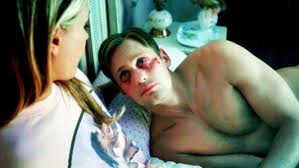
Thirsty for a Fresh Take on All Things True Blood?

WELCOME! Thirsty for a fresh take on all things True Blood? Pull up a virtual barstool at the Pierced Pomegranate Tavern where sisters Rachel and Rebecca are serving up juicy feminist analysis with a twist and opening a vein of thoughtful sociocultural dialogue on HBO's hit series.

Like the epic literary salons of eras past - theaters for conversation and debate which were, incidentally, started and run by women; where the spirited debate about the issues of the day ran as copiously as the actual spirits did - but updated for the digital age, the Pierced Pomegranate Tavern is a fun forum for exploring questions ripe for discourse about the human condition & today's most crucial social issues through the medium of True Blood.

Your salonnières are not peddling liquor per se, but they are offering up new and alternative ideas informed by such diverse influences as pop culture, art, music, cultural history, Goddess studies, transformative theory, literature and poetry, and archaeomythology, filtered through the sieve of their own lived experiences as feminist women of a particular age, background, and culture.

This is a space where you - patrons and passersby alike - can view and engage with these perspectives through the lens of True Blood and contribute your own thoughts. So, no matter if you're a Truebie or a more casual viewer of True Blood, or your drink of choice is a pomegranate martini - one of Rachel's favorite cocktails to drink and Rebecca's to mix - an herbal tea, a frothy double mocha latte, or a can of Fresca (wink, wink) you're invited to join the conversation on the show's complexities in a way that can spark transformation.

Hopefully you'll find something to sink your teeth...err...straw, into! PLEASE ENJOY RESPONSIBLY ;-)

YOU'VE BEEN SERVED (A WARNING)...

The Pierced Pomegranate Tavern is dedicated to exploring social issues and more through the lens of True Blood. As such, you may encounter:

*SPOILERS
*TRIGGERS
related to the often provocative and adult themes presented by the show

If you choose to enter and participate in this virtual salon, please be prepared to do so in a thoughtful, respectful, and mature fashion with the above in mind. Click here to check out our comment policy. Thanks!

Disclaimer

No copyright infringement is intended, all rights to True Blood belong to HBO, credit is ascribed to sites where images appearing here were originally found.

Showing posts with label Sam Merlotte. Show all posts

Thursday, September 15, 2011

Women Setting Boundaries in True Blood S4 Finale

WOW. I mean, really, WOW. There's so much that can be said about the unreal True Blood S4 finale that aired this past Sunday, "And When I Die".

Multiple viewings of it may in fact be truly hazardous to your health!

Case in point: I crashed at Rebecca's house on Tuesday night, and we decided to re-watch the episode together. Just as the opening credits began, our brother pulled into the driveway and we shot each other looks acknowledging the fact that as soon as he came in the door and realized we were watching it AGAIN, he might just kill us!

You see, Johnny's a fan of the show too, but for him watching each episode once is enough. And when he comes in from work, he likes to relax in front of the tube and decompress. So as the key turned in the door we braced ourselves and when we heard him in the hallway, we both grimaced and Rebecca almost timidly called out, "hey man" to test his mood. 

Luckily for us, his shift had been good and he was feeling benevolent. Striding up the stairs, he caught the strains of Bad Things rising and joked, "third time's the charm, huh?" before briefly taking inventory of the fridge and descending back down the stairs to his room.

Whew, close call. We were now free to watch "And When I Die" yet again, and although each of us had already seen it at least once (we viewed the finale together late Sunday night and Rebecca had re-watched the next day and taken notes), we were both still feeling the effects of the fangover and attempting the process the show's dizzying chain of events. 

As I mentioned at the beginning of this post, so much happened during the finale that we could discuss here at the PPT. But since the Web has been abuzz for several days with recaps, reflections, and questions concerning the central action, I'd like to address a subtly nuanced theme of female empowerment nestled within the episode's dizzing action.  

Easy to overlook in light of the general craziness of the S4 finale, this theme is made evident in the pattern of several female characters drawing boundaries for themselves in their relationships that emerged during the course of the show, particularly in relation to Sookie, Jessica, Luna & Holly.

Rebecca and I started to flesh out our ideas on this topic on Tuesday night.

When the episode ended, we joked a little about how I had, in a moment of denial that the season had actually come to its conclusion on Sunday night, told her "no, we've got to see the coming attractions" when she lifted the remote to switch the station. Rebecca had astutely pointed out on Sunday that there would be no trailers for next week and that I'd have to face the fact that a sobering nine months of True Blood withdrawal stretched out like a barren wasteland before us.

Maybe a little over-dramatic, but true nonetheless.

So we laughed a little about that again, and Rebecca quickly turned our attention to an article she had read online that pointed out how, in her two-way break up with Eric and Bill, Sookie has actually chosen herself.


Although leaving without either of them in her life caused she and both her lovers great heartache, Sookie realized - perhaps due in part to the poignant words of her dearly departed Gran's spirit - that being alone is nothing to be afraid of.

And that maybe the best thing for her to do instead of trying to choose between Bill and Eric was to take some time to discover and get to know herself, outside of a relationship. Although shocked and deeply hurt, both vampires respected Sookie's wishes enough (at least for now) to let her go.


Similarly, during her sexy Halloween night tryst with Jason, Jessica verbalized her own sense that she is just barely getting to know herself.

Jessica is Rebecca's favorite female character for the reason that she feels the baby vamp displays the most real, believable [human] emotion. Sorry Sookie - Rebecca's words, not mine ;-) but I don't disagree.


Despite their strong mutual attraction and genuine caring towards one another, Jessica was brave and authentic enough to draw a mid-coitus line in the sand, telling Jason that she did not want to be his girlfriend. It's not that she doesn't want him; she's simply not ready to commit to him yet because she recognizes her inexperience in relationships and she doesn't want to hurt Jason the way Hoyt ended up hurt when they broke up.

In this scene, Jessica asserted herself as a sexual woman and vampire who is beginning to know what she wants and needs and isn't afraid to articulate that to the man in her life. And for his part, Jason was understanding and accepting of Jessica's reticence to jump into a committed relationship with him or to be intimate enough with him to drink his blood; as Jessica said, at least not yet.

Luna, too, put the breaks on a close encounter that could have heated up into quite the romantic night for she and Sam.
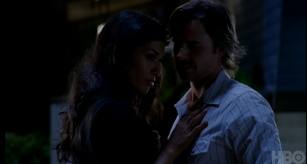

Not because she's not ready to stay the night with Sam or for them to be an official item (although that may well the be the case), but because she felt her baby girl Emma may not be. Luna and Sam both displayed the emotional maturity required to take their budding relationship slow; let's hope the snarling wolf that confronted Sam just as the van carrying Luna and Emma home drove up the Merlotte's driveway towards the parish road and out of view doesn't put the permanent brakes on this promising couple!

Last but not least, we've got fairy-costumed Holly, who, despite (or maybe because of) her mental and physical exhaustion brought on by the drama of the night had the gumption to tell it like it is to a persistent, Halloween bouquet-toting Andy Bellefleur.

Here's the dialogue courtesy of Television Without Pity

Andy: "Sorry about the last time, when I took your flowers."
Holly: "That's okay, you were nervous."
Andy: "No, I was a drug addict. V. thought I needed it to do the job, and to talk pretty ladies like you... So I didn't feel like a loser all the time. It worked for a while, then it didn't."
Holly, wearily: "Okay look, honey. You're really sweet and everything, but this is all just too much for me right now."
Andy: "It's no problem. Lot of baggage, I get it. I just wanted to say that I'm sober and I'm lonely. And I can be good to someone if they let me. 'Night."


After taking in and weighing what he had to say, Holly asked Sheriff Andy for a much-needed hug, which I think may have been balm for both their souls. I look forward to seeing what will come next for these two, and if the kind of "rigorous honesty" the tragically doomed Debbie Pelt had talked about having with Alcide might prevail for both of them; given their respective pasts (Holly as a survivor of sexual assault and Andy as a recovering addict) should they become involved.

Now, the above is not to suggest that self-actualization and being in relationship are mutually exclusive. In fact, as the introduction to the section on self-in-relation in the book Weaving the Visions: New Patterns in Feminist Spirituality asserts, the idea of self as relational is prominent in feminist thinking.

The concept of the relational self has not caught on in the traditions of dominant Euro-Western philosophy and theology in which Descartes's' vision of the self as essentially rational, disembodied, and solitary holds sway. From this perspective, it is easy to see how relationships could be seen as detrimental to the growth and development of the self - especially for women - whose stereotyped roles as nurturers and caregivers of others threaten to swallow us alive.

Another vision of the self suggests that we are by nature embodied, passionaterelational, and communal. Many feminist adhering to this viewpoint stress that identity is found in community. Black womanist theologian Delores S. Williams coined the term "relational interdependence" to name Black women's struggles for freedom from racist and sexist stereotypes within the context of relationships, family, and community. In this view, women's independence is relational.

There is no you without me; no me without you. The self is forged in relationship.

Even so, drawing healthy boundaries for the relationships that structure our lives and bind us to others is necessary, and it's refreshing to see the women of True Blood taking these steps - and their men responding in kind!

Yours in TB withdrawal...

~ Rachel

Monday, August 1, 2011

Pam's Taken the Veil

So Pam's taken the veil.


And last night, she was hiding under a blanket to evade Eric's gaze when they were thrown in King Bill's subterranean slammer together.

Did she really have much of a choice?

Ever the style maven, last week's Pam—dressed in funerary black lace with a heavy veil covering her decaying face (“Even when her face is putrefying, she comes up with an outfit for putrefying,” Kristen Bauer van Straten remarked in an interview posted to The Vault)—had to deal with the aftermath of a spell cast on her by possessed witch Marnie that has caused her immortal vampire body to rot.

And this week, it's only gotten worse!

I found it interesting that HBO on Demand's description of last Sunday's episode, Me and the Devil, makes mention of this fact with the phrase, "Pam takes the veil".

What's so intriguing about this verbiage?

Thefreedictionary.com defines this term as the life or vows of a nun.

And when I think of  becoming a nun, one of the first mental pictures that comes to mind is that of a woman retreating from the world and hiding (or being confined) behind the imposing walls of the convent.

Let's take a look at thefreedictionary.com's definition of veil:

veil
n.
1. A length of cloth worn by women over the head, shoulders, and often the face.
2. A length of netting attached to a woman's hat or habit, worn for decoration or to protect the head and face.
3. The part of a nun's headdress that frames the face and falls over the shoulders.
4.
a. A piece of light fabric hung to separate or conceal what is behind it; a curtain.
b. Something that conceals, separates, or screens like a curtain: a veil of secrecy.
v. veiled, veil·ing, veils
v.tr.
1. To cover with or as if with a veil: Dense fog veiled the bridge.
2. To conceal or disguise.

One word in particular is repeated over and over: conceal.

This is significant because it speaks to what a woman must do when her beauty is marred. She must hide, separate, screen herself off. As The Vault interview "Kristin Bauer talks about her 'face-off' states, "Having her skin peel off in ribbons of goo is a massive blow for Pam"; an affront to her vanity.

And for a woman whose priorities include Eric and her appearance (not always in that order), this presents quite the predicament.

Pam: "I can put up with a lot, but fuck with my face and it's time to die!" S4E5 Me and the Devil

To understand why this fate is worse for Pam than, say, her maker's would be, let's take a moment to consider the core difference between the spells the possessed Marnie cast on both vampires.

The spell cast on Eric wiped clean his mind, that part of the self envisaged in Cartesian dualism as being characteristically male. The one cast on Pam disfigured her body, that which is associated with the female; the second-mentioned and therefore lesser valued of the male/female pair of lhierarchical dualisms.

Applying this framework of gendered hierarchical dualisms, the biblical Adam is revealed as a soul type, while Eve is of the flesh (Stone, 1976). In Christian theology, it was asserted that women must become more "like a man" (more "rational" and "spiritual" than is her "nature") to come into relationship with God, who was envisaged as masculine.

Feminist scholar Carol Christ writes that according to poet, essayist and feminist Adrienne Rich, such views have made the body "so problematic for women that it often seemed easier to shrug if off and travel as a disembodied spirit" (1997, p. 148). If only it were so easy for Pam; if only she could escape the prison of her rotting flesh like her ghostly harasser Antonia has. But there can be no such simple solution for Pam. As a woman, she is, as Rich writes, controlled by being lashed to her body - "the carnal flesh to which the elevated mind is shackled" (Sanchez-Grant, 2008, p. 78).

As Sanchez-Grant writes, if the mind is allied with culture and reason, it follows that the body is associated with all that is "other"; if woman is inextricably associated with the body, and the body is regarded as inferior to the mind - then surely woman is the inferior Other.

This theme has run through several of my last posts.

That's why the curse Marnie (under Antonia's influence) uttered, "Corrupt unsanctified corpse who walks behold your true self" is so torturous for Pam; for woman, dualism insists that the body is the true self, the essentialized ground of our being.

Under this logic, had the spell beset Pam's mind as the one cast on Eric did, it wouldn't be so bad.

This sexist construction of gender holds that the [feminine] body is entirely separate from the true inner self.

Intriguingly, under the witch's magic, amnesia Eric has become more endearing - he's playful, gentle, contrite for past offenses; he openly displays emotion and seems perhaps more his authentic self.

You know something? The more I think about it, maybe in his current state amnesia Eric is even more than his authentic self. He seems transcendent, self-sacrificing. Godric-like, even.

And he gets the girl, since he is more attractive to Sookie than when he is cold, cruel and calculating, swaggering "real" Eric.

While it's true that he must hide in Sookie's house for fear his vulnerable state may make him an easy target for anyone gunning for him (i.e. the witches, Bill, etc.) Pam must truly hide behind a mourning shroud - lamenting the death of her "true" self since the face a woman shows the world is how she is judged.

This connects to Sam Trammell's uneasiness at his character's yelling "damn, you're ugly" at a female bar patron as he crashed into Merlotte's fresh off his bender; hung over, agitated, and over-the-top belligerent. In my post on Dragon * Con 2010 I noted that it seemed Mr. Trammell sensed the egregiousness of assailing a woman's appearance, since aside from impugning her sexuality (i.e. labelling her as promiscuous, a whore, a "dyke", etc.) it's is one of the most cutting attacks someone can level at a female in our culture.

And here's a (depressing) dose of reality: Nearly half of men questioned in a recent poll of 70,000 people said they would ditch a partner who gained weight, compared to only 20 percent of women. Talk about how the body "feeds" identity, how a woman's "corporeal experience" influences her overall experience (Sanchez-Grant, 2008)!

Pam's own maker has made constant reference to how he could never harm Sookie because she is so beautiful. Where you suprised that in last night's I Wish I Was the Moon Eric recoiled only slightly from Pam, that he didn't all-out reject her ruined visage?

She has become the dreaded Rotting Goddess.


Hecate, She who repels. "A hideous hag and flesh-eating ghoul, her skin pallid and decaying, her robes a shroud...the repository for all the dark and fearsome forces of the feminine divine" (Ward, 2006, pp. 152-153).

She is Rot. Ooze and decay may have no place in the life of the disembodied [rational, male] mind, yet the messiness of birth, sex, and death - the cycle of embodied life - refuses to disappear. This is Hecate's realm. To exhume Her is to face the death aspect of the Goddess and the fusion of need and fear She arouses.

According to Ward (2006), the fear we projected of the Rotting Goddess onto witches long ago we now put onto ordinary women. He writes:
I get a flicker of something vile when I contemplate the image of the Rotting Goddess. She viscerally repels me, yet draws me, as if she holds a secret for me inside her fetid mouth, a flicker of truth about men's revulsion towards feminine flesh. I remember a friend of mine - he was only in high school at the time, and yet he understood this all too well - he told me he had found an easy way to break up with a girlfriend after he no longer wanted to be with her. When they started making out he said he would keep his eyes open, and he would just examine her, as if through a microscope. He would stare at the glistening pores, pimples, blackheads, the creases, hairs, erupting moles and folded skin. He would feel nauseated, and that would be the end of his attraction for her. In my 20s, in India and Thailand, I learned Buddhist techniques for eliminating sexual desire that followed much the same course. I was instructed to imagine a woman's body split up into five heaps of skin, nails, hair, teeth and internal organs, or to visualize a woman as nothing but sacks of blood and pus and shit. Feel sexual desire for that? Thus men learn that it is to treat women like dirt (as matter, not Mater) and break their spell over us.
WOW.

Perhaps, in her current spellbound state, Pam can teach us about how men at large have been socialized to see women.

References

Christ, C.(1997) Rebirth of the goddess.  New York: Routledge.

Sanchez-Grant (2008).  The Female Body in Margaret Atwood's The Edible Woman and Lady Oracle. Journal of International Women’s Studies, 9, #2, 77-92

Ward, T. (2006). Savage breast: One man’s search for the goddess. New York: O Books.

Thursday, July 28, 2011

I am your daddy and I'm gonna teach you how to hunt, shoot, trap and fish and…and how to take clothes out of the dryer

So a bathrobed Terry Bellefleur promised the baby boy he cradled in his arms in I'm Alive and On Fire. Contrast his words with Melinda Mickens’ to her prodigal son Tommy when they were reunited after a time apart: “Don’t you cry too, you’ve gotta be the man”.

Do you see a difference in terms of the image of manhood and masculinity; what it means to grow up and be male in our culture conveyed by these scenes? I do. 

On the one hand, we've got a sensitive father figure imagining aloud his future as a male role model for his wife's son Mikey who, although not his child biologically, he is raising as his own. They'll do all kinds of typical red-blooded American outdoorsy guy stuff together, and yeah, he'll show his boy how to do things that until recently were reserved for the domestic womanly sphere, too.

And on the other, we've got a [conniving and manipulative in her own right] mother trapped in an abusive patriarchal marriage encouraging her son to adhere to more retro-rigid models of masculinity and repress his emotions. 

We need different – more like new - images of maleness and masculinity to replace the ones that reassert the genderized ethos of domination, as Tommy’s mom does when she entreats him to bottle up his feelings, dry up his tears.

In the words of womanist midwife (and professor of women’s studies at my alma mater, the California Institute of Integral StudiesArisika Razak:
The last time I checked, men had tear ducts. They had arms for holding babies.They cared about their children. And they cried at births. (1991, p. 172)
Maybe she was checking Season 4 of True Blood!

tear ducts - check!

arms for holding babies - check!

caring about children - check!

The current season of True Blood - and the episode I'm Alive and On Fire specifically - have delivered several such images that run counter to our culture's image of male heroes as warriors, conquerors of women and nature; a picture of masculinity a growing number of men are increasingly uncomfortable with.

Take Eric, for instance.
No, no no - not that Eric....


...the new Eric.
Nope, wrong again! Not the jogging suited Eric of Season 2 who showed up freshly shorn at the Forever 21-esque boutique where Bill was shopping for Jessica, declaring, "it's the new me".
I'm talking about the new-new Eric. Amnesia Eric. He's contemplative. Playful. Vulnerable, even. And seemingly contrite for the sins of his [distant & more recent] past. Sookie sees the change, noticing out loud to Eric, "It's just that you weren't always like this; gentle, sweet, but it suits you.” (S4E5 Me and the Devil)

Indeed, this [perhaps temporary] version of the Viking, Eric 2.0 seems light years away from the swaggering, coldly calculating, at-times viciously cruel (or as Sookie said in last week's episode, the "smug sarcastic ass") side of the vampire sheriff we have come to know best.
YOU LIKE?
*Sorry, couldn't resist adding that in - truebies will get the reference!.
Sookie certainly seems to. Yet despite her obvious warming to him, Eric doubts himself. Something deep within him knows that he has drifted from society's expectations of an [alpha] male and he fears Sookie will reject him for it.

In the I'm Alive and on Fire scene below, Sookie climbs down into her basement cubby to rouse the uncharacteristically [for the Eric she thinks she knows] morose vampire moping there. She comments that the "real" Eric would not be so down. He begs to differ, replying in protest, "I AM real".  
This exchange is particularly relevant to the point I'm trying to make about True Blood offering up new, more expansive images of masculinity:

Eric: You think I'm weak.
Sookie: No.
Eric: You want the Eric that doesn't feel.
Sookie: It's not that.

Feminist scholar and CIIS professor Carol Christ (1997, p. 161) writes:
Rooted in the ethos of the warrior, modern societies have been described as "dominator cultures" by cultural historian (also on the CIIS faculty) Riane Eisler. The ethos of dominator cultures states that power stems from control. Dominators are taught to control women, nature, children, animals, other men, their own bodies, and their feelings and sensations. The ethos of domination denies or disparages human embodiment, relationship, and interdependence. In the ethos of dominator cultures, finitude, vulnerability, and limitation are called weaknesses.  
We've seen Eric's emotional side before; with Godric, Pam, even with Sookie. But this new openness to feeling, this often being lost in emotive reverie stuff would likely not have jived too well with his human life as a Nordic warrior - or with his present duties as a figure of considerable authority amidst the shifting sands of the cutthroat vampire hierarchy.

It must feel strange and unsettling to Eric; like weakness. On the contrary, in the new Eric I see an image of masculinity that's a step towards changing the patterns of domination that govern our lives and society.
"In a society that wishes us to see men as devoid of feelings,
let us hold an image of men as nurturers (Razak, 1991, p. 172)
And then, we've got Terry who - as we wrote on our Forum's Scope page - describes himself as "a nurturer". This seems an odd juxtaposition with his military background, since the military identity tends to be traditionally hypermasculine in the U.S.  
In Christ's thinking, military training figures prominently in the indoctrination into dominator cultures; into the way such social systems define masculinity and power. "Manhood" is equated with the denial of Eros (defined as a transformative force of intelligent, embodied love which connects us to each other and the web of life) and its replacement with violence. Feminist political scientist Judith Hicks Stieham's quote underscores her point:
The appeal to manhood is very much part of military training...the familiar "This is my rifle, this is my gun [pointing to the penis], one is for killing, one is for fun." (1997, p.162)
The ethos of this institution that breaks down young men's defenses (that which connects them with others) in order to turn "boys" into "men" who readily submit to authority and are prepared to kill has permeated the whole of our culture. In the rituals of daily life we reenact its basic training.

Christ ponders, what would happen if all the energy and resources (money and human capital) spent on war and the cost of repairing its damages were instead devoted to the nurturing of life?

Razak (1991) proposes that new images can be created by men who participate in childbirth and affirm themselves as nurturers of life. Could Terry as a wounded warrior/ wounded healer - someone who [usually, except for that whole Arlene pregnancy thing] responds well to the emotions needs of others, doesn't shy away from holding another wounded man in his embrace, and finds fulfillment in nurturing family life - be seen as positing a new model of maleness? And a particularly potent image of masculinity for our times, at that, given that scores of battle-worn soldiers will soon be returning to our shores from the Iraq and Afghanistan fronts? 

And finally, there's everyone's favorite shape-shifting bar owner, Sam Merlotte. Sure, he's interested in pursuing a romantic relationship with Luna, so getting on her daughter's good side just makes good sense. But did you notice that initially, Luna seemed hesitant to even let Sam know she had a daughter; much less let him meet or get close to her?

Luna's shady behavior when he showed up at her door to return her seducing favor almost led me to believe that she was harboring not a pint-sized dynamo of a kid, but another man inside. Her leeriness to allow a strange man into her daughter's life is perfectly understandable; she's instinctively protecting her child, and part of her probably thought Sam would bolt at the sight of such "baggage".

But he proved her wrong! Sam was immediately at ease with Luna's daughter, crouching down to ask her, "which Barbie doll do I get, I hope she has a bunch of pretty dresses." If a rugged, scruffy-sexy guy sitting on the floor playing with Barbies isn't masculinity stereotype busting, I don't know what is!
Children are usually pretty adept judges of character; from the image to the right, it appears as though Luna's daughter has given Sam her stamp of approval. She can probably sense his genuine vibe.
Men in our culture are not raised to see themselves as relational; they have long been socialized to accept the model of the linear hero’s journey in which others he meets along the path are seen as either assets or barriers to his achieving his purpose.

As Christ writes, many thinkers have portrayed “man” as an isolated rational and moral individual – an island, if you will – and have posited an intrinsic opposition between the self and others who are perceived as impinging upon the freedom of the self. This ideal “independent self” of traditional philosophies and theologies can be seen as a fiction.

Theologian Martin Buber says, there is no “I” without a “Thou”, no self that is not created in relationship with others.

The basic word I-You can only be spoken with one’s whole being. The concentration and fusion into a whole being can never be accomplished by me, can never be accomplished without me. I require a You to become, becoming I, I say You. All actual life is encounter. (Christ, 1997, p. 137)
Buber states further that it is wrong to say that first we “are” and then we “enter into” relationships. "Rather, the longing for relation is primary, the cupped hand into which the being that confronts us nestles…In the beginning is the relation – as the category of being, as readiness, as a form that reaches out to be filled" (Christ, 1997, p. 137).

Too often, the models for being extended to men are more accurately represented by a closed fist than by an open hand reaching out to clasp with another. 

The men of True Blood profiled here - at least in their current incarnations - seem to have hands open and outstretched; they seem ready for relationship, for conceiving of themselves as relational. 

We absolutely need new images, integral models of maleness and masculinity, but, as Razak (1991, p. 165) writes, we must also answer "the critical need our society has to make a new model for human interaction". My eyes are glued to True Blood for what I hope will be a continuing stream of alternative images that can add to the discourse in this regard.

~ Rachel    
References
Christ, C.(1997) Rebirth of the goddess.  New York: Routledge.

Razak, A. (1991). Toward a Womanist analysis of birth. In Diamond, I. & Orenstein, G.F. (Eds.), Reweaving the world: The emergence of ecofeminism. (pp. 165-172). San Francisco: Sierra Club Books. 

Wednesday, July 20, 2011

"You Smell Like Dinner"

Your blood tastes like freedom, Sookie; like sunshine in a pretty blond bottle.
                                                                            ~Eric Northman

As I sit here nursing a ginger ale on the rocks, I wonder if maybe it isn't high time for Sookie to start wearing a different eu de toilette. I mean, after all, Eric isn't the only one who has "complimented" her on her scent, in a more-menacing-than-admiring kind of way. You haven't forgotten Liam's "Man, she smells fuckin' sweet!" (S1E3 Mine), have you? I doubt Sookie has, either.


Thing is, there's no lotion, potion, body splash, perfume, or other such fragrance-emitting product that's responsible for the way Sookie smells.

In Season 3 Sookie began to struggle with her identity and self-worth after discovering that it's her blood - and its scent and taste; the delicate bouquet (in S4E3 If You Love Me, Why Am I Dyin'? Eric sniffs the air, catching her perfume which he can only describe as being "Like wheat, honey and sunlight") and exquisite flavor of it that has drawn Bill, and perhaps others as well, to her. She starts to think that it's not her - not who she is, but how she tastes; how her blood can service others - that matters. She's just the [pretty] packaging. 

And everyone, meaning every supe, has noticed. Her special palate, that is - although perhaps one might be sensitive to her growing sense of self-doubt, too.

Lorena may have hated Sookie, but she sure didn't mind her taste: "No wonder Bill was drawn to you. You're delicious.” (S3E7 Hitting the Ground).

While Bill insisted to Sookie, "it is not your blood I love. I love you. Your heart, your mind, your soul... you have brought light back into my life", he did admit that hers was, "the most delicious blood I've ever tasted" (S3E10 I Smell A Rat).

Last season, upon meeting Sookie - decked out in a lacy white top and cute denim mini; looking as much the fish out of water at Lou Pines as anyone likely could - Alcide's werewolf bouncer buddy eyed her up and down and quipped, "you look like dinner". In the next scene, if you recall, she was nearly sexually assaulted.

Even good 'ol Sam's thoughts echoed this "you smell good enough to eat" theme when Sookie listened in on him during their G-rated Season 1 canoodle in his office. Is that really any wonder, though, since his go-to shift is a collie, and we all know that man's best friend's nose is a mighty powerful organ! Even still, knowing that her smell is probably a big part of what caused her sexy boss to pine over her for so long has got to be quite a blow for Sookie. 

And the list goes on. The cavalcade of vamps, weres, and shifters itching to get a taste of Sookie seems virtually never ending.

We may well be onto something here, as if the episode's title alone wasn't enough of a hint. In her essay, "The Female Body in Margaret Atwood's The Edible Woman and Lady Oracle" Sofia Sanchez-Grant points out society's view that the (patriarchally encoded) female body is consumable.

And not just Sookie's body.

Other women are consumable commodities, too.

Now, of course, I know men are fed on as well, I do watch the show; but I think the sociocultural meaning of some of the examples I've pulled out here makes the consumption of females a little different.

Remember how Eric paid a "blood hooker" so that he could feed on her - and he seemed to prefer that she struggle and pretend that she didn't want it?


And when he consumed Hadley against her will as leverage to get her paramour the Queen to reveal  information about Sookie, he rated the other Stackhouse girl's taste like he was reviewing a take-out joint for the local paper: "Mmm-mmm. I 'd give her three stars." (S3E7 Hitting the Ground).


Speaking of take-out joints, perhaps you'll recall how Russell and Lorena deliberated before commanding Bill to procure a woman from a strip club for their dining pleasure, just like they were ordering off a Chinese food menu:

Russell: In the mood for anything in particular?
Lorena: Someone smoky. Not too fatty.
Russell: See, I was thinking... ethnic.
Lorena: Mm.
(S3E4 9 Crimes)

Once procured, they feasted on this "disposable sex worker" with relish - her blood running out of their limo and onto the ground like a perverse chocolate fountain.


Russell's appetite for "something ethnic" calls to mind the language of "gastronomic sexuality" Raquel Z. Rivera (2003, p. 129) describes as being part of the hip-hop lexicon when it comes to the "sweet, thick, pretty, round and various shades of brown...blackberry molasses to butta pecan" women that populate many rap music videos.

If you remember dancing to Big Pun's hit "Still Not A Player" in the clubs back in the late '90's like I do, you know that blackberry molasses to butta pecan reference above alludes to this song. The line's actually, "I love from butta pecan to blackberry molass' I don't discriminate, I regulate every shade of that ass".

Back in S4E1 the drunkard hanging around the back alley near the cagefighting ring tossed similar language at Tara and Naomi, labeling them for his consuming gaze as: "...some of that chocolate banana swirl...every woman's got a price".


In her essay, "Butta Pecan Mamis: Tropicalized Mamis - 'Chocolate Caliente'" Rivera points out that while the video's camerawork alternating between groups of lighter and comparatively darker-skinned women in order to punctuate the singsong chorus, "Boriqua, Morena" is meant to distinguish between these two groups of women, they come together by virtue of Pun's sexual desire.

According to Rivera, these women are eroticized and exoticized, as Pun lays claim to both Puerto Rican and African American "ghetto brunettes". Boriquas and morenas, "brown" women and "black" women may be distinct, but as he and other artists including Jay Z ("Who You Witt II") and Son Doobie ("XXX Funk") construct them, they are part of a commercialized landscape of desire. Sistas and mamis are "their" women to be consumed.  

Here we have the beginnings of the transcultural reality of the "I-want-them-all" mentality, where women are not real subjects, complex and distinct, but interchangeable; "infinitely substitutable beings" (p. 145).

Tim Ward illustrates this concept clearly. In his book Savage Breast: One Man's Search for the Goddess (2005, p. 28) he recalls a translation of old Tibetan meditations that contained his ultimate sexual fantasy:
The sutra instructed the reader to visualize a Bodhisattva sitting in meditation while he projects 200 emanations of himself, each one appearing to a dakini, a powerful and beautiful female spirit. Immediately the 200 dakinis become sexually magnetized to his 200 emanations, and they couple in passionate embrace. To each feminine spirit, the Bodhisattva appears as if he is the only one, and each of them gives herself completely to him. But the true Bodhisattva, he sits alone in his meditation in perfect detached repose. I realized that this was my fantasy, to have every beautiful woman magnetized to me so I could enjoy them all, while giving myself emotionally to none of them. That's what I wanted with the women I had affairs with. Not that I ever once said that I loved them, ever once tried to fool them. Is that evil? I don't know. I don't think so. Is it shitty? Well, I imagine the dakinis would be pretty pissed off at the Bodhisattva is they knew... 
He wanted them all - all for his consumption.

In the sphere of the commercial consumption of female sexuality, women are "indispensible as members of the collective at the core of male pleasure - females, honeys, hotties, bitches, hoes, freaks, chickenheads, pigeons, chicks - they are branded with the 'mark of the plural' that makes them expendable and easily substitutable as individuals" (Rivera, 2003, p. 147).   

Sookie deflects Eric's characterization of her as being consumable; his leering gaze as he utters the phrase, "Well, aren't you sweet" suggesting that she is, in fact, as Rivera (2003, p. 127) writes of the six chocolate-drenched young women [of color - chocolate caliente] swirling in a cup of hot cocoa on the cover of the 1998 rap album The Rude Awakening "sexily awaiting ingestion". Sookie replies, "Not really." (S1E4 Escape from Dragon House)

So she's seen as consumable alright, even though she's like not to be - but perhaps not so interchangable. There's something different about her that sets her apart, that makes her extra-special-tasty. References to Sookie's "sweetness" are constant; no doubt, they are a marker of her "alignment with the good" which makes her not unlike Dracula's Mina Harker. In the words of the character Abraham Van Helsing, the fictional Mina is:
...one of God's women, fashioned by His own hand to show us men and other women that there is a Heaven where we can enter, and that its light [emphasis mine, sound familiar?] can be here on earth...so true, so sweet, so noble...(p. 226)
According to Susan Parlour (2009), the text of Dracula is littered with references to Mina's sweetness, who, though she transgressed the role of women in Victorian society to a certain degree, was readmitted to the patriarchal machine due, largely in part, to her sexual reticence and acceptance of the sexual mores and etiquette of the times.

Likewise, might Sookie be seen as an avatar of virtuous and virginal [white] womanhood? After all, according to prevailing stereotypes at least, women of color are more primal and sexual but in the world of True Blood the taste of virgin blood is the best of all, second only to baby's blood. When she was a virgin, Sookie's blood was covetted, to be sure...but like butta pecanness, her fairy blood's got an enticing flavor all its own that makes her a highly sought after commodity.       

She does it again, thowing off amnesia Eric's hungry advances in Season 4's 3rd episode, yelling at him, "I'm not your fucking dinner!". Later in the episode, she reminds Eric of how he tasted her against her will; that he basically "fang raped" her. He seemed genuinely taken aback and sorry.

Must we be seen as essentially edible? And if we are, does this essentialism isolate us within our conmumable bodies from other facets of ourselves, i.e. the "masculine" brain and the "feminine" body?

Atwood's character Joan rejects the multi-breasted Diana of Ephesus as a symbol of "the essence of femininity itself"(2003, p. 80).


It is, rather, a "paradigm of the patriarchally controlled female body"  (2003, p. 80):
She had a serene face, perched on top of a body shaped like a mound of grapes. She was draped in breasts from neck to ankle, as though inflicted with a case of yaws: little breasts at top and bottom, big ones around the middle. The nipples were equipped with sprouts, but several of the breasts were out of order.
I stood licking my ice-cream cone, watching the goddess coldly. Once I would have seen her as an image of myself, but not any more. My ability to give was limited, I was not inexhaustible. I was not serene, not really. I wanted things, things for myself. 
Sanchez-Grant writes that Joan's assertion is a protest against a society that situates her as a reproductive machine, suggesting as the food imagery and the character's unromantic terms imply - to be endlessly giving, to nourish and sustain others is "simply to be edible" (2003, p. 80).

My conclusion is that woman can be drained, she is not just a font of nourishment for [male] others.


Here's some other references to the edible & the consumable in You Smell Like Dinner:
  • When Sookie walked in on Jessica feeding on a man other than Hoyt in the ladies room at Fangtasia, the baby vamp spat, "I can eat who I want"
  • Bill's response to Nan Flanagan when in London, 1982, she asks him why he doesn't kill his prey: "They might be dinner but they don't deserve to die"
  • The conversation within Sam's new shifter entourage about the ethics of factory egg farming and the bourgeois attitudes of some animal rights activists
What do these themes mean to you? We'd love to hear your thoughts. Please share them in the comments space below.

~ Rachel

References


Parlour, S. (2009). Vixens and Virgins in the 19th century Anglo-Irish Novel: Representations of the feminine in Bram Stoker's Dracula. Journal of Dracula Studies, # 11.


Rivera, R. Z. (2003). New York Ricans from the Hip Hop Zone. New York: Palgrave.


Sanchez-Grant, S. (2008). The Female Body in Margaret Atwood's The Edible Woman and Lady Oracle. Journal of International Women's Studies, Vol. 9, #2.


Ward, T. (2006). Savage Breast: One Man’s Search for the Goddess. New York, NY: O Books

Friday, July 15, 2011

"She's Not There"

There's so much I could talk about when it comes to the premiere episode of True Blood Season 4, "She's Not There". What to tackle first? There's Sookie's brief Alice in Wonderland-esque hiatus in Faerie with granddaddy Earl - who himself was gone for 20 years - and the pulse-pounding escape sequence that follows. Or, maybe the "who would you rather trust, a vampire or a politician" propaganda-off between Eric and Bill. And then, of course, there's the introduction of several new supes and magical personages for us to contend with.

But most of these have already been addressed elsewhere on the web, and with so many worthy and intriguing points of departure for contemplating the new season I think I'll veer off in a different direction altogether, thank you very much!

I want to explore a feeling.

The sucking, vacant, wanting feeling several scenes of "She's Not There" inspired in me - and with such a title, is it any wonder?

Sookie's not the only one who wasn't, or isn't, there.

What happens when one goes away - and stays away - departs the premises, or withdraws emotionally? How do those left behind deal?

Let's plumb this pattern of "not being there" a little deeper, shall we?

Arlene's not there, not really, for her son Mikey. She fears him; what's in him, what he is, how he reminds her of René. The guilt is killing her, and she professes to love Mikey, but she doesn't fully, she can't. How will her emotional distancing impact her baby boy, her new marriage with Terry, her sense of self? Will this darkness leach into her parenting of Coby and Lisa? As Terry (over?)identifies with Mikey, claiming him as his true son, will he begin to drift from Arlene? Will they become isolated in their troubles?

When someone withdraws from, or isn't there - fully present - in a relationship or community, tension and resentment are inevitable, whether the missing party returns or lingers, partly detached, not truly invested.

Conflict breaks out.

Images of sparring or downright pummelling were everywhere in "She's Not There"...

...from Tara (or Toni?!?) the cage fighter, pounding on the woman who is ostensibly her lover:


...to the colliding behemoths both Jessica and Sookie paused on while flipping the TV channels (did you notice that?!?):


And speaking of Jessica flipping through the TV stations, I gotta tell ya, the scene that unfolded between she and Hoyt, with her sitting on the couch - remote and Tru Blood in hand - as he's coming in the door from work really, really got to me. Maybe it's because I'm in a long term, committed, co-habitating relationship that I can feel their pain. Maybe it's because the person I'm in that relationship with - the man I married - is the one and only romantic partner I've had since I was 17, the age at which Jessica was turned and that she will remain for all time. So perhaps I feel a certain sense of kinship with her.

But, man - o -man, did that scene throw me for a loop. As the scene played out, I could hardly believe my eyes and ears. Who was that angry, resentful Hoyt, and where did he come from? How could their happy relationship devolve, dissolve this way? How could they verbally tear at each other so?

Some deeper, more allegorical questions took shape in my mind later.

Alan Ball has repeatedly stated that True Blood delves into the "terrors of intimacy"; here, I see a foray into the "terrors of domesticity" - and what can happen when the shine on a brand-spanking-new relationship dulls with time and apathy.

Hoyt: "You remember I eat, right? Like, food? Be nice to have some in the house".
Jessica: "You remember I don't eat, right?" (referring to human food) "It's all dead, permanently, forever, dead". 

What happens when what feeds one partner doesn't feed - or even revolts - the other? When one's hunger is not satiated in the relationship? Where can common ground be found? If one or both of them is looking for something outside of the relationship, are either of them really there?

On their post-fight date night at Fangtasia, Hoyt apologizes to Jessica for losing his temper with her; she says she's sorry too but she can't help staring at another man upon whom she wishes to feed from across the room. The smell of the "O neg with a twist of B pos" cocktail Hoyt buys for her at the bar turns her stomach. We know Tru Blood isn't enough for her; she can subsist on it - barely - but she's not living, not really.

And Pam, in the very special way that only Pam can - points this out to Jessica, remarking that if she's asking Hoyt to bring her to Fangtasia, their relationship probably isn't enough for her. Pam more than alludes to the idea that for Jessica, living with Hoyt is not normal or natural; it's not enough. Is she right? Do Jessica and Hoyt have irreconcilable differences?

Believe me, I totally understand the concept of the honeymoon being over, and that puppy-love doesn't last. But there was just something so sharp and jabbing about Hoyt and Jessica's ways of being towards one another that was totally jarring for me.

I can't help but hear the words to "Losing a Whole Year" by one of my favorite bands, Third Eye Blind, when I think about this scene. Not only is the title appropriate for this episode, but the lyrics are so choked with bitterness that I feel the song captures its emotional tenor, unfortunately, all too well.

I remember you and me used to spend the whole goddamned day in bed
lying in your room we'd lay like dogs
and the phone would ring like a joke that's left unsaid...

...and now I realized that you never heard
one goddamned word I ever said.
It always seemed the juice used to flow
in the car, in the kitchen you were good to go...

...now we're stuck with the tube
a sink full of dishes and some aqualube.

And if it's not the defense then you're on the attack...


And what about that freaky baby doll? It wasn't shown in "She's Not There" but it came back into play in a subsequent episode...could it represent that gangrenous appendage that infects, insidiously rots a relationship away from the inside out?


You know, the meddlesome in-laws...

Jessica: "I'm cooking for ya. Just like your mama."
Hoyt: "Look, don't bring her into this. That woman's dead to me".
Jessica: "Yeah, and if her aim were any better, I'd be a pile of goo and she'd be making your eggs".

...or money, or sex, or jobs...or just different expectations of what makes for a fulfilling and happy life. Can that diseased element of a relationship - the thing we find ourselves fighting about most - be excised, or at least worked around, or through?

The fact that this disturbing scene ended with both Hoyt and Jessica laughing - being able to find a common ground of humor and caring in spite of their conflict - gave me hope that there is still something of their original connection to build upon and salvage what they've got together. I do believe they love each other, but sometimes love isn't enough.

And what about when the life you've got isn't enough; when it's left you feeling vulnerable, exposed, traumatized?

Tara has responded by leaving it behind. All of it. Her friends. Her family. Her job. Her town. Her look. Her name.

She has taken on a new identity, a new life. But it seems to me that she's not really there for it. She's got a girlfriend, Naomi, who seems to truly care for her, but doesn't know her - anything at all about her, who she really is. I get it that we are all in constant states of flux, that there is no core, base, true self - that our entire lives are journeys of discovery. And not in the sense of a linear trajectory bringing us through a progression of trials and tribulations until we find ourselves; our real, true, selves. We are constantly in the process of becoming, until the day we die.

It was my favorite poet, afterall - the sage Walt Whitman, who wrote in his masterwork Leaves of Grass:

Do I contradict myself? Very well, then I contradict myself, I am large, I contain multitudes.
We may very well all contain multitudes - but which of her multitudes is Tara revealing to Naomi, what of herself is she sharing? Naomi believes her to be Toni, from Atlanta. And while it's possible that Tara may be bisexual or lesbian - that the Tara we have known throughout True Blood's run thus far, is a front, a facade - honestly, there has never been any hint that Tara might be gay. Is her sexual relationship with Naomi just another part of her escape? How can Tara be present in their relationship, or to herself, for that matter, if the self she shows to Naomi is a fabrication woven as a protecting wrapping against her past?

Now, we know that Tara has been fighting an internal battle for quite some time...


...but now, with all she has done to sever her new self from the old, might she become lost to herself - as amnesia Eric does in subsequent episodes?

Coming back to Bon Temps and rekindling her relationships with Lafayette, Sookie and the rest may be good for her. And what of Naomi's place in her life? We'll see.

Right now, that question's sort of making me think of more "Losing A Whole Year" lyrics:

I kind of get the feeling like I'm being used...

...When you were yourself it was tasting sweet
soured into a routine deceit
well this drama is a bore...

...and I don't wanna play no more.

Sam doesn't want to play anymore, either. With guns, at least. In this episode, he spills to his shifter "anger management" group:
I knew it was wrong, even before I pulled the trigger. It was like some other person fired that gun and there was nothing I could do to stop him.
Sam feels like he wasn't there - wasn't in his body. Sam's description of this kind of "out of body experience" sounds an awful lot like dissociation - a disruption of normal psychological functioning in response to stress or trauma - that is often triggered unconsciously as a means for the self to, in essence, protect itself. To or retreat from or insulate the self against something too threatening to face. In Seasons 2 & 3 we saw that Sam does indeed have things in his past that he's running away from, actions he deeply regrets. Now he can add shooting Tommy, his own brother, to that list. Can he get back to himself in Season 4?

As the episode wound down, we found ourselves at Hot Shot with Jason, observing his friendly and good natured rapport with the youth of the town as he doled out foodstuffs from the back of his truck. He has stepped into and more than filled the vacuum left by Crystal, who is also among the missing - she's not there. Jason feels her loss. He's tired. He comments to the kids, "We really need to get your Aunt Crystal back here ASAP. Y'all could use a momma and I could use a break". When Becky asked had he spoken to Crystal, he replied, "not yet, but I can think of one or two things I'd like to tell her when I do find her". His resentment comes through. It doesn't feel good to be abandoned - to be left holding the bag. To be on the hook for other people's responsibilities.

And by the end of the show, we knew that others might soon be feeling the way that Jason felt about Crystal having taken off, disappearing, about him - since people would eventually notice that he was missing, not there, but wouldn't know why - that he was being held against his will.

I'll be interested to see how this theme carries through the rest of Season 4.

Any thoughts? Please share them in the comments space below. Thanks!

~ Rachel  

Saturday, June 25, 2011

Guest Bartending at the Mid-Atlantic Popular/American Culture Association Annual Conference to Explore Maryann & Sam's S2 Contemporization/Reversal of Primal Motifs - the Divine Female & Sacred Bull; the Goddess-Queen & her Year King consort

We've lined up another "guest bartending" gig for 2011!
  
I (Rachel) will be delivering a paper on True Blood at the Mid-Atlantic Popular/American Culture Association Annual Conference in Philadelphia this November.

Returning to the Science Fiction and Fantasy track that was my home base at the PCA/ACA conference in San Antonio this past April, I'll be addressing the Season 2 story arc that principally involved the maenad Maryann Forrester & our favorite shifter, Sam Merlotte.    

Here's the paper's title: Echoes of Goddess Culture’s Reversal and Subversion in HBO’s True Blood                 

Here's its 150 word abstract: This visual talk opens a vein on the contemporary human condition by exploring how HBO’s wildly entertaining series True Blood taps into ancient archetypes and mythologies  still pulsing in our modern psyches, flowing through―and informing―today’s cultural currents. When viewed through the lens of Goddess scholarship, the maenad Maryann Forrester’s Season 2 characterization and story arc can be seen as contemporizing the primal motifs of the Divine Female and Sacred Bull; the Goddess-Queen and her Year King consort. True Blood’s reversal of these antecedents’ key elements echoes the subversion of Goddess mythology five millennia ago as peaceful, egalitarian society was supplanted by patriarchy. Drawing upon 800,000 years of art and myth and amplifying leading voices in feminist thought, archaeomythology, and women's studies not often heard in mainstream discourse we will trace parallels between True Blood and this buried history and explore the socio-cultural implications of Goddess culture’s decline on our society.

Since Philly is just a hop, skip, and a jump away from my home in NY, I look forward to having a nice little entourage attend the conference - if you live nearby or just feel like visiting the City of Brotherly Love, why don't you stop by the Pierced Pomegranate Tavern when we set up shop there this fall!

~ Rachel