Thirsty for a Fresh Take on All Things True Blood?

WELCOME! Thirsty for a fresh take on all things True Blood? Pull up a virtual barstool at the Pierced Pomegranate Tavern where sisters Rachel and Rebecca are serving up juicy feminist analysis with a twist and opening a vein of thoughtful sociocultural dialogue on HBO's hit series.

Like the epic literary salons of eras past - theaters for conversation and debate which were, incidentally, started and run by women; where the spirited debate about the issues of the day ran as copiously as the actual spirits did - but updated for the digital age, the Pierced Pomegranate Tavern is a fun forum for exploring questions ripe for discourse about the human condition & today's most crucial social issues through the medium of True Blood.

Your salonnières are not peddling liquor per se, but they are offering up new and alternative ideas informed by such diverse influences as pop culture, art, music, cultural history, Goddess studies, transformative theory, literature and poetry, and archaeomythology, filtered through the sieve of their own lived experiences as feminist women of a particular age, background, and culture.

This is a space where you - patrons and passersby alike - can view and engage with these perspectives through the lens of True Blood and contribute your own thoughts. So, no matter if you're a Truebie or a more casual viewer of True Blood, or your drink of choice is a pomegranate martini - one of Rachel's favorite cocktails to drink and Rebecca's to mix - an herbal tea, a frothy double mocha latte, or a can of Fresca (wink, wink) you're invited to join the conversation on the show's complexities in a way that can spark transformation.

Hopefully you'll find something to sink your teeth...err...straw, into! PLEASE ENJOY RESPONSIBLY ;-)

YOU'VE BEEN SERVED (A WARNING)...

The Pierced Pomegranate Tavern is dedicated to exploring social issues and more through the lens of True Blood. As such, you may encounter:

*SPOILERS
*TRIGGERS
related to the often provocative and adult themes presented by the show

If you choose to enter and participate in this virtual salon, please be prepared to do so in a thoughtful, respectful, and mature fashion with the above in mind. Click here to check out our comment policy. Thanks!

Disclaimer

No copyright infringement is intended, all rights to True Blood belong to HBO, credit is ascribed to sites where images appearing here were originally found.

Showing posts with label Arlene. Show all posts

Thursday, July 28, 2011

I am your daddy and I'm gonna teach you how to hunt, shoot, trap and fish and…and how to take clothes out of the dryer

So a bathrobed Terry Bellefleur promised the baby boy he cradled in his arms in I'm Alive and On Fire. Contrast his words with Melinda Mickens’ to her prodigal son Tommy when they were reunited after a time apart: “Don’t you cry too, you’ve gotta be the man”.

Do you see a difference in terms of the image of manhood and masculinity; what it means to grow up and be male in our culture conveyed by these scenes? I do. 

On the one hand, we've got a sensitive father figure imagining aloud his future as a male role model for his wife's son Mikey who, although not his child biologically, he is raising as his own. They'll do all kinds of typical red-blooded American outdoorsy guy stuff together, and yeah, he'll show his boy how to do things that until recently were reserved for the domestic womanly sphere, too.

And on the other, we've got a [conniving and manipulative in her own right] mother trapped in an abusive patriarchal marriage encouraging her son to adhere to more retro-rigid models of masculinity and repress his emotions. 

We need different – more like new - images of maleness and masculinity to replace the ones that reassert the genderized ethos of domination, as Tommy’s mom does when she entreats him to bottle up his feelings, dry up his tears.

In the words of womanist midwife (and professor of women’s studies at my alma mater, the California Institute of Integral Studies) Arisika Razak:
The last time I checked, men had tear ducts. They had arms for holding babies.They cared about their children. And they cried at births. (1991, p. 172)
Maybe she was checking Season 4 of True Blood!
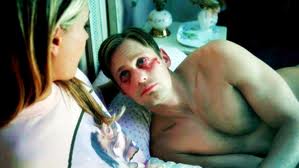
tear ducts - check!

arms for holding babies - check!

caring about children - check!

The current season of True Blood - and the episode I'm Alive and On Fire specifically - have delivered several such images that run counter to our culture's image of male heroes as warriors, conquerors of women and nature; a picture of masculinity a growing number of men are increasingly uncomfortable with.

Take Eric, for instance.
No, no no - not that Eric....


...the new Eric.
Nope, wrong again! Not the jogging suited Eric of Season 2 who showed up freshly shorn at the Forever 21-esque boutique where Bill was shopping for Jessica, declaring, "it's the new me".
I'm talking about the new-new Eric. Amnesia Eric. He's contemplative. Playful. Vulnerable, even. And seemingly contrite for the sins of his [distant & more recent] past. Sookie sees the change, noticing out loud to Eric, "It's just that you weren't always like this; gentle, sweet, but it suits you.” (S4E5 Me and the Devil)

Indeed, this [perhaps temporary] version of the Viking, Eric 2.0 seems light years away from the swaggering, coldly calculating, at-times viciously cruel (or as Sookie said in last week's episode, the "smug sarcastic ass") side of the vampire sheriff we have come to know best.
YOU LIKE?
*Sorry, couldn't resist adding that in - truebies will get the reference!.
Sookie certainly seems to. Yet despite her obvious warming to him, Eric doubts himself. Something deep within him knows that he has drifted from society's expectations of an [alpha] male and he fears Sookie will reject him for it.

In the I'm Alive and on Fire scene below, Sookie climbs down into her basement cubby to rouse the uncharacteristically [for the Eric she thinks she knows] morose vampire moping there. She comments that the "real" Eric would not be so down. He begs to differ, replying in protest, "I AM real".  
This exchange is particularly relevant to the point I'm trying to make about True Blood offering up new, more expansive images of masculinity:

Eric: You think I'm weak.
Sookie: No.
Eric: You want the Eric that doesn't feel.
Sookie: It's not that.

Feminist scholar and CIIS professor Carol Christ (1997, p. 161) writes:
Rooted in the ethos of the warrior, modern societies have been described as "dominator cultures" by cultural historian (also on the CIIS faculty) Riane Eisler. The ethos of dominator cultures states that power stems from control. Dominators are taught to control women, nature, children, animals, other men, their own bodies, and their feelings and sensations. The ethos of domination denies or disparages human embodiment, relationship, and interdependence. In the ethos of dominator cultures, finitude, vulnerability, and limitation are called weaknesses.  
We've seen Eric's emotional side before; with Godric, Pam, even with Sookie. But this new openness to feeling, this often being lost in emotive reverie stuff would likely not have jived too well with his human life as a Nordic warrior - or with his present duties as a figure of considerable authority amidst the shifting sands of the cutthroat vampire hierarchy.

It must feel strange and unsettling to Eric; like weakness. On the contrary, in the new Eric I see an image of masculinity that's a step towards changing the patterns of domination that govern our lives and society.
"In a society that wishes us to see men as devoid of feelings,
let us hold an image of men as nurturers (Razak, 1991, p. 172)
And then, we've got Terry who - as we wrote on our Forum's Scope page - describes himself as "a nurturer". This seems an odd juxtaposition with his military background, since the military identity tends to be traditionally hypermasculine in the U.S.  
In Christ's thinking, military training figures prominently in the indoctrination into dominator cultures; into the way such social systems define masculinity and power. "Manhood" is equated with the denial of Eros (defined as a transformative force of intelligent, embodied love which connects us to each other and the web of life) and its replacement with violence. Feminist political scientist Judith Hicks Stieham's quote underscores her point:
The appeal to manhood is very much part of military training...the familiar "This is my rifle, this is my gun [pointing to the penis], one is for killing, one is for fun." (1997, p.162)
The ethos of this institution that breaks down young men's defenses (that which connects them with others) in order to turn "boys" into "men" who readily submit to authority and are prepared to kill has permeated the whole of our culture. In the rituals of daily life we reenact its basic training.

Christ ponders, what would happen if all the energy and resources (money and human capital) spent on war and the cost of repairing its damages were instead devoted to the nurturing of life?

Razak (1991) proposes that new images can be created by men who participate in childbirth and affirm themselves as nurturers of life. Could Terry as a wounded warrior/ wounded healer - someone who [usually, except for that whole Arlene pregnancy thing] responds well to the emotions needs of others, doesn't shy away from holding another wounded man in his embrace, and finds fulfillment in nurturing family life - be seen as positing a new model of maleness? And a particularly potent image of masculinity for our times, at that, given that scores of battle-worn soldiers will soon be returning to our shores from the Iraq and Afghanistan fronts? 

And finally, there's everyone's favorite shape-shifting bar owner, Sam Merlotte. Sure, he's interested in pursuing a romantic relationship with Luna, so getting on her daughter's good side just makes good sense. But did you notice that initially, Luna seemed hesitant to even let Sam know she had a daughter; much less let him meet or get close to her?

Luna's shady behavior when he showed up at her door to return her seducing favor almost led me to believe that she was harboring not a pint-sized dynamo of a kid, but another man inside. Her leeriness to allow a strange man into her daughter's life is perfectly understandable; she's instinctively protecting her child, and part of her probably thought Sam would bolt at the sight of such "baggage".

But he proved her wrong! Sam was immediately at ease with Luna's daughter, crouching down to ask her, "which Barbie doll do I get, I hope she has a bunch of pretty dresses." If a rugged, scruffy-sexy guy sitting on the floor playing with Barbies isn't masculinity stereotype busting, I don't know what is!
Children are usually pretty adept judges of character; from the image to the right, it appears as though Luna's daughter has given Sam her stamp of approval. She can probably sense his genuine vibe.
Men in our culture are not raised to see themselves as relational; they have long been socialized to accept the model of the linear hero’s journey in which others he meets along the path are seen as either assets or barriers to his achieving his purpose.

As Christ writes, many thinkers have portrayed “man” as an isolated rational and moral individual – an island, if you will – and have posited an intrinsic opposition between the self and others who are perceived as impinging upon the freedom of the self. This ideal “independent self” of traditional philosophies and theologies can be seen as a fiction.

Theologian Martin Buber says, there is no “I” without a “Thou”, no self that is not created in relationship with others.

The basic word I-You can only be spoken with one’s whole being. The concentration and fusion into a whole being can never be accomplished by me, can never be accomplished without me. I require a You to become, becoming I, I say You. All actual life is encounter. (Christ, 1997, p. 137)
Buber states further that it is wrong to say that first we “are” and then we “enter into” relationships. "Rather, the longing for relation is primary, the cupped hand into which the being that confronts us nestles…In the beginning is the relation – as the category of being, as readiness, as a form that reaches out to be filled" (Christ, 1997, p. 137).

Too often, the models for being extended to men are more accurately represented by a closed fist than by an open hand reaching out to clasp with another. 

The men of True Blood profiled here - at least in their current incarnations - seem to have hands open and outstretched; they seem ready for relationship, for conceiving of themselves as relational. 

We absolutely need new images, integral models of maleness and masculinity, but, as Razak (1991, p. 165) writes, we must also answer "the critical need our society has to make a new model for human interaction". My eyes are glued to True Blood for what I hope will be a continuing stream of alternative images that can add to the discourse in this regard.

~ Rachel    
References
Christ, C.(1997) Rebirth of the goddess.  New York: Routledge.

Razak, A. (1991). Toward a Womanist analysis of birth. In Diamond, I. & Orenstein, G.F. (Eds.), Reweaving the world: The emergence of ecofeminism. (pp. 165-172). San Francisco: Sierra Club Books. 

Friday, July 15, 2011

"She's Not There"

There's so much I could talk about when it comes to the premiere episode of True Blood Season 4, "She's Not There". What to tackle first? There's Sookie's brief Alice in Wonderland-esque hiatus in Faerie with granddaddy Earl - who himself was gone for 20 years - and the pulse-pounding escape sequence that follows. Or, maybe the "who would you rather trust, a vampire or a politician" propaganda-off between Eric and Bill. And then, of course, there's the introduction of several new supes and magical personages for us to contend with.

But most of these have already been addressed elsewhere on the web, and with so many worthy and intriguing points of departure for contemplating the new season I think I'll veer off in a different direction altogether, thank you very much!

I want to explore a feeling.

The sucking, vacant, wanting feeling several scenes of "She's Not There" inspired in me - and with such a title, is it any wonder?

Sookie's not the only one who wasn't, or isn't, there.

What happens when one goes away - and stays away - departs the premises, or withdraws emotionally? How do those left behind deal?

Let's plumb this pattern of "not being there" a little deeper, shall we?

Arlene's not there, not really, for her son Mikey. She fears him; what's in him, what he is, how he reminds her of René. The guilt is killing her, and she professes to love Mikey, but she doesn't fully, she can't. How will her emotional distancing impact her baby boy, her new marriage with Terry, her sense of self? Will this darkness leach into her parenting of Coby and Lisa? As Terry (over?)identifies with Mikey, claiming him as his true son, will he begin to drift from Arlene? Will they become isolated in their troubles?

When someone withdraws from, or isn't there - fully present - in a relationship or community, tension and resentment are inevitable, whether the missing party returns or lingers, partly detached, not truly invested.

Conflict breaks out.

Images of sparring or downright pummelling were everywhere in "She's Not There"...

...from Tara (or Toni?!?) the cage fighter, pounding on the woman who is ostensibly her lover:


...to the colliding behemoths both Jessica and Sookie paused on while flipping the TV channels (did you notice that?!?):


And speaking of Jessica flipping through the TV stations, I gotta tell ya, the scene that unfolded between she and Hoyt, with her sitting on the couch - remote and Tru Blood in hand - as he's coming in the door from work really, really got to me. Maybe it's because I'm in a long term, committed, co-habitating relationship that I can feel their pain. Maybe it's because the person I'm in that relationship with - the man I married - is the one and only romantic partner I've had since I was 17, the age at which Jessica was turned and that she will remain for all time. So perhaps I feel a certain sense of kinship with her.

But, man - o -man, did that scene throw me for a loop. As the scene played out, I could hardly believe my eyes and ears. Who was that angry, resentful Hoyt, and where did he come from? How could their happy relationship devolve, dissolve this way? How could they verbally tear at each other so?

Some deeper, more allegorical questions took shape in my mind later.

Alan Ball has repeatedly stated that True Blood delves into the "terrors of intimacy"; here, I see a foray into the "terrors of domesticity" - and what can happen when the shine on a brand-spanking-new relationship dulls with time and apathy.

Hoyt: "You remember I eat, right? Like, food? Be nice to have some in the house".
Jessica: "You remember I don't eat, right?" (referring to human food) "It's all dead, permanently, forever, dead". 

What happens when what feeds one partner doesn't feed - or even revolts - the other? When one's hunger is not satiated in the relationship? Where can common ground be found? If one or both of them is looking for something outside of the relationship, are either of them really there?

On their post-fight date night at Fangtasia, Hoyt apologizes to Jessica for losing his temper with her; she says she's sorry too but she can't help staring at another man upon whom she wishes to feed from across the room. The smell of the "O neg with a twist of B pos" cocktail Hoyt buys for her at the bar turns her stomach. We know Tru Blood isn't enough for her; she can subsist on it - barely - but she's not living, not really.

And Pam, in the very special way that only Pam can - points this out to Jessica, remarking that if she's asking Hoyt to bring her to Fangtasia, their relationship probably isn't enough for her. Pam more than alludes to the idea that for Jessica, living with Hoyt is not normal or natural; it's not enough. Is she right? Do Jessica and Hoyt have irreconcilable differences?

Believe me, I totally understand the concept of the honeymoon being over, and that puppy-love doesn't last. But there was just something so sharp and jabbing about Hoyt and Jessica's ways of being towards one another that was totally jarring for me.

I can't help but hear the words to "Losing a Whole Year" by one of my favorite bands, Third Eye Blind, when I think about this scene. Not only is the title appropriate for this episode, but the lyrics are so choked with bitterness that I feel the song captures its emotional tenor, unfortunately, all too well.

I remember you and me used to spend the whole goddamned day in bed
lying in your room we'd lay like dogs
and the phone would ring like a joke that's left unsaid...

...and now I realized that you never heard
one goddamned word I ever said.
It always seemed the juice used to flow
in the car, in the kitchen you were good to go...

...now we're stuck with the tube
a sink full of dishes and some aqualube.

And if it's not the defense then you're on the attack...


And what about that freaky baby doll? It wasn't shown in "She's Not There" but it came back into play in a subsequent episode...could it represent that gangrenous appendage that infects, insidiously rots a relationship away from the inside out?


You know, the meddlesome in-laws...

Jessica: "I'm cooking for ya. Just like your mama."
Hoyt: "Look, don't bring her into this. That woman's dead to me".
Jessica: "Yeah, and if her aim were any better, I'd be a pile of goo and she'd be making your eggs".

...or money, or sex, or jobs...or just different expectations of what makes for a fulfilling and happy life. Can that diseased element of a relationship - the thing we find ourselves fighting about most - be excised, or at least worked around, or through?

The fact that this disturbing scene ended with both Hoyt and Jessica laughing - being able to find a common ground of humor and caring in spite of their conflict - gave me hope that there is still something of their original connection to build upon and salvage what they've got together. I do believe they love each other, but sometimes love isn't enough.

And what about when the life you've got isn't enough; when it's left you feeling vulnerable, exposed, traumatized?

Tara has responded by leaving it behind. All of it. Her friends. Her family. Her job. Her town. Her look. Her name.

She has taken on a new identity, a new life. But it seems to me that she's not really there for it. She's got a girlfriend, Naomi, who seems to truly care for her, but doesn't know her - anything at all about her, who she really is. I get it that we are all in constant states of flux, that there is no core, base, true self - that our entire lives are journeys of discovery. And not in the sense of a linear trajectory bringing us through a progression of trials and tribulations until we find ourselves; our real, true, selves. We are constantly in the process of becoming, until the day we die.

It was my favorite poet, afterall - the sage Walt Whitman, who wrote in his masterwork Leaves of Grass:

Do I contradict myself? Very well, then I contradict myself, I am large, I contain multitudes.
We may very well all contain multitudes - but which of her multitudes is Tara revealing to Naomi, what of herself is she sharing? Naomi believes her to be Toni, from Atlanta. And while it's possible that Tara may be bisexual or lesbian - that the Tara we have known throughout True Blood's run thus far, is a front, a facade - honestly, there has never been any hint that Tara might be gay. Is her sexual relationship with Naomi just another part of her escape? How can Tara be present in their relationship, or to herself, for that matter, if the self she shows to Naomi is a fabrication woven as a protecting wrapping against her past?

Now, we know that Tara has been fighting an internal battle for quite some time...


...but now, with all she has done to sever her new self from the old, might she become lost to herself - as amnesia Eric does in subsequent episodes?

Coming back to Bon Temps and rekindling her relationships with Lafayette, Sookie and the rest may be good for her. And what of Naomi's place in her life? We'll see.

Right now, that question's sort of making me think of more "Losing A Whole Year" lyrics:

I kind of get the feeling like I'm being used...

...When you were yourself it was tasting sweet
soured into a routine deceit
well this drama is a bore...

...and I don't wanna play no more.

Sam doesn't want to play anymore, either. With guns, at least. In this episode, he spills to his shifter "anger management" group:
I knew it was wrong, even before I pulled the trigger. It was like some other person fired that gun and there was nothing I could do to stop him.
Sam feels like he wasn't there - wasn't in his body. Sam's description of this kind of "out of body experience" sounds an awful lot like dissociation - a disruption of normal psychological functioning in response to stress or trauma - that is often triggered unconsciously as a means for the self to, in essence, protect itself. To or retreat from or insulate the self against something too threatening to face. In Seasons 2 & 3 we saw that Sam does indeed have things in his past that he's running away from, actions he deeply regrets. Now he can add shooting Tommy, his own brother, to that list. Can he get back to himself in Season 4?

As the episode wound down, we found ourselves at Hot Shot with Jason, observing his friendly and good natured rapport with the youth of the town as he doled out foodstuffs from the back of his truck. He has stepped into and more than filled the vacuum left by Crystal, who is also among the missing - she's not there. Jason feels her loss. He's tired. He comments to the kids, "We really need to get your Aunt Crystal back here ASAP. Y'all could use a momma and I could use a break". When Becky asked had he spoken to Crystal, he replied, "not yet, but I can think of one or two things I'd like to tell her when I do find her". His resentment comes through. It doesn't feel good to be abandoned - to be left holding the bag. To be on the hook for other people's responsibilities.

And by the end of the show, we knew that others might soon be feeling the way that Jason felt about Crystal having taken off, disappearing, about him - since people would eventually notice that he was missing, not there, but wouldn't know why - that he was being held against his will.

I'll be interested to see how this theme carries through the rest of Season 4.

Any thoughts? Please share them in the comments space below. Thanks!

~ Rachel  

Monday, July 11, 2011

Scary Children

It came without ribbons! It came without tags!
It came without packages, boxes, or bags!


Fans of Dr. Seuss, like me, will get the reference. Standing frozen in the snow, incredulous, the Grinch pondered thusly how Christmas could appear to the Whos down in Whoville without fanfare after he had so cruelly snatched their holiday trappings under the cover of night.


I feel like Arlene's baby has appeared in sort of the same way. Seemingly unannounced. Unheralded. Suddenly, he's just here.


Smiling sweetly up at his momma amidst a scattering of decapitated Barbies as if he'd been there all along.


Sure, we knew he was coming, what with Arlene's bizarre Season 3 experiences leading up to baby Mikey's appearance. Like when she first found out the little critter was on the way...


...and that the child she was carrying was not Terry's but René's.


But when Season 4 premiered and Mikey was, well just there...it felt oddly out of whack for me. As the audience, we did not get to witness Arlene's journey through the rest of her pregnancy and the pain, doubt and conflict - both inner and outwardly with Terry - she experienced as part of it.


We weren't there for Mikey's birth, and suddenly, he's just there. I'm sure the writers cooked up this little bit of cognitive dissonance for us quite purposefully.


Everyone gets so worked up over Bill's perceived betrayal of Sookie, what about René's deception of Arlene? Imagine her horror at the revelation that the fetus growing inside her was the offspring of the double-dealing serial killer who had conned his way into her heart and home using an invented persona? That the baby would be a constant reminder of the man who had wormed his way into her life and the lives of her children; the same man that she had slept next to each night, having been kept oblivious to his unspeakable acts of murder and butchery?


This could easily spawn thoughts and feelings rancorous enough to choke on, or be choked by, if you ask me!

 And is it any wonder Arlene's extreme unease would transfer to the unborn baby?  
That she would feel stifled, suffocated, and utterly snuffed out by the prospect of bringing this child - René's child - into the world? 


As a social worker who spends quite a bit of time seeing clients in the community, I'm in my car frequently; this affords me the opportunity to listen to the radio a lot. On June 23rd, I caught the tail end of a program on WBAI that I like to describe as one that plays the most edgy, underground-of-the-indie music you'll never hear on radio otherwise. It's called Shocking Blue and the DJ Delphine Blue spun one particular track that crept into my consciousness in such a creepy-crawly way that I just had to pull over and take note of it.


The song is called "Scary Children", and even though we had not yet met Mikey it made me think of Arlene's baby immediately.


Give it a play and maybe you'll see why.


In my mind, Arlene's body had been colonized by a baby she did not want to bring to term. As Sanchez-Grant (p. 77, 2008) writes, "The female body, as a site of oppression, has always been the means by which patriarchy exerts control over women".


The song's eerie, foreboding tone - it's plodding, incessant beat - conveys such an encroaching, inescapable sense of doom that I felt it captured and distilled the helplessness to express her own will that I imagined Arlene must have been feeling. Her confusion as Terry - generally benign, wise, battle-addled Terry - forced, imposed his will on her.


His need to be validated by this baby that is not biologically his robbed her of her free will and ability to choose as he insisted that she keep and carry the baby. He developed an irrational attachment to and love for this unborn child - a baby Arlene did not want and tried desperately to rid herself of...


...a baby growing inside her that reminded her of all the pain, betrayal, and devastation wrought by René - something she does not want back in her life.


Terry's over-identification with Mikey continues.


There were practical, economic concerns - can they afford this baby - that Terry ignored or denied while Arlene was pregnant.


Elsewhere in the blogosphere I've read other analyses suggesting that through this story arc woman is yet again portrayed as the crafty deceiver...


...this fallback trope is revealed as Arlene supposedly uses her feminine wiles to dupe the trusting Terry into believing that he is indeed the unborn child's father.


Yet, ultimately, even after he learns the truth about the child's paternity from Arlene, he emotionally manipulated her into keeping the baby, to be the conduit  through which his needs could be satisfied - his sense of self and worth bolstered, his desire for his life to mean something fulfilled.


This, coming after their joint experience at having both their wills subverted by Maryann...


 ...their relationship, which grew from a spark of genuine caring, consummated while their consciousness was not their own. That Terry, who even while under Maryann's influence was driven to protect his "special lady" would attempt to exert such control over Arlene and her reproductive sovereignty is surprising, and frankly, disconcerting.


But Terry gets to be the good guy, doesn't he? The bottom line is that Terry is a good guy, and it's admirable that he has stood by Arlene and been a father to her child, even if, because of Arlene's distrust and emotional rejection of the baby, continuing to do so will require that he (and Mikey) will have to "love on her more". Even so, the fact remains that although only he and Arlene know it right now, Terry is playing father to a child that is not his, and by doing so he can be judged positively as having "manned up", taken responsibility, and stepped in as a loving dad.


But, were it to get out that Arlene hoped and strived to miscarry her unborn baby - even though she is already a loving mother to Coby and Lisa...

  
...she could well be recast in the image of the deviant woman who throws off the role of the maternal, her "reproductive destiny" (Sanchez-Grant, p. 78, 2008).


Not unlike Bram Stoker's Lucy; who, as a vampire, "violently thrusts an infant from her breast" ( Parlour, 11, 2009):
With a careless motion, she flung to the ground, callous as a devil, the child that up to now she had clutched strenuously to her breast, growling over it as a dog growls over a bone. The child gave a sharp cry, and lay there motionless. There was a cold-bloodedness in the act which wrung a groan from Arthur; when she advanced to him with outstretched arms and a wanton smile, he fell back and hid his face in his hands.
Is this not the type of harsh judgement many women who wish to exercise their right to choose to have an abortion - and sometimes even just to practice birth control since initially, proof of marriage and a husband's written consent was required for American and British women who requested the Pill (Sanchez-Grant, 2008) and much more recently, pharmacists have denied filling prescriptions for it on religious or moral grounds - are met with? As a veteran of the 2004 March for Women's Lives in Washington D.C.  during which a million women demonstrated for our reproductive rights and health (Rebecca was there too, and so was our Mom) and were met by Bible brandishing, moralizing extremists, I would say yes.


I think there's plenty more mileage left in this story arc now that Mikey is with us:
  • Sanchez-Grant (p. 78, 2008) quotes David Morgan & Sue Scott, editors of Body Matters: Essay on the Sociology of the Body, "Historically, women have been defined by their 'biological potentiality', and the female reproductive system has worked to reduce women to the sum of their child-bearing parts". Arlene has, as Adrienne Rich argues (Sanchez-Grant, 2008), been controlled by lashing her to her body in this way. If he is to be seen as inherently evil due solely to the genes passed onto him by his dead father, will Mikey, too, be the victim of the "biology as destiny" fate that the feminist movement has been battling for decades?
  • Will he become a wedge between the newlywed Arlene and Terry?
  • Is there something off about him, or will his alleged evilness become a self-fulfilling prophecy unfolding in response to Arlene's projections?

I, for one, will be watching this Season 4 sub story closely!


How about you?


Please use the comments section below to let us know.


~ Rachel

References

Parlour, S. (2009). Vixens and Virgins in the 19th century Anglo-Irish Novel: Representations of the feminine in Bram Stoker's Dracula. Journal of Dracula Studies, # 11.

Sanchez-Grant, S. (2008). The Female Body in Margaret Atwood's The Edible Woman and Lady Oracle. Journal of International Women's Studies, Vol. 9, #2.

Thursday, December 9, 2010

Raise a Glass to Real Grrrl Power: Women in Solidarity Part II - Theme 1 - of Mothers and Daughters

Confronting "Girl-On-Girl Combat"
In Part I of this series I outlined some questions Naomi Wolf's Harper's Bazaar piece Girl VS. Girl raises about the nature of female conflict and rivalry:


• Is it inborn or are we socialized to engage in emotionally devastating struggle with one another?
• Are there alternatives or other ways of being?
• What kinds of social conditions would have to exist for different relations between women to emerge?
• If this dynamic is based more in nurture than nature, who suffers most and who stands to gain by the way women are acculturated to be in fierce competition at all times?
• Are women's relationships distorted in the media and pop culture to insinuate a higher prevalence of rancor and social sabotage - and if so - who is getting their kicks at our expense?


How best to wade into the whirlpool of these questions?


I will tap into the twin wellsprings of True Blood and the surging movement of women's studies - scholarship, (and particularly feminist scholarship) in the areas of history, religion & spirituality, anthropology, archeomythology, linguistics, art, literature, and more. Bubbling up from both of these abundant sources are the stories, allegories, images, narratives, and analysis that can support us to:


• Understand contemporary women's relationships within the context of our prevailing (dominator) culture and to take a look at how its social structures (i.e. dating & courtship, career ladder, marriage, and family) can impact on a woman’s ability to maintain continuing, fruitful connections with other women

 • Explore the assumption that all women feel isolation and separation from or animosity toward other women; is it part of a larger trend towards conceptualizing women's experiences in universalizing terms that exclude diverse perspectives (i.e. women of color, indigenous women, etc.)

 • Seek representations of, or models for, the creative dynamic of women living in relation with one another; multigenerational patterns of connection, continuity, cooperation, and community amongst women to foster deepened insight into our relationships with each other at the personal, cultural, and archetypal levels


SO LET'S DIP INTO THE FONT, SHALL WE?

A Swimming Pool for the Metaphoric Mind
You remember my last posts' overview of the metaphoric mind, right? Well, to carry along the water metaphor I started above, what follows is a a virtual swimming pool for the metaphoric mind...and it ain't no kiddie pool, folks! 

No, dear friends, it's a near-bottomless well in which we can dive deep into select images that illuminate women's relationships on True Blood and surface with insight into the parallels that exist between the complex interpersonal dynamics and story arcs of the show's female characters and the art, myth, narratives, and histories of archaic cultures and living traditions that bring nuance to our ways of being and interacting with each other. Let's try to plug into our metaphoric minds and see where they take us...

No Simple Answers
Here's what this discussion isn't meant to be:
  • An attempt to idealize women and our relationships with each other, deny our rivalry and conflict, or to paint us in broad, reductionist brushstrokes. After all, the feminine is no simple construct. I'm not saying Naomi Wolf has it all wrong; we women get along just fine all the time, thank you very much. To do so would deny the need to critically engage, interrogate, and challenge female conflict.
  • An exhaustive, authoritative, or all-encompassing review or history lesson; it's a discussion of women's relationships organized around a sampling of True Blood images on the themes that stood out for me and the parallels that emerged from the historic and sociological record.
  • An argument for the superiority of the mythopoetic worldview which speaks clearest to the metaphoric mind; it is a call to strike greater balance between this way of thinking and being and the linear-rational that dominates today.
  • A call to retreat to the past. Even though many of the preeminent scholars of archaic Goddess-based cultures (Marija Gimbutas, Merlin Stone, Carol Christ, Max Dashu, Riane Eisler, Vicky Noble, etc.) agree that the Neolithic and pre-Classical cultures which flourished in Old Europe and the ancient Mediterranean, Near, and Middle East showed all the signs of peaceful egalitarianism - no fortifications or caches of weaponry which would speak to the presence of war, no palaces which would indicate royal hierarchy or the existence of haves and have-nots but the remains of housing which evidences a comfortable quality of life enjoyed by all, and an artistic tradition which documents the free, joyous, and sophisticated societies our forebearers lived in - we can't, and shouldn't pine for a time machine that can take us back to those days. As Gadon (1989, p. 377) writes, "We cannot - would not - wish to return to some golden prehistoric age; but in reclaiming our lost heritage we can build upon the values encoded in the prehistoric survivals".
  • A recommendation that we engage in cultural appropriation or a justification to think  - misguidedly - that we can graft some romanticized vision or version of other cultures or lifeways upon our own.

The main idea here is that WHEN WE ARE MET WITH...AND SEE THAT THERE HAVE BEEN - AND STILL ARE - ALTERNATIVES TO THE STATUS QUO, new paths open and we see that the way things are isn't the way they have to be.

We are washed out into floodplains of new and expanded human possibility in terms of women's relationships with each other. 

A Exploration of Women's Relationships Organized into 5 Themes

Here's the 1st theme:  
The Archetypal Mother-Daughter on True Blood: Themes of Separation and Connection


TARA & LETTIE MAE


Let's begin by looking at one volatile rendering of a most primal of female bonds; that of mother to daughter, which seemingly reinforces Shakti Woman author Vicki Noble's assertion, "The Feminine is fragmented, shattered, and scattered about the earth. Women have been isolated from one another" (1991, p. 3): Tara and Lettie Mae.

In her feminist reconceptualization of the Demeter-Persephone myth, Charlene Spretnak (1989) affirms the power of this original matrix and the fundamental importance of female relationships, asserting that the sacred story of archetypal Mother and Daughter long pre-dates the Christian deification of father and son; in the ancient Eleusinian (pre-Classical Greek) religion it was celebrated as an expression of the central human mystery.

The myth of Greek Goddesses Demeter and Persephone is the classic story of descent, death and rebirth, and of separation and reunion between archetypal Mother and Daughter (Austen, 1990).


Terracotta statuettes of Demeter and Persephone from Myrina, c.100 BC. British Museum
It's easy to see how much they cherish each other

In the myth's most well-known (patriarchal Greek) version, mother and daughter live together in a bliss state until Hades, God of the Underworld, rapes and abducts Persephone.


Demeter so mourns her daughter's loss that the world begins to wither.
Persephone finally returns to her mother, but because she was tricked into eating a few pomegranate seeds, she must go back to the underworld for part of the year, during which time winter reigns on earth above.


Austin (1990) posits that in the original mythology, Persephone chose to leave the paradise of life with her mother of her own free-will; perhaps she descended to the underworld to experience another side of herself like the Sumerian Inanna did, perhaps to gain wisdom from Hecate, the ancient Goddess of the Underworld.
 Either way, each version tells the story of descent and re-emergence, of separation from and reunion with the mother.

In her book Stories from the Motherline: Reclaiming the Mother-Daughter Bond, Finding Our Feminine Souls psychotherapist Naomi Ruth Lowinsky quotes feminist poet and essayist Adrienne Rich who reiterates the mother-daughter bond’s power:
Although there have been some poignant moments of tenderness between them, we have certainly seen more painful estrangement than deepest mutuality in Tara and Lettie Mae's relationship as they struggle to repair the frayed cord of their mother-daughter bond:
There is nothing in human nature more resonant with charges than the flow of energy between biologically alike bodies, one of which has lain in amniotic bliss inside the other, one of which has labored to give birth to the other. The materials are here for the deepest mutuality and the most painful estrangement. (1992, pg. 53) 


Lowinsky's (1992, pp. 34-35) vision of the pain and separation that punctuates the mother-daughter dance mirrors Tara and Lettie Mae's relationship:

We are all born of deeply wounded mothers...In listening to the stories from my patients' Motherlines, I can usually trace the deprivation or anger back for generations...They look at their daughters with the hatred they feel for their own female selves, and profoundly stunt their daughter's development.

Video courtesy of YouTube user kathchick7, thanks!

She continues, "In a great collective leap we distanced ourselves from the lives of our mothers and grandmothers...Mothers and daughters suffer a wrenching distance between them" (Lowinsky, pp. 28, 31).

Gadon (1989) writes that separation and reunion, the restoration of the primary relationship to the mother, is the great motif underlying the Demeter-Persephone myth. We have seen Tara and Lettie Mae cycle back and forth between separation and reunion; they seem in constant conflict and yet also seem to always - in one way or another - long for each other. Will we see their mother-daughter bond ultimately repaired and restored? Does this story arc comment on the value our society accords the mother-daughter bond, or women's bonds in general?

JESSICA

As Jessica's ties to her family of origin - and to her biological mother - give way to the new blood tie between she and her maker/father figure Bill, Season 3 of True Blood finds her involved in a trio of pseudo mother-daughter relationships that speak more to separation and strife than to connection:


Arlene tries to ward Jessica off
What is she so afraid of? Is she fearful because Jess is a vampire,
or is it something else altogether?

Demeter and Persephone were so closely linked that they were simply known as "The Two Goddesses"; as Gadon (1989) writes, in the early 5th century B.C.E. bas-relief to the left, mother and daughter are nearly indistinguishable in appearance - the maiden is characterized only by the flower she carries, the mother only by the fruit. The key to understanding the symbolic meaning of this image, as mother and daughter gaze intently - smilingly and knowingly, even - into each other's eyes, is that flower and fruit, narcissus and pomegranate, represent their respective roles. For Jungian Eric Neumann, the unity of Demeter and Persephone is the central content of the Eleusinian Mysteries; the goddesses belong together in their seamless transformation from one to the other. Gadon (p. 161) quotes Neumann, "the daughter becomes identical with the mother; she becomes a mother and is so transformed into Demeter. Precisely because Demeter and Kore (Persephone) are archetypal poles of the Eternal Woman; mature woman and virgin, the mystery of the Feminine is endlessly renewed.

Is it such a stretch to cast Arlene and Jessica similarly as archetypal poles? Think back to when Sam first hired Jessica - do you remember Arlene chastising him, saying something like, "you know there's only one redhead at Merlotte's!"?  Arlene sees a younger version of herself in Jessica, and when they're face-to-face in matching Merlotte's uniforms it's hard not to see a resemblance. Arlene fears being displaced by her "younger self"; a fear not entirely unwarranted in our youth-obsessed culture. Rather than embracing the vulnerable baby vampire, either as a young woman in need of a mother figure or as a symbol of the cyclical pattern of eternal rebirth, Arlene allows her fear to cast her into competition and conflict with Jessica.

Jessica's relationship with another potential surrogate mother figure; Maxine Fortenberry, her on-again-off-again human boyfriend's mother, doesn't fare much better (for different reasons), as these images attest:


Jessica yearns for mothering, and we can tell from her video blog that she'd like to think maybe she's found it (what she herself refers to as a "big-sister-crush") in Pam - a female vampire she looks up to and turns to when in need and no one else is around to help her - but who is also a a party to Jessica’s stolen humanity - she too can be seen as a (begrudging) surrogate mother figure:

Here's Pam callously kicking Jessica into her grave...


And yet, Like Athena before her, Pam herself is a "daughter of man" who has and needs no mother.


Athena came into being after her father the Sky God Zeus killed the Goddess Mettis and swallowed her; from his head was born Athena, fully formed and girded for battle (Christ, 1997)

And so it is that the Goddess comes from God, female from male; like Athena born of Zeus, Aphrodite was born from the severed genitals of Ouranos (Christ, 1997), the ancient Egyptian God Ptah caused all the other gods to come into being through an act of masturbation, thus totally eliminating the need for a Divine Ancestress, and as the Judeo-Christian Adam and Eve story - which to a certain extend pervades the collective consciousness of today's Western culture - states, "For the man is not of the woman but the woman of the man" (Stone, 1976, pp. 227-228).


Not only does this kind of mythology deny the biological truth of birth (thinkers like Christ and Stone posit that this was almost certainly a political move undertaken by the molders of these revisionist myths as a shift from matrifocal to patrifocal social structure was taking place), but it also paints a very different picture of the importance of the mother-daughter bond than does the Demeter-Persephone myth: it totally subverts, refutes, and disavows it.


Does this type of thinking - that the mother-daughter (and by extension, the woman-woman bond) is inherently prickly, has little real meaning, and is therefore expendable - have any bearing upon today's female relationships?

SOOKIE & TARA 

What do Tara and Sookie as surrogate sisters have to do with the theme of separation and connection between mothers and daughters? True Blood offers us some images of them in close sisterly bond which radiates out - at least in part - from their orbit around the same mother figure: Gran.

The relationship between Tara and Sookie has its ups and downs - like relationships between any sisters (Rebecca and I included) or very close friends usually do - but despite their differences and the trouble that always finds them they are joined by a deep mutuality. Their relationship sometimes comes to blows over men but it is never minimized or overcome by the men in either of their lives.  
They (try to) keep each other real!

   
Their caring for each other is born of the love they shared with and received from Gran, the same woman who was not their mother but to varying extents played that role for both of them from their childhood.


Lots to think about, huh? So what do you think?

If you'd like to explore my take on the Archetypal Mother-Daughter bond, which (as evidenced in the images from True Blood we see here) can manifest through a connection we have with a woman from our own bloodlines, or with a woman of an alternative or chosen lineage such as an adopted, surrogate, spiritual, or mentor mother figure further, you might be interested in checking out a paper that I presented at a conference on spirituality and social work in Canada in 2008: Re-Imagining the Myth of Demeter and Persephone: Exploration of the Constructs of Marriage and Nuclear Family  

In it, you'll find a practical guide for tracing the Motherline, which is what Lowinsky describes as a name for a pattern, for the oneness of body and psyche, for the experience of continuity amongst women. She conceptualizes it as a central organizing principle in the psyche of women, "like the stem and the roots of the tree of life, through which a woman is related to the ancient earth of female procreation" (p. 4).

Whether or not we feel a close connection to our mothers, whether or not our mothers are still living, the Motherline heritage this is passed down to us, or that we choose to subscribe to, can provide a rich exploration of our deepest selves. Tracing it might open new windows on the concept of female rivalry and conflict.
 
In the next installment, I'll look at images of  women's relationships in True Blood and their parallels in the art, stories, narratives, and histories of the past and present in the context of these themes:
  • Female Competition Manifested in the Classic Love Triangle
  • Women Sharing Support, Connection & Compassion
  • Female Allies, Helpers & Guides
  • Women United in Ritual
Bye-bye for now!


~ Rachel

References

Austen, H. I. (1990). The heart of the goddess: Art, myth and meditations of the  world’s sacred feminine. Berkeley: Wingbow Press 

Christ, C.(1997) Rebirth of the goddess.  New York: Routledge

Gadon, E. W. (1989). The once and future Goddess. San Francisco: HarperSanFrancisco 

Lowinsky, N.R. (1992). Stories from the motherline: Reclaiming the mother-daughter bond, finding our feminine souls. Los Angeles: Jeremy P. Tarcher, Inc.

Spretnak, C. (1989). The Myth of Demeter and Persephone. In Plaskow, J. & Christ, C. P. (Ed.), Weaving the visions: New patterns in feminist spirituality. (pp. 72-76). San Francisco: Harper and Row.

Stone, M. (1976). When god was a woman. New York: Harcourt, Inc.