Thirsty for a Fresh Take on All Things True Blood?

WELCOME! Thirsty for a fresh take on all things True Blood? Pull up a virtual barstool at the Pierced Pomegranate Tavern where sisters Rachel and Rebecca are serving up juicy feminist analysis with a twist and opening a vein of thoughtful sociocultural dialogue on HBO's hit series.

Like the epic literary salons of eras past - theaters for conversation and debate which were, incidentally, started and run by women; where the spirited debate about the issues of the day ran as copiously as the actual spirits did - but updated for the digital age, the Pierced Pomegranate Tavern is a fun forum for exploring questions ripe for discourse about the human condition & today's most crucial social issues through the medium of True Blood.

Your salonnières are not peddling liquor per se, but they are offering up new and alternative ideas informed by such diverse influences as pop culture, art, music, cultural history, Goddess studies, transformative theory, literature and poetry, and archaeomythology, filtered through the sieve of their own lived experiences as feminist women of a particular age, background, and culture.

This is a space where you - patrons and passersby alike - can view and engage with these perspectives through the lens of True Blood and contribute your own thoughts. So, no matter if you're a Truebie or a more casual viewer of True Blood, or your drink of choice is a pomegranate martini - one of Rachel's favorite cocktails to drink and Rebecca's to mix - an herbal tea, a frothy double mocha latte, or a can of Fresca (wink, wink) you're invited to join the conversation on the show's complexities in a way that can spark transformation.

Hopefully you'll find something to sink your teeth...err...straw, into! PLEASE ENJOY RESPONSIBLY ;-)

YOU'VE BEEN SERVED (A WARNING)...

The Pierced Pomegranate Tavern is dedicated to exploring social issues and more through the lens of True Blood. As such, you may encounter:

*SPOILERS
*TRIGGERS
related to the often provocative and adult themes presented by the show

If you choose to enter and participate in this virtual salon, please be prepared to do so in a thoughtful, respectful, and mature fashion with the above in mind. Click here to check out our comment policy. Thanks!

Disclaimer

No copyright infringement is intended, all rights to True Blood belong to HBO, credit is ascribed to sites where images appearing here were originally found.

Showing posts with label Gran. Show all posts

Friday, December 24, 2010

Contemplating a Different Kind of Jingle Ball...Celebrating Secession?!?

I listen to NPR; it's a great way to keep up with current events. While driving around the other day, I heard something on one of the afternoon shows that puzzled, and frankly, upset me: South Carolina, in the first of a four-year series of events planned to celebrate the state's decision 150 years ago to secede from the United States of America, held a "Secession Ball"  this past Monday.

Have you heard about this? It doesn't seem to have garnered widespread media attention - but I was able to find a piece in the Huffington Post covering the gala, "NAACP Protests 'Secession Ball' In South Carolina".
The article's title certainly hints at the controversial nature of the Charleston ball; protesters held up placards emblazoned with phrases like, "SC Suffers from the 'Confederacy of the Mind'", while supporters and attendees spoke to the desire to honor heritage, not hate.

What is your reaction to this? Clearly, the fallout from the Civil War and Reconstruction continues to reverberate; North and South alike must face and process this painful period and come to grips with how the issues that were germane to it are still a part of our lives today.

I, for one, would love to hear some diverse takes on this, from readers in different parts of the nation, and perhaps outside the U.S. Please weigh in on this one!

Remember a while back when I posted an image from the wall of Fangtasia - George W. Bush as a vampire taking a bite out of Lady Liberty? One of the points I was trying to make in that post is that True Blood is such a dense, multilayered show; like an onion, you can just keep peeling away layer after layer of skin and find something new underneath.

This issue of the "Secession Ball" reminded me of a powerful - though fleeting - image from Season One, Episode Five (I think), Sparks Fly Out. Do you remember the scene when, right before the Descendants of the Glorious Dead meeting got underway, two men came out with the Confederate Flag and placed it in a pedestal at the front of the church? The camera panned to Tara - the only African-American present as far as I could see (and certainly the only African-American woman in the all-white audience), and she was clearly impacted by the introduction and prominent display of this loaded symbol.


Here's that part of the scene transcribed, courtesy: http://www.losttv-forum.com/forum/showthread.php?t=56195

In the church, two older men place a Confederate flag onto a pedestal base, as Tara (perhaps the only African-American in attendance) watches wide-eyed, saying nothing. There is an empty seat to her right, and more on her left. Sam and Sookie make their way down the row of chairs.)

Sookie (to Tara): Hey, girl. Can we join you?

(Sam and Sookie approach Tara.)

Sam: Hi, Tara.

Tara (laughing nervously): Sure, come on in.

(Sam sits at Tara's left, and Sookie sits at Sam's left.)


look closely and you'll see the tension in this picture- recall that Sam recently
slept with Tara but still pines for Sookie; and Tara knows it 
Tara (to herself): Could always use more white people.

(Tara elbows Sam and he jumps)

I've got to go and make merry with my family (Rebecca will be there!) for the holiday, but when I come back, I'm going to be putting up some images from this scene, some quotes from the book "Regulating the Lives of Women" that I think are relevant to it, and posing some questions to ponder as visions of sugarplums dance through your heads on this Christmas Eve!

HAPPY HOLIDAYS FROM THE PIERCED POMEGRANATE TAVERN!

OK, I'm back after a snowed-in Christmas weekend. Hope your holiday was happy! As I was saying...

TARA AND THE CONFEDERATE FLAG
What might this potent imagery and quietly- but powerfully - written and played scene say about the legacy of Confederate culture and slavery in the South, and how Tara confronts it?

Does Tara's relationship to symbols of the Confederacy like the flag differ than those of anyone else gathered for the DGD meeting? What are her experiences with the Confederate flag, and with her predominantly white friends and associates (and as of Season One when this scene took place, lover) as an African-American woman? What happens for Tara at the intersection of race, class, and gender in Bon Temps?

We can't answer all these questions in this post, but we can take on a few.

I wonder if Tara's relationship to Sam, and to Sookie, in the quasi-love triangle they found themselves in over the course of Season One, might have been at least in part informed or impacted by how "white colonial society simply denied the 'rights of womanhood' to black slaves" (Abramovitz, 1996) - particularly in the South.

In her book "Regulating the Lives of Women: Social Welfare Policy from Colonial Times to the Present", Mimi Abramovitz deftly uses first-person narrative material to paint a devastating picture of what life was like for black women under slavery. They never had the right to legal marriage, family integrity, or protection from physical, sexual, or economic abuse. The brutality we associate with slavery - the beatings, lynchings, mistreatment, and more - was in many ways exacerbated for female slaves; they were vulnerable in ways male slaves weren't.

According to Abramovitz, the reproductive labor done by female slaves for their masters was indistinguishable from other kinds of labor. Especially after the slave trade was outlawed in 1808, plantation owners became increasingly interested in the inhumane "breeding" of slaves. The threat of sexual assault from white masters and overseers was constant. Virtually all of the slave narratives contain accounts of the sexual victimization of slave women. Although our modern sensibilities may be shocked or offended by the use of language in this slave's report, I think it's valuable for us to read her first-person account of the rampant abuse which originally appeared in "We are Your Sisters: Black Women in the Nineteenth Century" by Dorothy Sterling:
Ma mama said that a nigger 'oman couldn't help herself, fo' she had to do what de marster say. Ef he come to de field whar de women workin' an' tel gal to come on, she had to go, He would take one down in de woods an use her all de time he wanted to, den send her on back to work. Times nigger 'omen had chillun for de marster an his sons and some times it was fo' de ovah seer. (Abramovitz, 1996, p. 64)
Rape was institutionalized as part and parcel of slavery; black women's sexual integrity was crushed, their rights of motherhood denied, their choice all but removed when it came to sexual contact with white men. The child of a slave recounted what happened when his mother tried to choose:
I don't like to talk 'bout dem times 'cause my mother did suffer misery. You know dar was an overseer who use to tie mother up in the barn wid a rope aroun' her arms up over her head, while she stood on a block. Soon as dey got her tied, di block was moved an' her feet dangled, you know, couldn't tech de flo'. Dis ole man, now would start beaten' her nekked 'til the blood run down her back to her heels. I asked mother 'what she done fer 'em to beat and do her so? She said, 'Nothin 'other dan 'fuse to be wife to dis man'.
Under slavery black women often found them doubly victimized when white women took their wrath out on female slaves while their husbands, sons, and brothers continued to rape and abuse with impunity.

Now, we know that for a time slavery also existed in the North and racism continued here far after its abolition. We also know that despite the regulation of slavery, black family ties persisted, black slaves- both men and women - resisted their subordination' they escaped slaveholders, carried out uprisings, deliberately withheld their labor, and taught themselves to read in clandestine "midnight schools" often run by women. I am not for a moment suggesting that black slaves, or African-Americans living in the South or other part of the U.S. today should be seen only - or mainly - as victims. What I AM suggesting is that we face the painful history of slavery and we must consider how its legacy still impacts and influences life in our nation.

We see some of this in Tara's character development and story arc; she is depicted as a strong women who is self-educated, she has directly challenged men - Bill over the issue of slavery in his family, Sam over what she perceives as his racism in their sexual relationship (which he may well be blind to), and Andy and Bud over what she views as illegitimate police power.

Is it unreasonable to think that her sexual relationship with Sam might be problematized due in part to the history of female slave's sexual exploitation by white men?

SOCIAL CONTROL OR CHANGE?
Maxine Fortenberry admonishes that Adele Stackhouse hadn't really thought through the idea of booking the church for this particular DGD meeting, since the guest of honor was a vampire who might just sizzle up like a slab of fat-back bacon when he caught sight of the big cross at the front of the room. But maybe, just maybe, the church as venue was more thought out and purposefully planned (not by Gran, but by the writers, of course) to send a message of social control.

Could it be that the church as institution- and all the symbols of religious tradition housed within which condition us and to a certain extent mold our ideas and behavior (even if we are not personally religious, since we live in a society deeply rooted and soaked in Judeo-Christian tradition)...


...like the altar bearing the words from scripture which recall Jesus' sacrifice and the sacrament of communion commemorating it, juxtaposed with the DGD sign featuring the Confederate flag as a reminder of yet another sacrificial body - the rebel soldiers killed in battle - and the cross, here draped by yet another powerful symbol of patriotism, the American Flag...


...be set up here as legitimizing devices for the maintenance of the status quo - the version of the social order that the DGD so fondly recalls?

Adele told Mayor Norris she didn't know why Bud Dearborne felt compelled to wear his Sheriff's uniform to the DGD meeting. Could it be that True Blood's writers wanted the friendly lawman to bring a tacit expression of state power to the DGD by having him wear his uniform, which is emblematic of law and order?


We may be onto something with the theme of seemingly benign reassertion of social order and control. Let's take a look at surface-level appearances. Certainly Adele Stackhouse, the organizer of this event, is a beloved figure for many reasons and a model of welcoming and tolerance in Bon Temp; the grandfatherly Mayor Norris - although slightly wary of Bill's vampiric presence - does not seem to be a bigot...
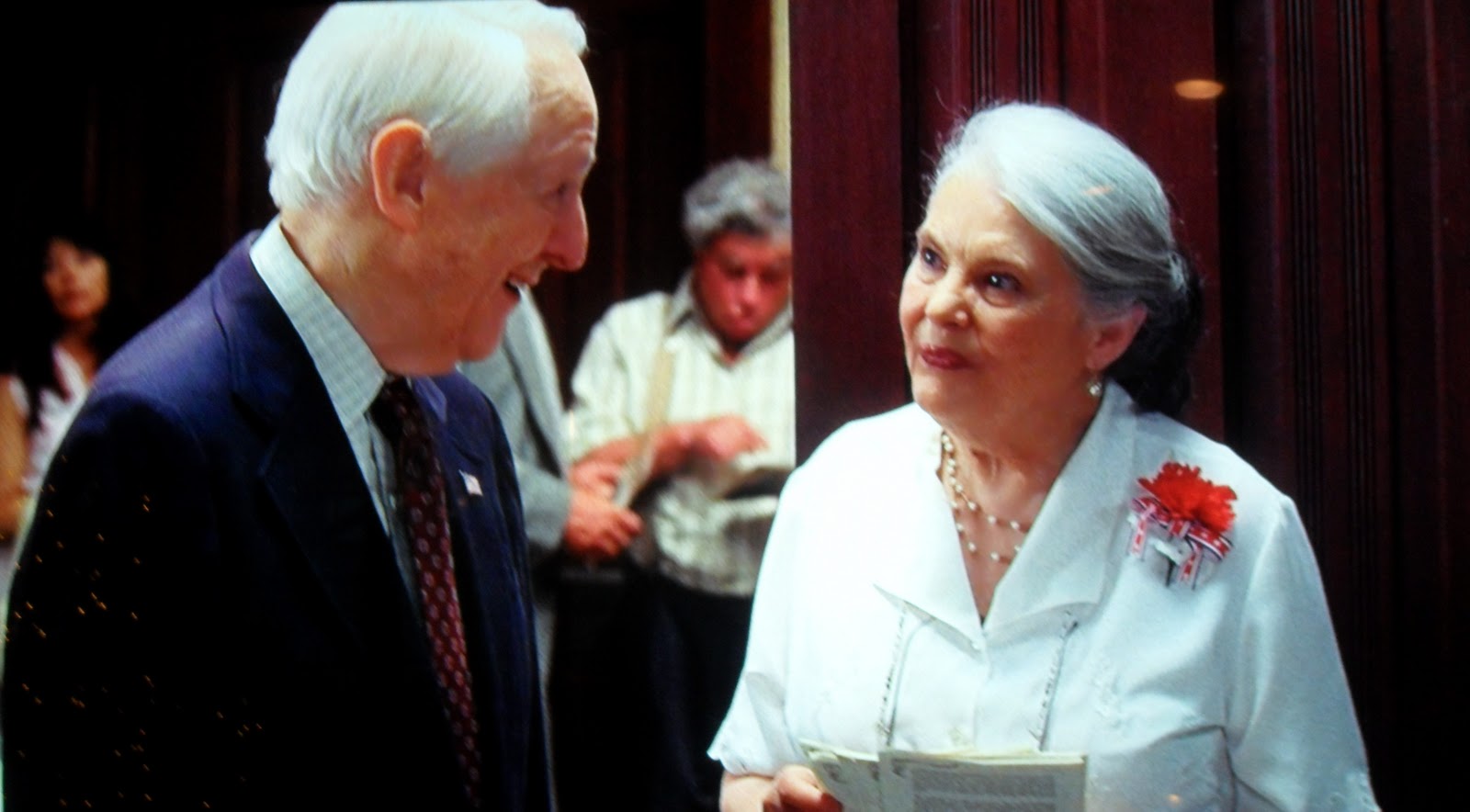


...and looking out over the (overwhelmingly white) faces of the DGD attendees one may be inclined view this as a celebration of family and community history as opposed to the uplifting of racism.


And yet, the Confederacy it celebrates had in its very constitution a clause outlawing the banning of slavery; it was an inherently stratified (and often brutal) society built upon the backs of people who were owned as chattel. 

Here we see the people of Bon Temps casting a nostalgic eye towards this past, perhaps earnestly wishing to find themselves in the recollections of the gallantry and heroic deeds of their forebearers who bravely fought in what Adele called the "war for Southern independence". We've got to take pause to really think about the complexities of the impulse behind the DGD.

I think this scene beautifully illustrates the push-and-pull of old and new ideas and social constructions; of changes happening within the community and within the larger society even as some try desperately to hold onto the past.

Remember when Royce and company made their entrance to the DGD meeting, commenting that everyone assembled looked so old; to paraphrase, they thought they were there for vampires, not the descendants of the walking dead? In this seemingly throwaway turn of phrase, the DGD and its aging membership is cast as a dinosaur, a quaint if irrelevant relic from another time. Could this be a comment on the place of the most damaging of the ideas that formed the backbone of the Confederacy in the New South - a fading remnant?

Could it be that having Bill Compton, both "Other" (vampire) and "one of us" (founding citizen of Bon Temps) at the front of the congregation, speaking from the pulpit, was True Blood's way of suggesting that perhaps Southern society is wrestling with its history and identity - it can be at once old and new, rooted in legacy and facing the future, and that things, people, and whole cultures can, and do, in fact, change?

LOCATION, LOCATION, LOCATION (AND IDENTITY, AND BACKGROUND, ETC...)
These are the musings of a white woman from the North of a certain age and background. We need diverse voices to round out this conversation. Please lend us yours!


~ Rachel

References

Abramovitz, M (1996). Regulating the lives of women: Social welfare policy from colonial times to the present. Boston: South End Press. 

Thursday, December 9, 2010

Raise a Glass to Real Grrrl Power: Women in Solidarity Part II - Theme 1 - of Mothers and Daughters

Confronting "Girl-On-Girl Combat"
In Part I of this series I outlined some questions Naomi Wolf's Harper's Bazaar piece Girl VS. Girl raises about the nature of female conflict and rivalry:


Is it inborn or are we socialized to engage in emotionally devastating struggle with one another?
Are there alternatives or other ways of being?
What kinds of social conditions would have to exist for different relations between women to emerge?
If this dynamic is based more in nurture than nature, who suffers most and who stands to gain by the way women are acculturated to be in fierce competition at all times?
Are women's relationships distorted in the media and pop culture to insinuate a higher prevalence of rancor and social sabotage - and if so - who is getting their kicks at our expense?


How best to wade into the whirlpool of these questions?


I will tap into the twin wellsprings of True Blood and the surging movement of women's studies - scholarship, (and particularly feminist scholarship) in the areas of history, religion & spirituality, anthropology, archeomythology, linguistics, art, literature, and more. Bubbling up from both of these abundant sources are the stories, allegories, images, narratives, and analysis that can support us to:


• Understand contemporary women's relationships within the context of our prevailing (dominator) culture and to take a look at how its social structures (i.e. dating & courtship, career ladder, marriage, and family) can impact on a woman’s ability to maintain continuing, fruitful connections with other women

 • Explore the assumption that all women feel isolation and separation from or animosity toward other women; is it part of a larger trend towards conceptualizing women's experiences in universalizing terms that exclude diverse perspectives (i.e. women of color, indigenous women, etc.)

 • Seek representations of, or models for, the creative dynamic of women living in relation with one another; multigenerational patterns of connection, continuity, cooperation, and community amongst women to foster deepened insight into our relationships with each other at the personal, cultural, and archetypal levels


SO LET'S DIP INTO THE FONT, SHALL WE?

A Swimming Pool for the Metaphoric Mind
You remember my last posts' overview of the metaphoric mind, right? Well, to carry along the water metaphor I started above, what follows is a a virtual swimming pool for the metaphoric mind...and it ain't no kiddie pool, folks! 

No, dear friends, it's a near-bottomless well in which we can dive deep into select images that illuminate women's relationships on True Blood and surface with insight into the parallels that exist between the complex interpersonal dynamics and story arcs of the show's female characters and the art, myth, narratives, and histories of archaic cultures and living traditions that bring nuance to our ways of being and interacting with each other. Let's try to plug into our metaphoric minds and see where they take us...

No Simple Answers
Here's what this discussion isn't meant to be:
  • An attempt to idealize women and our relationships with each other, deny our rivalry and conflict, or to paint us in broad, reductionist brushstrokes. After all, the feminine is no simple construct. I'm not saying Naomi Wolf has it all wrong; we women get along just fine all the time, thank you very much. To do so would deny the need to critically engage, interrogate, and challenge female conflict.
  • An exhaustive, authoritative, or all-encompassing review or history lesson; it's a discussion of women's relationships organized around a sampling of True Blood images on the themes that stood out for me and the parallels that emerged from the historic and sociological record.
  • An argument for the superiority of the mythopoetic worldview which speaks clearest to the metaphoric mind; it is a call to strike greater balance between this way of thinking and being and the linear-rational that dominates today.
  • A call to retreat to the past. Even though many of the preeminent scholars of archaic Goddess-based cultures (Marija Gimbutas, Merlin Stone, Carol Christ, Max Dashu, Riane Eisler, Vicky Noble, etc.) agree that the Neolithic and pre-Classical cultures which flourished in Old Europe and the ancient Mediterranean, Near, and Middle East showed all the signs of peaceful egalitarianism - no fortifications or caches of weaponry which would speak to the presence of war, no palaces which would indicate royal hierarchy or the existence of haves and have-nots but the remains of housing which evidences a comfortable quality of life enjoyed by all, and an artistic tradition which documents the free, joyous, and sophisticated societies our forebearers lived in - we can't, and shouldn't pine for a time machine that can take us back to those days. As Gadon (1989, p. 377) writes, "We cannot - would not - wish to return to some golden prehistoric age; but in reclaiming our lost heritage we can build upon the values encoded in the prehistoric survivals".
  • A recommendation that we engage in cultural appropriation or a justification to think  - misguidedly - that we can graft some romanticized vision or version of other cultures or lifeways upon our own.

The main idea here is that WHEN WE ARE MET WITH...AND SEE THAT THERE HAVE BEEN - AND STILL ARE - ALTERNATIVES TO THE STATUS QUO, new paths open and we see that the way things are isn't the way they have to be.

We are washed out into floodplains of new and expanded human possibility in terms of women's relationships with each other. 

A Exploration of Women's Relationships Organized into 5 Themes

Here's the 1st theme:  
The Archetypal Mother-Daughter on True Blood: Themes of Separation and Connection


TARA & LETTIE MAE


Let's begin by looking at one volatile rendering of a most primal of female bonds; that of mother to daughter, which seemingly reinforces Shakti Woman author Vicki Noble's assertion, "The Feminine is fragmented, shattered, and scattered about the earth. Women have been isolated from one another" (1991, p. 3): Tara and Lettie Mae.

In her feminist reconceptualization of the Demeter-Persephone myth, Charlene Spretnak (1989) affirms the power of this original matrix and the fundamental importance of female relationships, asserting that the sacred story of archetypal Mother and Daughter long pre-dates the Christian deification of father and son; in the ancient Eleusinian (pre-Classical Greek) religion it was celebrated as an expression of the central human mystery.

The myth of Greek Goddesses Demeter and Persephone is the classic story of descent, death and rebirth, and of separation and reunion between archetypal Mother and Daughter (Austen, 1990).


Terracotta statuettes of Demeter and Persephone from Myrina, c.100 BC. British Museum
It's easy to see how much they cherish each other

In the myth's most well-known (patriarchal Greek) version, mother and daughter live together in a bliss state until Hades, God of the Underworld, rapes and abducts Persephone.


Demeter so mourns her daughter's loss that the world begins to wither.
Persephone finally returns to her mother, but because she was tricked into eating a few pomegranate seeds, she must go back to the underworld for part of the year, during which time winter reigns on earth above.


Austin (1990) posits that in the original mythology, Persephone chose to leave the paradise of life with her mother of her own free-will; perhaps she descended to the underworld to experience another side of herself like the Sumerian Inanna did, perhaps to gain wisdom from Hecate, the ancient Goddess of the Underworld.
 Either way, each version tells the story of descent and re-emergence, of separation from and reunion with the mother.

In her book Stories from the Motherline: Reclaiming the Mother-Daughter Bond, Finding Our Feminine Souls psychotherapist Naomi Ruth Lowinsky quotes feminist poet and essayist Adrienne Rich who reiterates the mother-daughter bond’s power:
Although there have been some poignant moments of tenderness between them, we have certainly seen more painful estrangement than deepest mutuality in Tara and Lettie Mae's relationship as they struggle to repair the frayed cord of their mother-daughter bond:
There is nothing in human nature more resonant with charges than the flow of energy between biologically alike bodies, one of which has lain in amniotic bliss inside the other, one of which has labored to give birth to the other. The materials are here for the deepest mutuality and the most painful estrangement. (1992, pg. 53) 


Lowinsky's (1992, pp. 34-35) vision of the pain and separation that punctuates the mother-daughter dance mirrors Tara and Lettie Mae's relationship:

We are all born of deeply wounded mothers...In listening to the stories from my patients' Motherlines, I can usually trace the deprivation or anger back for generations...They look at their daughters with the hatred they feel for their own female selves, and profoundly stunt their daughter's development.

Video courtesy of YouTube user kathchick7, thanks!

She continues, "In a great collective leap we distanced ourselves from the lives of our mothers and grandmothers...Mothers and daughters suffer a wrenching distance between them" (Lowinsky, pp. 28, 31).

Gadon (1989) writes that separation and reunion, the restoration of the primary relationship to the mother, is the great motif underlying the Demeter-Persephone myth. We have seen Tara and Lettie Mae cycle back and forth between separation and reunion; they seem in constant conflict and yet also seem to always - in one way or another - long for each other. Will we see their mother-daughter bond ultimately repaired and restored? Does this story arc comment on the value our society accords the mother-daughter bond, or women's bonds in general?

JESSICA

As Jessica's ties to her family of origin - and to her biological mother - give way to the new blood tie between she and her maker/father figure Bill, Season 3 of True Blood finds her involved in a trio of pseudo mother-daughter relationships that speak more to separation and strife than to connection:


Arlene tries to ward Jessica off
What is she so afraid of? Is she fearful because Jess is a vampire,
or is it something else altogether?

Demeter and Persephone were so closely linked that they were simply known as "The Two Goddesses"; as Gadon (1989) writes, in the early 5th century B.C.E. bas-relief to the left, mother and daughter are nearly indistinguishable in appearance - the maiden is characterized only by the flower she carries, the mother only by the fruit. The key to understanding the symbolic meaning of this image, as mother and daughter gaze intently - smilingly and knowingly, even - into each other's eyes, is that flower and fruit, narcissus and pomegranate, represent their respective roles. For Jungian Eric Neumann, the unity of Demeter and Persephone is the central content of the Eleusinian Mysteries; the goddesses belong together in their seamless transformation from one to the other. Gadon (p. 161) quotes Neumann, "the daughter becomes identical with the mother; she becomes a mother and is so transformed into Demeter. Precisely because Demeter and Kore (Persephone) are archetypal poles of the Eternal Woman; mature woman and virgin, the mystery of the Feminine is endlessly renewed.

Is it such a stretch to cast Arlene and Jessica similarly as archetypal poles? Think back to when Sam first hired Jessica - do you remember Arlene chastising him, saying something like, "you know there's only one redhead at Merlotte's!"?  Arlene sees a younger version of herself in Jessica, and when they're face-to-face in matching Merlotte's uniforms it's hard not to see a resemblance. Arlene fears being displaced by her "younger self"; a fear not entirely unwarranted in our youth-obsessed culture. Rather than embracing the vulnerable baby vampire, either as a young woman in need of a mother figure or as a symbol of the cyclical pattern of eternal rebirth, Arlene allows her fear to cast her into competition and conflict with Jessica.

Jessica's relationship with another potential surrogate mother figure; Maxine Fortenberry, her on-again-off-again human boyfriend's mother, doesn't fare much better (for different reasons), as these images attest:


Jessica yearns for mothering, and we can tell from her video blog that she'd like to think maybe she's found it (what she herself refers to as a "big-sister-crush") in Pam - a female vampire she looks up to and turns to when in need and no one else is around to help her - but who is also a a party to Jessica’s stolen humanity - she too can be seen as a (begrudging) surrogate mother figure:

Here's Pam callously kicking Jessica into her grave...


And yet, Like Athena before her, Pam herself is a "daughter of man" who has and needs no mother.


Athena came into being after her father the Sky God Zeus killed the Goddess Mettis and swallowed her; from his head was born Athena, fully formed and girded for battle (Christ, 1997)

And so it is that the Goddess comes from God, female from male; like Athena born of Zeus, Aphrodite was born from the severed genitals of Ouranos (Christ, 1997), the ancient Egyptian God Ptah caused all the other gods to come into being through an act of masturbation, thus totally eliminating the need for a Divine Ancestress, and as the Judeo-Christian Adam and Eve story - which to a certain extend pervades the collective consciousness of today's Western culture - states, "For the man is not of the woman but the woman of the man" (Stone, 1976, pp. 227-228).


Not only does this kind of mythology deny the biological truth of birth (thinkers like Christ and Stone posit that this was almost certainly a political move undertaken by the molders of these revisionist myths as a shift from matrifocal to patrifocal social structure was taking place), but it also paints a very different picture of the importance of the mother-daughter bond than does the Demeter-Persephone myth: it totally subverts, refutes, and disavows it.


Does this type of thinking - that the mother-daughter (and by extension, the woman-woman bond) is inherently prickly, has little real meaning, and is therefore expendable - have any bearing upon today's female relationships?

SOOKIE & TARA 

What do Tara and Sookie as surrogate sisters have to do with the theme of separation and connection between mothers and daughters? True Blood offers us some images of them in close sisterly bond which radiates out - at least in part - from their orbit around the same mother figure: Gran.

The relationship between Tara and Sookie has its ups and downs - like relationships between any sisters (Rebecca and I included) or very close friends usually do - but despite their differences and the trouble that always finds them they are joined by a deep mutuality. Their relationship sometimes comes to blows over men but it is never minimized or overcome by the men in either of their lives.  
They (try to) keep each other real!

   
Their caring for each other is born of the love they shared with and received from Gran, the same woman who was not their mother but to varying extents played that role for both of them from their childhood.


Lots to think about, huh? So what do you think?

If you'd like to explore my take on the Archetypal Mother-Daughter bond, which (as evidenced in the images from True Blood we see here) can manifest through a connection we have with a woman from our own bloodlines, or with a woman of an alternative or chosen lineage such as an adopted, surrogate, spiritual, or mentor mother figure further, you might be interested in checking out a paper that I presented at a conference on spirituality and social work in Canada in 2008: Re-Imagining the Myth of Demeter and Persephone: Exploration of the Constructs of Marriage and Nuclear Family  

In it, you'll find a practical guide for tracing the Motherline, which is what Lowinsky describes as a name for a pattern, for the oneness of body and psyche, for the experience of continuity amongst women. She conceptualizes it as a central organizing principle in the psyche of women, "like the stem and the roots of the tree of life, through which a woman is related to the ancient earth of female procreation" (p. 4).

Whether or not we feel a close connection to our mothers, whether or not our mothers are still living, the Motherline heritage this is passed down to us, or that we choose to subscribe to, can provide a rich exploration of our deepest selves. Tracing it might open new windows on the concept of female rivalry and conflict.
 
In the next installment, I'll look at images of  women's relationships in True Blood and their parallels in the art, stories, narratives, and histories of the past and present in the context of these themes:
  • Female Competition Manifested in the Classic Love Triangle
  • Women Sharing Support, Connection & Compassion
  • Female Allies, Helpers & Guides
  • Women United in Ritual
Bye-bye for now!


~ Rachel

References

Austen, H. I. (1990). The heart of the goddess: Art, myth and meditations of the  world’s sacred feminine. Berkeley: Wingbow Press 

Christ, C.(1997) Rebirth of the goddess.  New York: Routledge

Gadon, E. W. (1989). The once and future Goddess. San Francisco: HarperSanFrancisco 

Lowinsky, N.R. (1992). Stories from the motherline: Reclaiming the mother-daughter bond, finding our feminine souls. Los Angeles: Jeremy P. Tarcher, Inc.

Spretnak, C. (1989). The Myth of Demeter and Persephone. In Plaskow, J. & Christ, C. P. (Ed.), Weaving the visions: New patterns in feminist spirituality. (pp. 72-76). San Francisco: Harper and Row.

Stone, M. (1976). When god was a woman. New York: Harcourt, Inc.