Thirsty for a Fresh Take on All Things True Blood?

WELCOME! Thirsty for a fresh take on all things True Blood? Pull up a virtual barstool at the Pierced Pomegranate Tavern where sisters Rachel and Rebecca are serving up juicy feminist analysis with a twist and opening a vein of thoughtful sociocultural dialogue on HBO's hit series.

Like the epic literary salons of eras past - theaters for conversation and debate which were, incidentally, started and run by women; where the spirited debate about the issues of the day ran as copiously as the actual spirits did - but updated for the digital age, the Pierced Pomegranate Tavern is a fun forum for exploring questions ripe for discourse about the human condition & today's most crucial social issues through the medium of True Blood.

Your salonnières are not peddling liquor per se, but they are offering up new and alternative ideas informed by such diverse influences as pop culture, art, music, cultural history, Goddess studies, transformative theory, literature and poetry, and archaeomythology, filtered through the sieve of their own lived experiences as feminist women of a particular age, background, and culture.

This is a space where you - patrons and passersby alike - can view and engage with these perspectives through the lens of True Blood and contribute your own thoughts. So, no matter if you're a Truebie or a more casual viewer of True Blood, or your drink of choice is a pomegranate martini - one of Rachel's favorite cocktails to drink and Rebecca's to mix - an herbal tea, a frothy double mocha latte, or a can of Fresca (wink, wink) you're invited to join the conversation on the show's complexities in a way that can spark transformation.

Hopefully you'll find something to sink your teeth...err...straw, into! PLEASE ENJOY RESPONSIBLY ;-)

YOU'VE BEEN SERVED (A WARNING)...

The Pierced Pomegranate Tavern is dedicated to exploring social issues and more through the lens of True Blood. As such, you may encounter:

*SPOILERS
*TRIGGERS
related to the often provocative and adult themes presented by the show

If you choose to enter and participate in this virtual salon, please be prepared to do so in a thoughtful, respectful, and mature fashion with the above in mind. Click here to check out our comment policy. Thanks!

Disclaimer

No copyright infringement is intended, all rights to True Blood belong to HBO, credit is ascribed to sites where images appearing here were originally found.

Showing posts with label Luna. Show all posts

Thursday, September 15, 2011

Women Setting Boundaries in True Blood S4 Finale

WOW. I mean, really, WOW. There's so much that can be said about the unreal True Blood S4 finale that aired this past Sunday, "And When I Die".

Multiple viewings of it may in fact be truly hazardous to your health!

Case in point: I crashed at Rebecca's house on Tuesday night, and we decided to re-watch the episode together. Just as the opening credits began, our brother pulled into the driveway and we shot each other looks acknowledging the fact that as soon as he came in the door and realized we were watching it AGAIN, he might just kill us!

You see, Johnny's a fan of the show too, but for him watching each episode once is enough. And when he comes in from work, he likes to relax in front of the tube and decompress. So as the key turned in the door we braced ourselves and when we heard him in the hallway, we both grimaced and Rebecca almost timidly called out, "hey man" to test his mood. 

Luckily for us, his shift had been good and he was feeling benevolent. Striding up the stairs, he caught the strains of Bad Things rising and joked, "third time's the charm, huh?" before briefly taking inventory of the fridge and descending back down the stairs to his room.

Whew, close call. We were now free to watch "And When I Die" yet again, and although each of us had already seen it at least once (we viewed the finale together late Sunday night and Rebecca had re-watched the next day and taken notes), we were both still feeling the effects of the fangover and attempting the process the show's dizzying chain of events. 

As I mentioned at the beginning of this post, so much happened during the finale that we could discuss here at the PPT. But since the Web has been abuzz for several days with recaps, reflections, and questions concerning the central action, I'd like to address a subtly nuanced theme of female empowerment nestled within the episode's dizzing action.  

Easy to overlook in light of the general craziness of the S4 finale, this theme is made evident in the pattern of several female characters drawing boundaries for themselves in their relationships that emerged during the course of the show, particularly in relation to Sookie, Jessica, Luna & Holly.

Rebecca and I started to flesh out our ideas on this topic on Tuesday night.

When the episode ended, we joked a little about how I had, in a moment of denial that the season had actually come to its conclusion on Sunday night, told her "no, we've got to see the coming attractions" when she lifted the remote to switch the station. Rebecca had astutely pointed out on Sunday that there would be no trailers for next week and that I'd have to face the fact that a sobering nine months of True Blood withdrawal stretched out like a barren wasteland before us.

Maybe a little over-dramatic, but true nonetheless.

So we laughed a little about that again, and Rebecca quickly turned our attention to an article she had read online that pointed out how, in her two-way break up with Eric and Bill, Sookie has actually chosen herself.


Although leaving without either of them in her life caused she and both her lovers great heartache, Sookie realized - perhaps due in part to the poignant words of her dearly departed Gran's spirit - that being alone is nothing to be afraid of.

And that maybe the best thing for her to do instead of trying to choose between Bill and Eric was to take some time to discover and get to know herself, outside of a relationship. Although shocked and deeply hurt, both vampires respected Sookie's wishes enough (at least for now) to let her go.


Similarly, during her sexy Halloween night tryst with Jason, Jessica verbalized her own sense that she is just barely getting to know herself.

Jessica is Rebecca's favorite female character for the reason that she feels the baby vamp displays the most real, believable [human] emotion. Sorry Sookie - Rebecca's words, not mine ;-) but I don't disagree.


Despite their strong mutual attraction and genuine caring towards one another, Jessica was brave and authentic enough to draw a mid-coitus line in the sand, telling Jason that she did not want to be his girlfriend. It's not that she doesn't want him; she's simply not ready to commit to him yet because she recognizes her inexperience in relationships and she doesn't want to hurt Jason the way Hoyt ended up hurt when they broke up.

In this scene, Jessica asserted herself as a sexual woman and vampire who is beginning to know what she wants and needs and isn't afraid to articulate that to the man in her life. And for his part, Jason was understanding and accepting of Jessica's reticence to jump into a committed relationship with him or to be intimate enough with him to drink his blood; as Jessica said, at least not yet.

Luna, too, put the breaks on a close encounter that could have heated up into quite the romantic night for she and Sam.
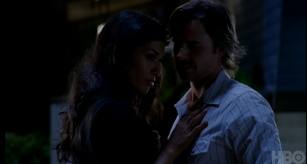

Not because she's not ready to stay the night with Sam or for them to be an official item (although that may well the be the case), but because she felt her baby girl Emma may not be. Luna and Sam both displayed the emotional maturity required to take their budding relationship slow; let's hope the snarling wolf that confronted Sam just as the van carrying Luna and Emma home drove up the Merlotte's driveway towards the parish road and out of view doesn't put the permanent brakes on this promising couple!

Last but not least, we've got fairy-costumed Holly, who, despite (or maybe because of) her mental and physical exhaustion brought on by the drama of the night had the gumption to tell it like it is to a persistent, Halloween bouquet-toting Andy Bellefleur.

Here's the dialogue courtesy of Television Without Pity

Andy: "Sorry about the last time, when I took your flowers."
Holly: "That's okay, you were nervous."
Andy: "No, I was a drug addict. V. thought I needed it to do the job, and to talk pretty ladies like you... So I didn't feel like a loser all the time. It worked for a while, then it didn't."
Holly, wearily: "Okay look, honey. You're really sweet and everything, but this is all just too much for me right now."
Andy: "It's no problem. Lot of baggage, I get it. I just wanted to say that I'm sober and I'm lonely. And I can be good to someone if they let me. 'Night."


After taking in and weighing what he had to say, Holly asked Sheriff Andy for a much-needed hug, which I think may have been balm for both their souls. I look forward to seeing what will come next for these two, and if the kind of "rigorous honesty" the tragically doomed Debbie Pelt had talked about having with Alcide might prevail for both of them; given their respective pasts (Holly as a survivor of sexual assault and Andy as a recovering addict) should they become involved.

Now, the above is not to suggest that self-actualization and being in relationship are mutually exclusive. In fact, as the introduction to the section on self-in-relation in the book Weaving the Visions: New Patterns in Feminist Spirituality asserts, the idea of self as relational is prominent in feminist thinking.

The concept of the relational self has not caught on in the traditions of dominant Euro-Western philosophy and theology in which Descartes's' vision of the self as essentially rational, disembodied, and solitary holds sway. From this perspective, it is easy to see how relationships could be seen as detrimental to the growth and development of the self - especially for women - whose stereotyped roles as nurturers and caregivers of others threaten to swallow us alive.

Another vision of the self suggests that we are by nature embodied, passionaterelational, and communal. Many feminist adhering to this viewpoint stress that identity is found in community. Black womanist theologian Delores S. Williams coined the term "relational interdependence" to name Black women's struggles for freedom from racist and sexist stereotypes within the context of relationships, family, and community. In this view, women's independence is relational.

There is no you without me; no me without you. The self is forged in relationship.

Even so, drawing healthy boundaries for the relationships that structure our lives and bind us to others is necessary, and it's refreshing to see the women of True Blood taking these steps - and their men responding in kind!

Yours in TB withdrawal...

~ Rachel

Thursday, July 28, 2011

I am your daddy and I'm gonna teach you how to hunt, shoot, trap and fish and…and how to take clothes out of the dryer

So a bathrobed Terry Bellefleur promised the baby boy he cradled in his arms in I'm Alive and On Fire. Contrast his words with Melinda Mickens’ to her prodigal son Tommy when they were reunited after a time apart: “Don’t you cry too, you’ve gotta be the man”.

Do you see a difference in terms of the image of manhood and masculinity; what it means to grow up and be male in our culture conveyed by these scenes? I do. 

On the one hand, we've got a sensitive father figure imagining aloud his future as a male role model for his wife's son Mikey who, although not his child biologically, he is raising as his own. They'll do all kinds of typical red-blooded American outdoorsy guy stuff together, and yeah, he'll show his boy how to do things that until recently were reserved for the domestic womanly sphere, too.

And on the other, we've got a [conniving and manipulative in her own right] mother trapped in an abusive patriarchal marriage encouraging her son to adhere to more retro-rigid models of masculinity and repress his emotions. 

We need different – more like new - images of maleness and masculinity to replace the ones that reassert the genderized ethos of domination, as Tommy’s mom does when she entreats him to bottle up his feelings, dry up his tears.

In the words of womanist midwife (and professor of women’s studies at my alma mater, the California Institute of Integral StudiesArisika Razak:
The last time I checked, men had tear ducts. They had arms for holding babies.They cared about their children. And they cried at births. (1991, p. 172)
Maybe she was checking Season 4 of True Blood!

tear ducts - check!

arms for holding babies - check!

caring about children - check!

The current season of True Blood - and the episode I'm Alive and On Fire specifically - have delivered several such images that run counter to our culture's image of male heroes as warriors, conquerors of women and nature; a picture of masculinity a growing number of men are increasingly uncomfortable with.

Take Eric, for instance.
No, no no - not that Eric....


...the new Eric.
Nope, wrong again! Not the jogging suited Eric of Season 2 who showed up freshly shorn at the Forever 21-esque boutique where Bill was shopping for Jessica, declaring, "it's the new me".
I'm talking about the new-new Eric. Amnesia Eric. He's contemplative. Playful. Vulnerable, even. And seemingly contrite for the sins of his [distant & more recent] past. Sookie sees the change, noticing out loud to Eric, "It's just that you weren't always like this; gentle, sweet, but it suits you.” (S4E5 Me and the Devil)

Indeed, this [perhaps temporary] version of the Viking, Eric 2.0 seems light years away from the swaggering, coldly calculating, at-times viciously cruel (or as Sookie said in last week's episode, the "smug sarcastic ass") side of the vampire sheriff we have come to know best.
YOU LIKE?
*Sorry, couldn't resist adding that in - truebies will get the reference!.
Sookie certainly seems to. Yet despite her obvious warming to him, Eric doubts himself. Something deep within him knows that he has drifted from society's expectations of an [alpha] male and he fears Sookie will reject him for it.

In the I'm Alive and on Fire scene below, Sookie climbs down into her basement cubby to rouse the uncharacteristically [for the Eric she thinks she knows] morose vampire moping there. She comments that the "real" Eric would not be so down. He begs to differ, replying in protest, "I AM real".  
This exchange is particularly relevant to the point I'm trying to make about True Blood offering up new, more expansive images of masculinity:

Eric: You think I'm weak.
Sookie: No.
Eric: You want the Eric that doesn't feel.
Sookie: It's not that.

Feminist scholar and CIIS professor Carol Christ (1997, p. 161) writes:
Rooted in the ethos of the warrior, modern societies have been described as "dominator cultures" by cultural historian (also on the CIIS faculty) Riane Eisler. The ethos of dominator cultures states that power stems from control. Dominators are taught to control women, nature, children, animals, other men, their own bodies, and their feelings and sensations. The ethos of domination denies or disparages human embodiment, relationship, and interdependence. In the ethos of dominator cultures, finitude, vulnerability, and limitation are called weaknesses.  
We've seen Eric's emotional side before; with Godric, Pam, even with Sookie. But this new openness to feeling, this often being lost in emotive reverie stuff would likely not have jived too well with his human life as a Nordic warrior - or with his present duties as a figure of considerable authority amidst the shifting sands of the cutthroat vampire hierarchy.

It must feel strange and unsettling to Eric; like weakness. On the contrary, in the new Eric I see an image of masculinity that's a step towards changing the patterns of domination that govern our lives and society.
"In a society that wishes us to see men as devoid of feelings,
let us hold an image of men as nurturers (Razak, 1991, p. 172)
And then, we've got Terry who - as we wrote on our Forum's Scope page - describes himself as "a nurturer". This seems an odd juxtaposition with his military background, since the military identity tends to be traditionally hypermasculine in the U.S.  
In Christ's thinking, military training figures prominently in the indoctrination into dominator cultures; into the way such social systems define masculinity and power. "Manhood" is equated with the denial of Eros (defined as a transformative force of intelligent, embodied love which connects us to each other and the web of life) and its replacement with violence. Feminist political scientist Judith Hicks Stieham's quote underscores her point:
The appeal to manhood is very much part of military training...the familiar "This is my rifle, this is my gun [pointing to the penis], one is for killing, one is for fun." (1997, p.162)
The ethos of this institution that breaks down young men's defenses (that which connects them with others) in order to turn "boys" into "men" who readily submit to authority and are prepared to kill has permeated the whole of our culture. In the rituals of daily life we reenact its basic training.

Christ ponders, what would happen if all the energy and resources (money and human capital) spent on war and the cost of repairing its damages were instead devoted to the nurturing of life?

Razak (1991) proposes that new images can be created by men who participate in childbirth and affirm themselves as nurturers of life. Could Terry as a wounded warrior/ wounded healer - someone who [usually, except for that whole Arlene pregnancy thing] responds well to the emotions needs of others, doesn't shy away from holding another wounded man in his embrace, and finds fulfillment in nurturing family life - be seen as positing a new model of maleness? And a particularly potent image of masculinity for our times, at that, given that scores of battle-worn soldiers will soon be returning to our shores from the Iraq and Afghanistan fronts? 

And finally, there's everyone's favorite shape-shifting bar owner, Sam Merlotte. Sure, he's interested in pursuing a romantic relationship with Luna, so getting on her daughter's good side just makes good sense. But did you notice that initially, Luna seemed hesitant to even let Sam know she had a daughter; much less let him meet or get close to her?

Luna's shady behavior when he showed up at her door to return her seducing favor almost led me to believe that she was harboring not a pint-sized dynamo of a kid, but another man inside. Her leeriness to allow a strange man into her daughter's life is perfectly understandable; she's instinctively protecting her child, and part of her probably thought Sam would bolt at the sight of such "baggage".

But he proved her wrong! Sam was immediately at ease with Luna's daughter, crouching down to ask her, "which Barbie doll do I get, I hope she has a bunch of pretty dresses." If a rugged, scruffy-sexy guy sitting on the floor playing with Barbies isn't masculinity stereotype busting, I don't know what is!
Children are usually pretty adept judges of character; from the image to the right, it appears as though Luna's daughter has given Sam her stamp of approval. She can probably sense his genuine vibe.
Men in our culture are not raised to see themselves as relational; they have long been socialized to accept the model of the linear hero’s journey in which others he meets along the path are seen as either assets or barriers to his achieving his purpose.

As Christ writes, many thinkers have portrayed “man” as an isolated rational and moral individual – an island, if you will – and have posited an intrinsic opposition between the self and others who are perceived as impinging upon the freedom of the self. This ideal “independent self” of traditional philosophies and theologies can be seen as a fiction.

Theologian Martin Buber says, there is no “I” without a “Thou”, no self that is not created in relationship with others.

The basic word I-You can only be spoken with one’s whole being. The concentration and fusion into a whole being can never be accomplished by me, can never be accomplished without me. I require a You to become, becoming I, I say You. All actual life is encounter. (Christ, 1997, p. 137)
Buber states further that it is wrong to say that first we “are” and then we “enter into” relationships. "Rather, the longing for relation is primary, the cupped hand into which the being that confronts us nestles…In the beginning is the relation – as the category of being, as readiness, as a form that reaches out to be filled" (Christ, 1997, p. 137).

Too often, the models for being extended to men are more accurately represented by a closed fist than by an open hand reaching out to clasp with another. 

The men of True Blood profiled here - at least in their current incarnations - seem to have hands open and outstretched; they seem ready for relationship, for conceiving of themselves as relational. 

We absolutely need new images, integral models of maleness and masculinity, but, as Razak (1991, p. 165) writes, we must also answer "the critical need our society has to make a new model for human interaction". My eyes are glued to True Blood for what I hope will be a continuing stream of alternative images that can add to the discourse in this regard.

~ Rachel    
References
Christ, C.(1997) Rebirth of the goddess.  New York: Routledge.

Razak, A. (1991). Toward a Womanist analysis of birth. In Diamond, I. & Orenstein, G.F. (Eds.), Reweaving the world: The emergence of ecofeminism. (pp. 165-172). San Francisco: Sierra Club Books. 

Saturday, July 23, 2011

And speaking of consuming women...how about a Grade-A prime "slab of flesh"?

You must forgive me for the gratuitous pun I'm about to drop. Here's my [paper thin] rationale; as Bill explained about Fangtasia's silly name in Escape From Dragon House, “You have to remember that most vampires are very old. Puns used to be the highest form of humor.”

So here goes...during my first go 'round with the Sofia Sanchez-Grant piece I referenced in Wednesday's You Smell Like Dinner post, a certain phrase really got its meat hooks into me: slab of flesh.

What comes up for you when you hear this?

Maybe something along the lines of one of the first things that pops up on Google image search using this rough idiom as a search term?


Try to imagine my surprise when, about halfway through the article "The Female Body in Margaret Atwood's The Edible Woman and Lady Oracle" it hit me. Those words, staring up at me, right there on page 85 as part of a beauty parlor episode!

OK, OK, maybe they weren't actually staring up at me, glowering at me from the page. But this being such an incongruous stringing together of words for the context in which they were used, it sorta felt like they were.

Sanchez-Grant chose to excerpt this illustration of the character Marian's visit to what she calls "a female space dedicated to the presentation of the female body" (2008, p. 84) quite deliberately. Also on page 84, she wondered if "culturally-ordained female spaces" are less hostile to women than is "masculine terrain" (i.e. sports arenas, etc.) and interpreted the following passage from Atwood's Lady Oracle as a response:
Marian had closed her eyes, leaning back against the operating-table, while her scalp was soaped and scraped and rinsed. She thought it would be a good idea if they would give anaesthetics to the patients, just put them to sleep while all these necessary physical details were taken care of; she didn't enjoy feeling like a slab of flesh, an object. (Sanchez-Grant, 2008, p. 85)
After reading what Sanchez-Grant calls a "surgical, somewhat violent description" of a trip to the salon, I scrawled a dark, etching line below the words I bolded in the excerpt above that almost tore through the paper. I wanted to make sure I'd remember to come back to this passage, because although for Sanchez-Grant this scene's meaning lay in its mirroring of the "incompatibility between patriarchal femininity and women's own feelings" (2008, p. 85) - my mental wheels started spinning in the direction of True Blood.  

Meanwhile…in the Twitterverse…

Just today, I came across this tweet from a female fan: "dear #TrueBlood: Would it kill you to show us a little full frontal nudity? MALE full frontal nudity".

Her emphasis on the male offers the perfect segue for what the phrase slab of flesh brought to my mind. We HAVE already had full frontal nudity on True Blood - FEMALE full frontal nudity.

Let's look at how the nude, frontal female body was presented in Season 3.


In these scenes (both curiously involving Eric), the nude, frontal female body was presented violently.

The naked, unnamed WWII-era female werewolf was pinioned to the wall by nails jabbed through her body as Eric interrogated her. True, she was clearly depicted as the "bad guy" and Eric was painted as the righteous one in disguise. But still, this scene - at least for me - sickeningly called to mind the sexualized torture Jewish, gypsy, and other women were subjected to at the hands of the Nazis as well as the rape and all other manner of indecencies women around the globe have faced in war zones.

If it was a love scene, at last year's Dragon * Con Sam Trammel dubiously characterized Yvetta's dungeon dalliance with Eric as a rough one. A highly aroused and stimulated, nude Yvetta was shackled to the floor and ceiling by her arms and legs in the dank bowels of Fangtasia while Eric thrust into her. Apparently for hours. Vampire stamina. Wow. OK...I'm getting distracted...

Sure, it was consensual, and yes, she certainly seemed to have enjoyed it. Women can - and do - enjoy unconventional sex and I have no quarrel with this whatsoever, as long as it's safe, sane, and its parameters are mutually agreed upon.

But might this scene (and the one above it) be a a comment on the sicker, darker, more twisted views of sexuality and the aesthetics of torture porn?

Are we slabs of meat on a hook? For whose gaze are these images intended? Who might find them titillating and why?

In his piece "How Internet Pornographers Market to Men vs. Women" on the sentinel site NetNanny Mark Kastleman reviews the typical attributes of the potential male online porn consumer in the cold, hard terminology the pornographers use:
Vision is the key perceptual sense in males-they "like to look"...They yearn to see body parts and things being done to those body parts...Males have up to 20 times more testosterone than females coursing through their mindbody. Testosterone fuels sexual drive and aggression. As a result, it's a turn-on for most viewers to see males dominate, be aggressive or even violent in sex with females... powerful imprinting of the images in the cells of the male mindbody.

Interesting.

I think it's also telling that we have not seen the male body depicted in such a way on the show. Even the [absolutely horrifying] story arc centered on Jason's use as a breeding stud in which he's bound to a filthy bed presents him as shirtless - his pants pulled down, but not fully exposed. One of the Hot Shot women even conscientiously drapes his groin with a rag after dismounting, ensuring that we, the audience, see nothing below the belt that we're not supposed to.


There are other connotations for slab of flesh, too...


 ...extending Raquel Rivera's concept of gastronomic sexuality further in a way that certainly isn't appetizing to me as a vegetarian.
   Women's bodies as consumable foodstuffs; commodities.
I struggled in a back-and-forth with myself about whether or not to post the infamous June 1978 Hustler cover with a women's legs sticking out of a meat grinder, captioned with publisher Larry Flynt's quote, "We will no longer hang women up like pieces of meat". My sense of propriety won out; I couldn't bear to muddy our tavern with such a distasteful, offensive image. But you can click on the link above to see it on Sociological Images; I think it drives my point home.

It's also interesting to contrast the way the nude female body has been represented thus far in season 4; we've seen much more artful, demure depictions. Think Luna's voluptuous form reclining in the grass as Sam approaches, one knee bent just so to obscure her lower half from our view.

And good on you Sam, you unwaveringly looked her in the eye!

~ Rachel  

References

Rivera, R. Z. (2003). New York Ricans from the Hip Hop Zone. New York: Palgrave.


Sanchez-Grant, S. (2008). The Female Body in Margaret Atwood's The Edible Woman and Lady Oracle. Journal of International Women's Studies, Vol. 9, #2.