Thirsty for a Fresh Take on All Things True Blood?

WELCOME! Thirsty for a fresh take on all things True Blood? Pull up a virtual barstool at the Pierced Pomegranate Tavern where sisters Rachel and Rebecca are serving up juicy feminist analysis with a twist and opening a vein of thoughtful sociocultural dialogue on HBO's hit series.

Like the epic literary salons of eras past - theaters for conversation and debate which were, incidentally, started and run by women; where the spirited debate about the issues of the day ran as copiously as the actual spirits did - but updated for the digital age, the Pierced Pomegranate Tavern is a fun forum for exploring questions ripe for discourse about the human condition & today's most crucial social issues through the medium of True Blood.

Your salonnières are not peddling liquor per se, but they are offering up new and alternative ideas informed by such diverse influences as pop culture, art, music, cultural history, Goddess studies, transformative theory, literature and poetry, and archaeomythology, filtered through the sieve of their own lived experiences as feminist women of a particular age, background, and culture.

This is a space where you - patrons and passersby alike - can view and engage with these perspectives through the lens of True Blood and contribute your own thoughts. So, no matter if you're a Truebie or a more casual viewer of True Blood, or your drink of choice is a pomegranate martini - one of Rachel's favorite cocktails to drink and Rebecca's to mix - an herbal tea, a frothy double mocha latte, or a can of Fresca (wink, wink) you're invited to join the conversation on the show's complexities in a way that can spark transformation.

Hopefully you'll find something to sink your teeth...err...straw, into! PLEASE ENJOY RESPONSIBLY ;-)

YOU'VE BEEN SERVED (A WARNING)...

The Pierced Pomegranate Tavern is dedicated to exploring social issues and more through the lens of True Blood. As such, you may encounter:

*SPOILERS
*TRIGGERS
related to the often provocative and adult themes presented by the show

If you choose to enter and participate in this virtual salon, please be prepared to do so in a thoughtful, respectful, and mature fashion with the above in mind. Click here to check out our comment policy. Thanks!

Disclaimer

No copyright infringement is intended, all rights to True Blood belong to HBO, credit is ascribed to sites where images appearing here were originally found.

Showing posts with label violence. Show all posts

Sunday, August 21, 2011

Character Spotlight: Hoyt Fortenberry - Hall of Shame

Hoyt Fortenberry, you have been charged with numerous counts of verbal, emotional, and psychological abuse. How do you plead?........

     It is with a heavy and utterly broken heart that I place Hoyt Fortenberry in this installation of our True Blood character Hall of Shame. We have created this space for those characters who at one time garnered nothing but respect and admiration but through a series of uncharacteristic behaviors have fallen from our good graces. We here at the PPT believe in the redemptive qualities of the human (or not so human at times) spirit; and reserve the right to remove any character who can rise above and move beyond their previous and or current offenses from these Halls. That being said let's take a closer look at what landed Hoyt here in the first place.

     How could you do this to us, Bubba? How could a man once so gentle, loving and kind turn into this angry, hate filled, abusive person that we saw last week? You were the only person in Merlottes with a kind thought for Dawn after her murder in the first season. You stood up to your mother calling her out for all her  racist beliefs (secret or otherwise). You have been a good and loyal friend to Jason, even when he referred to Rene-the murderous, misogynist, psychopath as his best friend (I know how much that must have hurt!). You met and fell in love with a beautiful, strong, smart and caring women who just happens to be a vampire.  Throughout all the discord you were our rock, a constant reminder of how good people can actually be. You gave all the bad boys of the world something to think about, proving that the nice guy COULD get the girl. These and many other selfless acts of blind love, and dedication to your moral compass are what made us all (Jessica included) fall in love with you.
****************************
     At the beginning of this season we saw a side of Hoyt we thought we'd never see. He has been argumentative, moody, insensitive, emotionally and verbally abusive towards Jessica; cutting her down to the quick with his words. He has violently lashed out, punching walls, throwing lamps and God knows what else around the house, and even though these actions can't physically hurt Jessica they can leave a very visible scar emotionally and psychologically. These abuses rank among the top offensives in most cases of domestic violence! He has made several unsubstantiated claims of Jessica's infidelity allowing his own self-consciousness to bubble up and pollute their relationship. This unhealthy pattern of behavior lead us to this scene as it played out last Sunday night. Re-watch this clip taken from True Blood season 4 episode 8: Spellbound for the last straw that landed Hoyt into our Hall of Shame.


      Couples fight all the time, but it is the way Hoyt fights that upsets me so much. He knows that he is not a physical match so he attacks Jessica verbally and emotionally. He tears into her, accusing her of sleeping with another man. Hoyt then goes on to commit what I consider to be a cardinal sin....he calls Jessica a bitch. While many women feel as though they have "taken back" the sting of being called a bitch, softening the blow by making the word theirs, I still find this word offensive and hurtful. When we think of the archetypal "bitch" what do we see? Does she come anywhere close to resembling Jessica or her actions in any way, shape, or form? I think not, which is precisely why the use of this word is so offensive. How can you say this to someone you love? "You don't deserve me" he yells "and I sure as hell don't deserve you". He goes on to list all the reasons he deserves someone better than Jessica. He attacks her nature both feminine and vampiric. "I deserve someone who's not gonna be a fuckin virgin for all eternity." Women have been simultaneously revered and shamed for their virginity; we are expected to be pure and virtuous yet taught to feel unwanted or inadequate if still a virgin. "I deserve someone I can have a normal life with, with babies....and daylight!" These are all things Hoyt was well aware of while falling for Jessica, things she cannot be held accountable for. Note her reaction as she hears these words. It's as if his words are literally wounding her...as Rachel pointed out, stabbing her like a knife in the chest. As if this weren't bad enough he lands his final blow by exclaiming he deserves someone who's "not fuckin dead" then with a look of disgust on his face revokes Jessica's invitation to their own home. When Hoyt slammed the door on Jessica, leaving her demoralized and sobbing on the front porch, did he also slam the door on any hope that this relationship can be mended? I, for one eagerly await the answer to this and would love to see if Hoyt has it in him to redeem his character's good name. Still a few hours until our next hit, just enough time to see what everyone else is thinking....Thoughts?? ~ Rebecca

Tuesday, August 2, 2011

As much as I love it, every bad thing that has ever happened to me is because of sex

Jason Stackhouse's relationship to sex is complicated and conflicted, to say the least.

And after narrowly escaping his breeding mill ordeal at Hot Shot, he knows it.

Flashback to Season 1. Do you remember the Cold Ground scene when, after Gran's death, Jason tried to lose himself in an empty, hollow, loveless tryst with a blond woman - a virtual stranger he couldn't remember the name of - who rode him reverse cowgirl-style? His bid to mindlessly fall back on predictable Stackhouse sexcapading as a means of escape backfired terribly. The two of them never made eye contact; while she moaned, "I love you", Jason softly cried.

His rape at Hot Shot felt to me like an extreme, twisted, alternate universe redux of that scene; his facial grimaces and sounds as he was repeatedly violated in the breeding shed reminded me very much of that scene.

While it’s true that he’s had lots of fun romps (with lots of different women) in the sack, Jason’s also had his share of sexual experiences that were exploitative and devoid of real emotion; where no true human connection or bonding took place – as in the two instances above.

And it seems to be going from bad to worse.

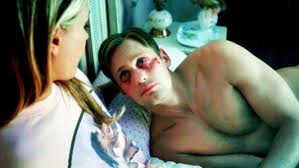
It's a good thing Hoyt and Jessica found him lying battered and bruised on the side of a deserted rural back road; the baby vamp's blood was his salvation. Having been miraculously healed by Jessica's blood, a restored-to health-Jason told his best friend over breakfast at Merlotte's:
As much as I love it, every bad thing that has ever happened to me is because of sex, (counting on his fingers) jealous boyfriends, becoming a drug addict, being accused of murder… Maybe God’s punishing me for having too much sex. He’s like "Jason Stackhouse you have fucked too many hot women, now let’s see how you like it."

*Transcription credit to Thought Catalog.
And now, part of Jason seems to think that maybe he's been the victim of reverse objectification, his studly past having finally caught up to him and put him in God's punishing crosshairs. 

In her online piece On Rape in True Blood Kat George addresses this concern:
Firstly, this insinuates that sexual "sins" are tantamount to punishment by rape. Secondly, the delivery of these lines is both humorous and cutesy on Jason’s part. Thirdly, since when was it ever OK to deserve rape (and how would we feel listening to a woman declaring that a rape was her just desserts)?
Good points, all.

But let’s remember, as Kirsty Walker (2010) writes in her essay "True Stud: Jason Stackhouse in Search of Masculinity", Jason is often the comic relief on the show. His light, funny tone with Hoyt is perhaps in keeping with this role and persona. Moreover, his use of a comical “God voice” - Jason Stackhouse you have fucked too many hot women, now let’s see how you like it - may very well be a defense mechanism. He’s been traumatized, and he knows it, but he's got to maintain some semblance of control - humor may be Jason's way of doing that, as it is for many people.

Ms. George takes the position that True Blood has trivialized the male experience of rape. While I agree that it is often underplayed in our society (as I wrote in my last post on Jason & Hot Shot) I don't think the show has treated this topic lightly or brushed it under the table.

In fact, I think it's brought new dimension to the mainstream discourse around sexual assault, particularly in light of the FBI’s 80-year-old, outdated definition of rape: "the carnal knowledge of a female forcibly and against her will." Each year the FBI omits hundreds of thousands of rapes from its Uniform Crime Report (UCR) based on this limited definition.

The FBI’s flawed definition of rape excludes any form of sexual assault that falls outside of the narrowest understanding of heterosexual sex, including the rape of men and boys as well as transgender people.

The FBI's stance on what rape is and isn't is evidence for the idea that in our culture, it is often questioned whether a red-blooded, virile guy like Jason can even be raped. Men are supposed to be into sex under any circumstance; expected to enjoy it every which way, with as many partners as possible. Under this paradigm, most will allow that maybe boys or weaklings can be sexually abused, manipulated, or dominated, but surely not young, strong ex-jocks who are seen as being in control, and insatiable in their hunger for sex.

Jason told Hoyt his experience was horrible; some might argue that a stud like him probably wouldn't (or maybe the right word here is shouldn't) have thought being forced to have sex with dozens of women was so awful if they had been hot women, and that he only protested because the women forced into the breeding line didn’t measure up to his standards of feminine beauty or sexiness.
But this thesis falls flat when one considers that the first woman to violate Jason had been the object of his desire, Crystal Norris, whose (in his words) "cute butt" he had chased all the way to Hot Shot.

He didn't want it, not even with her. Men can be raped, after all. Even by hot women.

I found out about the FBI's definition of rape from an action alert from  Change.org. You can sign their petition to tell the FBI to update their definition to include all forms of rape, by doing so you can help ensure that the resources law enforcement receives to aid survivors and apprehend perpetrators is based on real crime figures instead of dramatically underestimated statistics.

We've been trained to see Jason Stackhouse as a Louisiana Lothario, a "horn dog" who lets his penis guide him through life. Yet as Walker (2010) points out, while in his very first Strange Love scene Jason is depicted as a sexual creature, he is also shown to be perhaps not quite as experienced as he would have folks believe – and as his reputation would suggest (he was easily shocked by unconventional sexual behavior, i.e. the bite marks on Maudette's inner thigh). 

When it comes down to it, Jason is a man in search of his own masculinity in a world that no longer feels quite so stable or knowable; a world that has been upended by the appearance of vampires on the scene. Even for a guy like Jason, having been brought up in a patriarchal, heteronormative society where those in positions of power were for the most part other white males, navigating through a culture in flux is no easy task. (Walker, 2010). 

And up until now, he’s attempted to define himself through sex and violence (his Light of Day Institute adventure); both failed ideologies by which Jason could become self-actualized, according to Walker. As she writes, by the end of Season 1 he had come to experience sex as a bonding, as opposed to purely physically gratifying, experience. And he’s still learning and growing.

About his character, Ryan Kwanten has said, “it was important for Jason to have a sense of vulnerability and for the audience to be able to sympathize with him, and not to see him as…a piece of meat or just a dumb redneck, that there is really some soul and some hurt deep inside” (Walker, 2010, p. 122). 

The hurt in him has been exacerbated by his now conflicted relationship to sex, and his victim/survivor status.

So, despite the humorous tone Jason used to make some light of his dreadful experience with Hoyt and the racy distraction of his dream-sequence encounter with his buddy's girlfriend vampire Jessica, I am certain that his Hot Shot ordeal with have a profound and lasting impact on his continuing personal development. I am looking forward to seeing how this shakes out for him.

I just hope that since Jason now sees sex as the root cause of his troubles that he doesn't take what some might view as the next logical step and assign to women the wholesale label of temptress, she who leads man (i.e. him) down the garden path to ruin; the devil's door. 
Woman, The Devil’s Door
12th C. CE, France

Jason did say, “As much as I love it, every bad thing that has ever happened to me is because of sex”, and that worries me a little.  Could Crystal's betrayal set him on the course of viewing all women as deceivers, as Eve's daughters, as portals to the corruption of men?  
“Do you not realise, Eve that it is you?

The curse of God pronounced on your sex weighs still on the world. Guilty you must bear its hardships. You are the devil’s gateway, you desecrated the fatal tree, you first betrayed the Law of God, you softened up with your cajoling words the man against whom the devil could not prevail by force. The image of God, Adam, you broke him as if he were a plaything. You deserved death, and it was the son of God who had to die!”
                                                                                                              ~ Tertullian
I don’t think it will. Despite his puffed-up bravado when it comes to hooking up, I think Jason genuinely likes women - women in general, and the ones in his life.

And as Wayne Koestenbaum,  author of Humiliation, remarked in his 8/1/11 NPR, humiliating experiences, if you survive them, are capable of being reinterpreted. When most of your recognizable personality or sense of self worth is decimated and you wake up from that experience still alive - as Jason has - a kernel or residue of the self is left and gold can be spun from this straw.

Now, the self-depreciating Jason may never let on that he's been rocked to the core; he may well continue to bemoan the horrors of Hot Shot and joke about it in the next breath as he has with Hoyt. This is the guy who, last season, told Hoyt he never thought he was smart enough to be depressed, after all. But he is smart enough, sensitive and emotional enough - and human enough - to have been deeply impacted by his rape experience. And he has surely come through what Koestenbaum calls a "kiln of shame and suffering" which can lead to transfiguration.

Koestenbaum allows that not everyone can spin the experience in this way, but I think Jason can. And I think he can do it without vilifying all women in the process. Hopefully, although his rape was in no way his fault, he will also grow from this experience and learn to make better choices, since, as he admitted to Sookie in I Wish I Was the Moon, he's not always so good at controlling his impulses.

And I, for one, am pulling for him!

~ Rachel

Thursday, July 28, 2011

I am your daddy and I'm gonna teach you how to hunt, shoot, trap and fish and…and how to take clothes out of the dryer

So a bathrobed Terry Bellefleur promised the baby boy he cradled in his arms in I'm Alive and On Fire. Contrast his words with Melinda Mickens’ to her prodigal son Tommy when they were reunited after a time apart: “Don’t you cry too, you’ve gotta be the man”.

Do you see a difference in terms of the image of manhood and masculinity; what it means to grow up and be male in our culture conveyed by these scenes? I do. 

On the one hand, we've got a sensitive father figure imagining aloud his future as a male role model for his wife's son Mikey who, although not his child biologically, he is raising as his own. They'll do all kinds of typical red-blooded American outdoorsy guy stuff together, and yeah, he'll show his boy how to do things that until recently were reserved for the domestic womanly sphere, too.

And on the other, we've got a [conniving and manipulative in her own right] mother trapped in an abusive patriarchal marriage encouraging her son to adhere to more retro-rigid models of masculinity and repress his emotions. 

We need different – more like new - images of maleness and masculinity to replace the ones that reassert the genderized ethos of domination, as Tommy’s mom does when she entreats him to bottle up his feelings, dry up his tears.

In the words of womanist midwife (and professor of women’s studies at my alma mater, the California Institute of Integral StudiesArisika Razak:
The last time I checked, men had tear ducts. They had arms for holding babies.They cared about their children. And they cried at births. (1991, p. 172)
Maybe she was checking Season 4 of True Blood!

tear ducts - check!

arms for holding babies - check!

caring about children - check!

The current season of True Blood - and the episode I'm Alive and On Fire specifically - have delivered several such images that run counter to our culture's image of male heroes as warriors, conquerors of women and nature; a picture of masculinity a growing number of men are increasingly uncomfortable with.

Take Eric, for instance.
No, no no - not that Eric....


...the new Eric.
Nope, wrong again! Not the jogging suited Eric of Season 2 who showed up freshly shorn at the Forever 21-esque boutique where Bill was shopping for Jessica, declaring, "it's the new me".
I'm talking about the new-new Eric. Amnesia Eric. He's contemplative. Playful. Vulnerable, even. And seemingly contrite for the sins of his [distant & more recent] past. Sookie sees the change, noticing out loud to Eric, "It's just that you weren't always like this; gentle, sweet, but it suits you.” (S4E5 Me and the Devil)

Indeed, this [perhaps temporary] version of the Viking, Eric 2.0 seems light years away from the swaggering, coldly calculating, at-times viciously cruel (or as Sookie said in last week's episode, the "smug sarcastic ass") side of the vampire sheriff we have come to know best.
YOU LIKE?
*Sorry, couldn't resist adding that in - truebies will get the reference!.
Sookie certainly seems to. Yet despite her obvious warming to him, Eric doubts himself. Something deep within him knows that he has drifted from society's expectations of an [alpha] male and he fears Sookie will reject him for it.

In the I'm Alive and on Fire scene below, Sookie climbs down into her basement cubby to rouse the uncharacteristically [for the Eric she thinks she knows] morose vampire moping there. She comments that the "real" Eric would not be so down. He begs to differ, replying in protest, "I AM real".  
This exchange is particularly relevant to the point I'm trying to make about True Blood offering up new, more expansive images of masculinity:

Eric: You think I'm weak.
Sookie: No.
Eric: You want the Eric that doesn't feel.
Sookie: It's not that.

Feminist scholar and CIIS professor Carol Christ (1997, p. 161) writes:
Rooted in the ethos of the warrior, modern societies have been described as "dominator cultures" by cultural historian (also on the CIIS faculty) Riane Eisler. The ethos of dominator cultures states that power stems from control. Dominators are taught to control women, nature, children, animals, other men, their own bodies, and their feelings and sensations. The ethos of domination denies or disparages human embodiment, relationship, and interdependence. In the ethos of dominator cultures, finitude, vulnerability, and limitation are called weaknesses.  
We've seen Eric's emotional side before; with Godric, Pam, even with Sookie. But this new openness to feeling, this often being lost in emotive reverie stuff would likely not have jived too well with his human life as a Nordic warrior - or with his present duties as a figure of considerable authority amidst the shifting sands of the cutthroat vampire hierarchy.

It must feel strange and unsettling to Eric; like weakness. On the contrary, in the new Eric I see an image of masculinity that's a step towards changing the patterns of domination that govern our lives and society.
"In a society that wishes us to see men as devoid of feelings,
let us hold an image of men as nurturers (Razak, 1991, p. 172)
And then, we've got Terry who - as we wrote on our Forum's Scope page - describes himself as "a nurturer". This seems an odd juxtaposition with his military background, since the military identity tends to be traditionally hypermasculine in the U.S.  
In Christ's thinking, military training figures prominently in the indoctrination into dominator cultures; into the way such social systems define masculinity and power. "Manhood" is equated with the denial of Eros (defined as a transformative force of intelligent, embodied love which connects us to each other and the web of life) and its replacement with violence. Feminist political scientist Judith Hicks Stieham's quote underscores her point:
The appeal to manhood is very much part of military training...the familiar "This is my rifle, this is my gun [pointing to the penis], one is for killing, one is for fun." (1997, p.162)
The ethos of this institution that breaks down young men's defenses (that which connects them with others) in order to turn "boys" into "men" who readily submit to authority and are prepared to kill has permeated the whole of our culture. In the rituals of daily life we reenact its basic training.

Christ ponders, what would happen if all the energy and resources (money and human capital) spent on war and the cost of repairing its damages were instead devoted to the nurturing of life?

Razak (1991) proposes that new images can be created by men who participate in childbirth and affirm themselves as nurturers of life. Could Terry as a wounded warrior/ wounded healer - someone who [usually, except for that whole Arlene pregnancy thing] responds well to the emotions needs of others, doesn't shy away from holding another wounded man in his embrace, and finds fulfillment in nurturing family life - be seen as positing a new model of maleness? And a particularly potent image of masculinity for our times, at that, given that scores of battle-worn soldiers will soon be returning to our shores from the Iraq and Afghanistan fronts? 

And finally, there's everyone's favorite shape-shifting bar owner, Sam Merlotte. Sure, he's interested in pursuing a romantic relationship with Luna, so getting on her daughter's good side just makes good sense. But did you notice that initially, Luna seemed hesitant to even let Sam know she had a daughter; much less let him meet or get close to her?

Luna's shady behavior when he showed up at her door to return her seducing favor almost led me to believe that she was harboring not a pint-sized dynamo of a kid, but another man inside. Her leeriness to allow a strange man into her daughter's life is perfectly understandable; she's instinctively protecting her child, and part of her probably thought Sam would bolt at the sight of such "baggage".

But he proved her wrong! Sam was immediately at ease with Luna's daughter, crouching down to ask her, "which Barbie doll do I get, I hope she has a bunch of pretty dresses." If a rugged, scruffy-sexy guy sitting on the floor playing with Barbies isn't masculinity stereotype busting, I don't know what is!
Children are usually pretty adept judges of character; from the image to the right, it appears as though Luna's daughter has given Sam her stamp of approval. She can probably sense his genuine vibe.
Men in our culture are not raised to see themselves as relational; they have long been socialized to accept the model of the linear hero’s journey in which others he meets along the path are seen as either assets or barriers to his achieving his purpose.

As Christ writes, many thinkers have portrayed “man” as an isolated rational and moral individual – an island, if you will – and have posited an intrinsic opposition between the self and others who are perceived as impinging upon the freedom of the self. This ideal “independent self” of traditional philosophies and theologies can be seen as a fiction.

Theologian Martin Buber says, there is no “I” without a “Thou”, no self that is not created in relationship with others.

The basic word I-You can only be spoken with one’s whole being. The concentration and fusion into a whole being can never be accomplished by me, can never be accomplished without me. I require a You to become, becoming I, I say You. All actual life is encounter. (Christ, 1997, p. 137)
Buber states further that it is wrong to say that first we “are” and then we “enter into” relationships. "Rather, the longing for relation is primary, the cupped hand into which the being that confronts us nestles…In the beginning is the relation – as the category of being, as readiness, as a form that reaches out to be filled" (Christ, 1997, p. 137).

Too often, the models for being extended to men are more accurately represented by a closed fist than by an open hand reaching out to clasp with another. 

The men of True Blood profiled here - at least in their current incarnations - seem to have hands open and outstretched; they seem ready for relationship, for conceiving of themselves as relational. 

We absolutely need new images, integral models of maleness and masculinity, but, as Razak (1991, p. 165) writes, we must also answer "the critical need our society has to make a new model for human interaction". My eyes are glued to True Blood for what I hope will be a continuing stream of alternative images that can add to the discourse in this regard.

~ Rachel    
References
Christ, C.(1997) Rebirth of the goddess.  New York: Routledge.

Razak, A. (1991). Toward a Womanist analysis of birth. In Diamond, I. & Orenstein, G.F. (Eds.), Reweaving the world: The emergence of ecofeminism. (pp. 165-172). San Francisco: Sierra Club Books. 

Monday, February 21, 2011

And Pluto Can Start Bein' A Planet Again, Connected To Stuff...

Aahhh...Jason Stackhouse. Poor, gorgeous Jason Stackhouse. He of the farm boy good looks, perfect abs and wide-eyed man-child persona.


As Kirsty Walker writes in her essay appearing in the book "A Taste of True Blood: The Fangbanger's Guide" titled True Stud, "The people of Bon Temps don't take him seriously and, for the most part, neither do we. Both Jason and his storylines are usually played for laughs" (p. 111, 2010).

Perhaps Lafayette described Jason best, "that boy is sex on a stick!" (S1E1 Strange Love). But he's so much more than that, too...

A recent "Science Friday" on my local NPR radio station featured a piece on Pluto's demotion from planet to dwarf planet to FLR (Fairly Large Rock - I know, ridiculous and kind of sad, right!?!). For the past several years the former ninth planet of our solar system has been caught up in a wholesale redefinition of planethood that has seen it's celestial status bumped down a few notches.

What does this have to Jason Stackhouse, you ask? Or, more accurately, what would anything related to science ever have to do with Jason Stackhouse, you ask?

Not that I really need an excuse to think about Jason and his many charms ;-) but listening to the promos for this piece on Pluto reminded me of an exchange between our boy and Amy Burley right before they partake of V together for the first time:

Amy: God, I love your place, man. It's very un-self-conscious. So off-the-grid.
Jason: It was my parents' house. Haven't really done much with the place since they passed.
Amy: That's even better. I mean, this place goes back to like a more legitimate time, you know, before everything got totally out of whack.
Amy: Your parents are part of Gaia. You know what Gaia is, right? Theory of Gaia?
Jason: Yeah!
Amy: The earth is a living organism. Makes weather, which is good for us. Plants give us the chemicals we need. Everything is connected. But you know that.
Jason: Yeah, I don't like how they keep takin' stuff away. Like Pluto's not a planet anymore and a brontosaurus stopped being a dinosaur. You can't say somethin' stopped being what it's always been.
Amy: Do you live by yourself?
Jason: Yeah. Come on, let's do the V's.
Amy: Slow down, baby. Do you even know how this stuff works?
Jason (softly): No.
Amy: It's blood. It carries oxygen to our organs, right? That's what makes them function. So it keeps us goin'.
Amy: It's like gas in a car engine.
Jason: OK.
Amy: Vampires, they don't need oxygen. Everything just runs directly off the blood.
Jason: Ah, like those cars that run on corn.
(Amy holds up a vial of V and looks at it)
Amy: I've had this blood for like...forever, so we're gonna need to take some steps to keep it from coagulating.
Jason (whispering): Coagulating...!
Amy: Aspirin. Thins it.
(Amy opens the jar of aspirin, and places two in the mortar)
Amy: We'll get the full effect faster, and more intense.
(Amy opens the vial of V, puts a dropper in it, and withdraws some of the V. Jason gets off the sofa and kneels beside Amy as she places a single drop of V onto each of the white aspirin pills. The V quickly turns each pill blood red)
Amy: You just know this is what Holy Communion is symbolic of. This is the real deal here. None of that lame-ass empty ritual. This is nature's greatest gift.
(Jason smiles as he watches Amy grind the V-soaked aspirin pills with a pestle)
Jason: I thought they'd get all mushy.
Amy: No. See, the V adapts. It wants to be in us.
(Amy scrapes the red powder from the mortar with a blunt knife, and places the powder in two small doses on the small plate. Amy bows her head and prays)
Amy: We honor Gaia, and seek the deepest relationship to her.
(Amy looks at Jason, who wasn't praying. Jason bows his head, and Amy does likewise)
Jason: Uh, yeah. Me too. And Pluto can start bein' a planet again, connected to stuff.

Transcript for S1E7 Burning House of Love courtesy: http://www.losttv-forum.com/forum/showthread.php?t=56485

The bolded part of dialogue above points to how very much - at this particular juncture in his life  - Jason longs to restore the familiar. There's been an awful lot of change swirling around him and it seems to me that Jason would love nothing more than for the spiraling Milky Way to slow down a bit and for his universe to go back to being fixed and stable.


slow down already, will ya! you're making me dizzy with all this spinning!!! 


Why can't Pluto be a planet again, just like his matronly third grade teacher taught him it most certainly was? Why can't the status quo remain enshrined? Why must the proverbial they take things away, shake things up, make things change?

BECAUSE AFTER ALL, I'm just saying there's a reason things are the way they are...it's called, "this is how we do it!" (Jason Stackhouse to Bill Compton, S1E2 "The First Taste").

Jason spat this defensive retort to Bill when Bill pointed out that the reason things are the way they are is called injustice; it's not just the normal, established and right order of things maintaining itself. With Amy, however, we see Jason take a less aggressive stance; his tone is one of yearning, an innocent plea for life and the world to be as he knows it once again.

In True Stud, Kirsty Walker writes that True Blood shows us a society in a unique state of change. In many ways Jason's journey since Season 1 is the perfect barometer for the impact of a society in flux. According to Walker, as a white, heterosexual male (and I would add, a handsome former football god in the deep South where high school pigskin is the only game in town and its gladiators the home town heroes) Jason should very clearly be part of the dominant group in this patriarchal society. Except, in Bon Temps - backwater outpost that it is - even here vampires are "coming out of the coffin" and they, along with other supernatural (and supernaturally endowed) males like shifters and werewolves are threatening his elite status.

You see, especially in Season 1, Jason's identity and sense of self are very much wrapped in in the neat little package of masculinity; the "traditional" version of masculinity in which his physicality and sexual virility mark him as male - as master of his realm. As Walker writes, Jason can't seem to gain the respect of the female characters - his sister Sookie who tells him he doesn't have enough sense to pour piss out of a boot, or any of his various liaisons who call him a "moron," a "horn dog," and a "loser" (p. 115).

But Jason's never pinned his sense of worth or value on his smarts (although, in our estimation, he's underestimated himself and been similarly written off by most people he knows) - it's when his sexual potency is challenged (and fails) that he really starts to feel second best to the supes who seem to be beating him out "in the masculinity stakes" (Walker, p. 115) at every turn. When he loses his erection with Dawn, for example, she rebukes him, yelling that he was at one time the best sex she had ever had until he distanced himself from her, she hooked up with a vampire (likely Eric) and found that such uber-males never go soft, so to say.

Seems like Jason's manhood is shrinking like the diminished Pluto...


...and all the crude "size matters" jokes kind of apply - since a man can effectively be reduced down to his penis, right? (you're picking up the facetious tone I'm putting down here here, yes?)
 
 We know that in times of change the "haves" who feel they are losing ground seek a scapegoat to blame (usually the "have-nots") for their perceived loss of power and privilege. 'Cause as rights that were once accorded them exclusively are now more equitably distributed, they must be losing out, right? (more facetiousness)
In a semi-comical, semi-tragic sequence spread over several episodes in Season 1 we see Jason start to experience vampires as the bane of his existence...they're inescapable - on every TV channel, moving into his 'hood, "dating" his paramours, and now even putting the moves on his (virtuous) baby sister!

Jason's fear and loathing of vampires and his animosity towards them as they continue to unseat him from his throne of former glory and upend his comfortable and familiar - if narrow and unfulfilling - world climaxes in Season 2 when he joins up with the creepy/scary Fellowship of the Sun and is recruited into the paramilitary arm of this fundamentalist cult. At the FOS's summer/boot camp the Light of Day Institute, he takes the idea that "God hates fangs" to heart and funnels his hurt, rage, and alienation into his training to become a Soldier of the Sun.

Fortunately, this is not a straight path to destruction for Jason. Although we've seen his attempts to "man up", as Walker writes - in Season 1 through sex (and love) and in Season 2 through power and violence - by imitating overtly masculine male role models and stereotypes blow up in his face, it is the Lukenator, and not Jason, who blows himself up for the cause of preserving the status quo at all costs.

Jason - who prayed in S2 "Scratches" for God to give him a sign, "'Cause I'm lost. I'm so fucking lost" (Walker, p. 117) - finds a way to renegotiate the deconstructed concept of masculinity. According to Walker, sex and violence prove to be failed ideologies by which Jason could become self-actualized yet we find that we has taken steps in the direction of growth and development as a man and as a person.

Specifically, Walker sites 2 shifts; one in his (sexual) relationship to women and another in his relationship to vampires (or at least one specific vampire - Bill Compton).

We see Jason move away from sex as tool of selfish gratification, conquest and domination and towards sex as a mutually pleasurable and bonding experience - contrast his "American Psycho" nod, pointing at himself in the mirror in a self-congratulatory way while hooking up with Dawn with his practically melting together with Amy. Granted, his relationship with Amy was built upon a foundation of manipulation and glued together with V, but Jason does seem to have moved away from a "hit 'em and quit 'em" attitude towards women with her.

As Walker writes, "he had begun to use his masculinity to compliment femininity, rather than dominate it" (p. 121).

We know that by the time Jason had seen the error of his FOS ways and saved the day by nailing false prophet Rev. Steve Newlin right between the eyes with a paintball, he had also reconsidered his blanket condemnation of vampires and was willing to accept Bill if Sookie loved him. Yeah, yeah, he pulls a 180 on Bill after that nasty little incident when Bill nearly (accidentally) drained Sookie in S3, but it was a start, right?

And so, as his world continues to change; as the idea of masculinity and what it means to be a man, his family relationships, his town and the larger culture, and yes, even that distant rock-that-used-to-be-our-ninth-planet Pluto continue to be defined and redefined, Jason continues on his journey of self-discovery. Maybe things are spinning a little too fast for him at times; maybe it's hard for our Quixote of the Grabbit-Quik to keep his bearings as more than windmills turn around him.

But maybe, it could also be that Jason - like the oft-maligned Pluto - is part of a wholesale reconfiguration and realignment of life in the 21st century. If what we know, or take for granted, about our very heavens and the hunks of rock, metal and ice that hurtle through them can change, be reclassified and evolve, can't we? Can't our societal structure? Can't the way we think about and do...sex...relationships...masculinity and femininity....self and Other...power and equity?

I, for one, cast my vote for progress...and I'm rooting for you, Jason!

~ Rachel